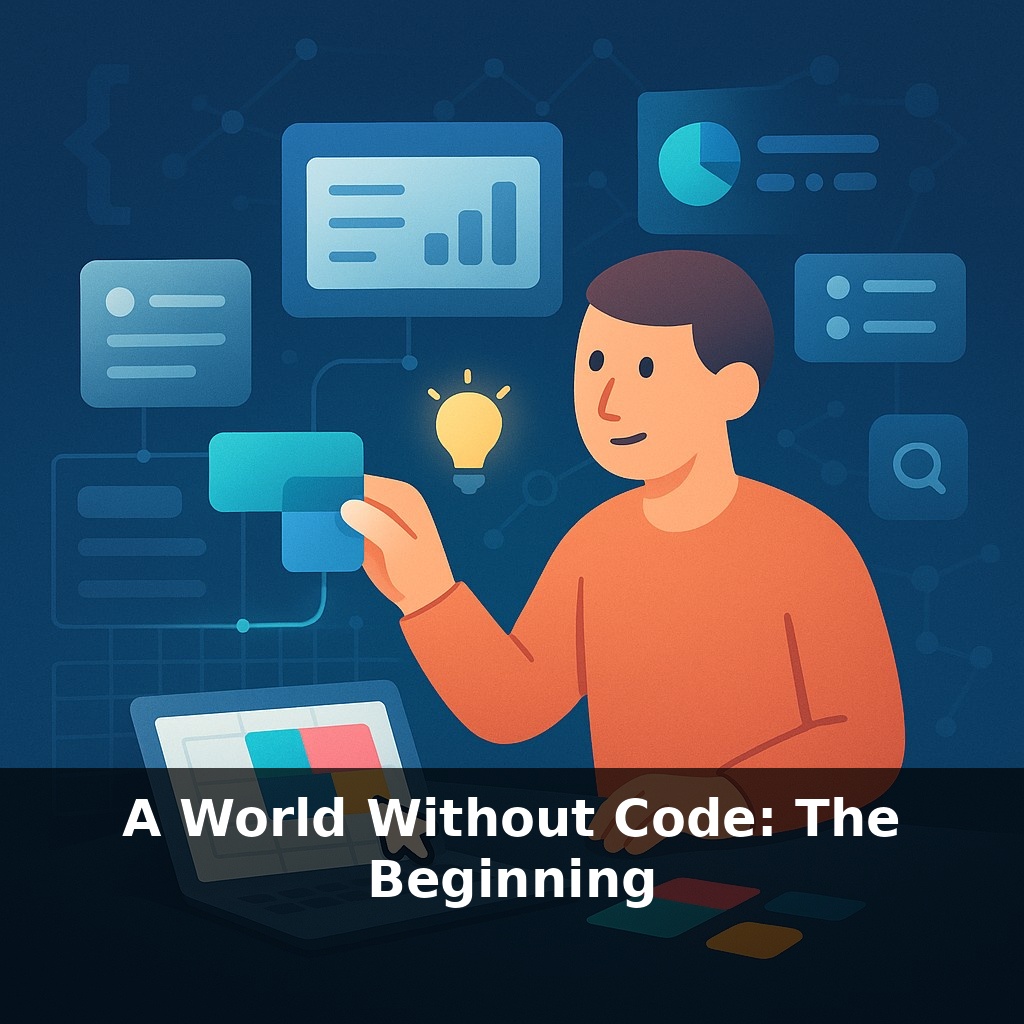
A World Without Code: The Beginning
📝 Transcript
Right now, more people are building software without writing code than at any point in history. A marketer prototypes a customer portal over lunch. A teacher builds a class app on a weekend. None call themselves “developers” — yet they’re quietly reshaping how software gets made.
But something bigger is happening than a few clever shortcuts. Behind those lunch-break builds sits an entire ecosystem that quietly flipped the rules of software on their head. Spreadsheets stopped being just tables and started acting like mini-databases. Tools like Airtable turned “just keeping track of stuff” into full-blown internal systems. Zapier stitched thousands of services together so data could move without anyone touching an API key. Bubble let people sketch complex workflows the way you’d outline a project on a whiteboard. These weren’t one-off tricks—they were the early signs of a new assumption: that creating software should feel less like learning a foreign language and more like arranging the apps already on your phone.
Now the pieces are maturing into something deeper: a stack. Cloud providers host the heavy lifting, APIs expose tiny “capabilities” like payments or translation, and no-code platforms sit on top, turning those capabilities into building blocks anyone can rearrange. A sales ops lead connects a CRM, a billing tool, and a support inbox into one flowing system. A small nonprofit strings together signups, emails, and reporting in an afternoon, not a quarter. What used to demand a project plan and a budget now looks more like configuring your phone—except it quietly runs a real business.
By the time Zapier can plug into more than 5,000 SaaS tools, something fundamental has shifted: the “parts” of software have been chopped up, labeled, and put on digital shelves for anyone to pick from. You don’t need to know how Stripe processes a payment or how Google Sheets stores a row; you just choose “when a new row is added, charge this card, send this email.” The hidden complexity stays hidden, yet the outcome feels tailored to you.
This is why no-code is less a single tool and more a new production line. On one end, specialized services expose focused capabilities—take payments, send SMS, analyze text, verify identity. In the middle, platforms like Bubble or Webflow turn those capabilities into visual components, ready to be dragged into place. On the other end, business users arrange those components around their own workflows and constraints. The result isn’t a generic template; it’s a custom-fit system whose uniqueness comes from how it’s assembled, not how each screw is machined.
The labor market is responding in real time. A 150% jump in no-code job postings on LinkedIn in just two years isn’t a fad curve; it’s a sign that “knowing the tools” is becoming its own specialization. You’ll now see roles like “Bubble Developer,” “Airtable Architect,” or “Power Platform Consultant” sitting right next to traditional engineering jobs. Companies aren’t just tolerating these skills—they’re budgeting for them.
Money is following the pattern too. Airtable’s US$11.7 billion valuation signaled that investors see more than a nicer spreadsheet; they see a control center for countless lightweight systems. Microsoft’s claim that Power Platform can cut app costs by 74% reframes “shadow IT” from a problem to a strategy: if non-technical teams can safely build what they need, the bottleneck shifts away from the overworked dev queue.
And despite the skepticism, these tools are growing up. Enterprise plans arrive with SOC 2 reports, SSO, regional data hosting, and audit logs. Under the friendly UI sit auto-scaling databases, containerized runtimes, and monitoring dashboards that would’ve taken an ops team weeks to wire together a decade ago.
A small HR team assembles a hiring pipeline in an afternoon: a form that feeds candidates into a table, triggers background checks, and schedules interviews on shared calendars. No one requests a sprint; they just wire up steps the way they already think about work. A solo founder launches a paid community by connecting signups, payments, and gated content, then iterates in real time as members give feedback. The “product roadmap” becomes a living document they adjust mid-week, not a quarterly ritual. A school administrator chains together attendance tracking, notifications to parents, and end-of-term reports without waiting for district approvals or vendors. In each case, the person closest to the problem becomes the one shaping the solution. Building software with no-code is like assembling a meal kit: the time goes into tasting and tweaking, not sourcing ingredients or cleaning industrial cookware. The frontier isn’t “Can this be built?” but “Who gets to decide how it works?”
A world without code isn’t a world without developers; it’s a world where they’re no longer gatekeepers. As AI copilots slip into no‑code tools, describing a process might spin up a working system before lunch. Building on this, policy will have to sprint to keep up: expect audits for citizen‑built workflows the way food trucks face health checks. And just as basic budgeting is taught in schools, “how to design a workflow” may join reading and math as a core digital life skill.
Soon, “learning tech” may look less like mastering syntax and more like arranging moving parts, the way a DJ layers tracks into a new song. Tools will fade into the background; what matters is spotting patterns, asking sharper questions, and safely experimenting. The frontier isn’t just faster apps—it’s everyday decisions quietly turning into living systems.
To go deeper, here are 3 next steps: 1) Open **Glide** or **Bubble** today and rebuild one simple workflow from your job (like a client intake form or inventory tracker) as a no-code app using their free templates. 2) Watch 2–3 beginner tutorials from **Makerpad** or **Buildspace** specifically on automating tasks with **Zapier** or **Make (Integromat)**, then connect one real tool you already use (e.g., Gmail → Google Sheets, Notion → Slack) into an actual running automation. 3) Read the first two chapters of **“The Rise of the No-Code Economy” by Ryan Hoover (Product Hunt essays + related blog posts)** and, as you read, keep your laptop open and recreate one example he mentions using the exact tools (Webflow, Airtable, or Carrd) so you end the session with a live, shareable project link.
From this course

The Magic of No-Code: How Anyone Can Automate
5 episodesUnlock all episodes
Full access to 5 episodes and everything on OwlUp.
Subscribe — $1.99/monthLess than a coffee ☕ · Cancel anytime