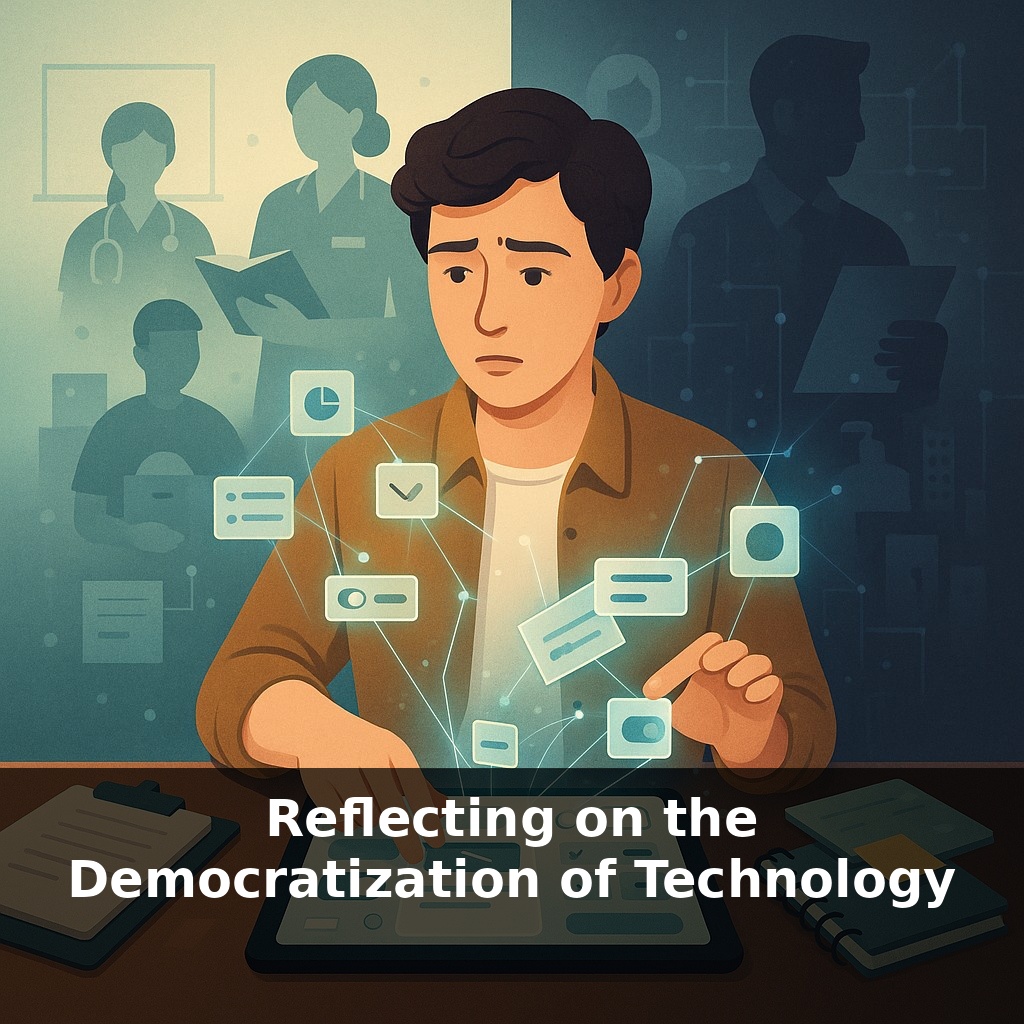
Right now, inside big companies, people who’ve never studied computer science already outnumber software engineers as app‑builders. A nurse, a teacher, a city clerk—quietly creating tools in their spare time. The paradox? More power in more hands… and far less control.
In this episode, let’s sit with the uncomfortable part of all this “tech for everyone” optimism. We celebrate when a teacher automates grading or a shop owner streamlines deliveries—but what happens when the tools that made them powerful quietly decide the rules?
Most no‑code platforms aren’t neutral utilities; they’re businesses with pricing tiers, opaque algorithms, and shifting terms. A school might pour months into a custom attendance system, only to find that a new pricing model makes it unaffordable. A clinic’s intake app could depend on an AI field that suddenly behaves differently after an update, nudging decisions in ways no one fully understands.
This isn’t just about convenience. It’s about who ultimately shapes the digital ground we’re all standing on—and who can move if it starts to crack.
Now add the human side: the ‘citizen developers’ driving this shift aren’t tech rebels—they’re people patching holes in broken systems. A social worker hacks together a tool to track housing cases; a small café chains spreadsheets and forms to survive on thin margins; a local NGO prototypes a benefits‑finder in a weekend because official portals are unusable. Their tools quietly start handling sensitive data, enforcing rules, even shaping who gets access to services. Yet the people closest to the problems often have the least say in how these tools are governed, audited, or sustained over time.
Here’s the quiet twist: as more people gain the ability to build software, the real bottleneck shifts from “Can I make this?” to “Should I make this, and on what terms?”
Consider what happens the moment a school, clinic, or neighborhood group moves from paper and conversation into structured digital flows. Decisions that used to be fuzzy and revisable become checkboxes and dropdowns. A form field forces a single gender option; a workflow rejects late applications automatically; a scoring rule quietly treats one neighborhood as “higher risk” than another. No malicious intent—just the way the logic was set up on a busy afternoon. But once these rules are encoded, they feel neutral, inevitable, even “objective.”
Now tie that to data. When a social program, a local business, or a student project starts capturing detailed records—health notes, income ranges, GPS locations—those builders become accidental data stewards. Who else can see this? How long is it kept? What happens if a tool is abandoned but the database lives on in a forgotten account? Many platforms make it effortless to collect sensitive information and surprisingly difficult to delete it cleanly or move it elsewhere.
Then there’s the question of bias. Prebuilt templates, “smart” defaults, and AI-powered suggestions embed choices made by distant product teams. A risk model assumes a Western credit history; an eligibility checker presumes stable internet access; a customer-priority rule favors people who respond quickly, sidelining those juggling multiple jobs or caregiving. The person assembling the app may never notice that the building blocks themselves carry cultural and economic assumptions.
Jobs and skills are transforming too. Routine tasks that once justified entire roles—data entry, basic reporting, simple approvals—can be automated in a single afternoon. Yet many organizations don’t pair that automation with retraining or shared ownership. The same person who builds the workflow might be the one whose role is quietly hollowed out by it.
In this landscape, governance can’t just be an IT checklist. It becomes a civic question: who inside an organization gets to set boundaries, audit logic, and demand explainability? If a local volunteer group or public office relies on a fragile constellation of apps, who is responsible when the original builder leaves or a vendor changes course? The tools are getting easier; the responsibility is not.
A city library decides to modernize: weekend volunteers spin up a no-code system for room bookings, late-fee amnesties, community events. It runs smoothly—until the quiet rules baked into their flows start steering behavior. The form only lists events in English. The booking cap favors people who can plan weeks ahead. The “most active members” list drives perks to regular visitors, not the shift workers who binge-use the library once a month.
Or take a micro-lender using templates to score loan applications. They never touch a line of code, yet a preloaded “risk” formula quietly downgrades applicants from neighborhoods with unstable addresses. No one in the room intended to redline; the spreadsheet just inherited old assumptions and wrapped them in polished charts.
Here’s the subtle part: each tiny decision—required fields, default choices, who gets notifications—acts like compound interest in finance. Small percentages, applied repeatedly, reshape who participates, who benefits, and who quietly falls outside the system’s edges.
Regulators are only just catching up to this shift. Instead of focusing only on “big tech,” they’ll need to treat everyday workflows like tiny public policies: subject to audits, sunset clauses, even appeals. Think of a town deciding yearly which roads still deserve maintenance; obsolete logic should face the same review. As automation spreads, unions, community groups, and professional bodies may demand a say in how these invisible rules are written—and unwritten.
If tech is our new civic infrastructure, then every flow you design is closer to zoning law than a handy shortcut. The next step isn’t to slow down but to build habits: pausing to ask who’s excluded, logging why rules exist, and planning how they can be challenged—so the future isn’t just easier to build, but also easier to question and revise.
Try this experiment: For the next three evenings, use only “democratized” tools—like Canva, ChatGPT, Notion, or a no-code app builder—to recreate something that used to require experts: a basic logo, a landing page, and a tiny app or workflow. Timebox each task to 45 minutes and keep a simple tally of every moment you think, “I’d normally need a designer/developer for this.” At the end, compare what you produced to what you *thought* you were capable of before, and decide one concrete thing you’ll now outsource less and learn to do yourself using these tools.