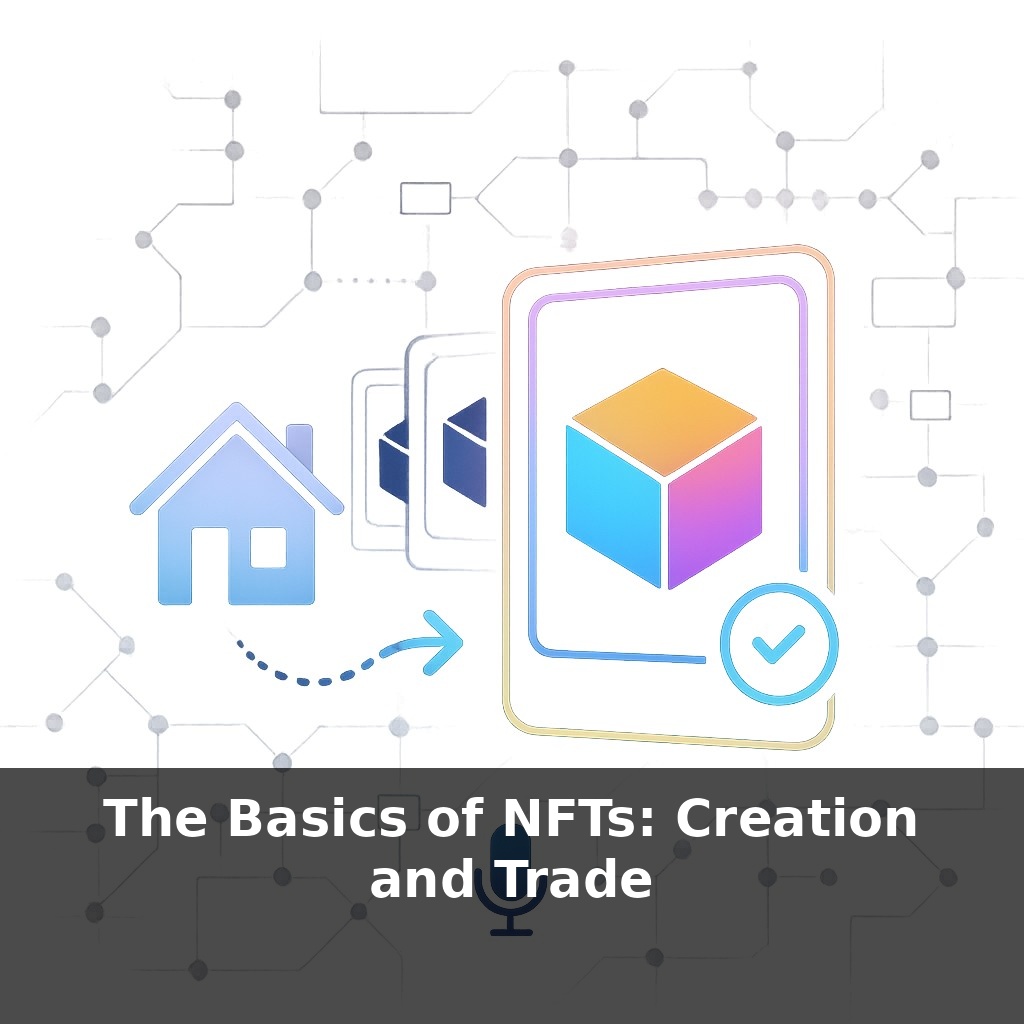
The Basics of NFTs: Creation and Trade
📝 Transcript
An NFT once sold for more than a house… yet the artwork was free to screenshot. In this episode, we drop straight into that paradox: how can a file anyone can copy become a scarce, tradable asset? Stay with me as we unpack how “owning digital stuff” actually works.
So if we already accept that “owning digital stuff” is a real thing, the next question is: how does that ownership actually get created and moved around?
Behind every flashy NFT drop sits a very unflashy process: a smart contract quietly minting tokens, assigning them to wallets, and later approving trades line by line, like a meticulous referee checking every play before updating the scoreboard. That’s where the real story begins—not with the artwork, but with the rules that define it on-chain.
In this episode, we’ll trace the life of an NFT from birth to resale: who writes the contract, what happens when you hit “mint,” how marketplaces talk to the blockchain, and why gas fees can suddenly spike and wreck your perfect launch timing. We’ll also look at royalties, and how creators try (and sometimes fail) to bake long-term income into their tokens.
Now we zoom in a layer: before any NFT shows up in a wallet, someone has to choose *what kind* of token it will be, how many can exist, and what rules it must follow. That usually means adopting standards like ERC-721 or ERC-1155, which act like shared “grammar” so wallets and marketplaces instantly know how to read the token. On top of that, creators decide what actually lives on-chain versus off-chain—images, traits, unlockable perks, or links to external servers. Think of it as designing a digital building: the blueprint (standard), the materials (data), and the zoning rules (permissions) all shape how people can use it later.
When a creator actually sits down to launch an NFT collection, the first decision isn’t “Which picture?” but “What structure am I building?” One route is a single smart contract for an entire collection; another is spinning up a fresh contract for each project. Big players like Yuga Labs (Bored Ape Yacht Club) tend to use a dedicated contract per collection to keep branding, logic, and legal boundaries crystal clear. Smaller creators sometimes deploy one “hub” contract and hang multiple mini-series off it to save costs and management overhead.
Then comes the choice between one-of-one pieces and editions. ERC-721 is great for “this exact token is unique,” but many artists want 50 or 5,000 identical prints. That’s where multi-token standards like ERC-1155 enter: the same token ID can represent many interchangeable copies. Think of it as building either a custom stadium for each team or a flexible arena that hosts many games with different seating maps.
Metadata design is surprisingly strategic. Creators decide on trait systems (backgrounds, accessories, rarity tiers) and how transparent they want to be. Some collections reveal metadata instantly; others ship everything as a placeholder, then flip a switch later. That delayed reveal mechanic isn’t just drama—it prevents buyers from sniping only the rarest pieces at mint time by reading the data early.
Where that metadata lives matters. Storing big files directly on Ethereum is prohibitively expensive, so most projects point to external locations. Better projects favor decentralized storage like IPFS or Arweave, where files are content-addressed and harder to quietly swap out. Lower-effort drops sometimes lean on simple web servers—cheaper and faster, but with the risk that one admin error or company failure breaks every image link.
Security and permissions shape the trade experience. Creators decide whether tokens can be paused, burned, or upgraded; marketplaces rely on standardized interfaces for safe transfers. Many contracts now bake in operator filters to steer trades toward royalty-respecting platforms, sparking ongoing tug-of-war between creator control and market liquidity.
Finally, the trade layer isn’t monolithic. High-end art often lives on curated platforms with tighter gatekeeping and custom auction logic. Mass-market collectibles favor low-fee chains and batch minting, like Reddit’s Polygon drops, where speed and scale trump ultra-granular customization. Across all of this, the “NFT” is less a picture and more a small programmable container for rights, rules, and relationships.
Think about how different NFT structures show up in the wild. A football club issuing season passes might pick ERC‑1155: one token ID for “2026 season ticket,” with thousands of identical seats in the same category, and separate IDs for VIP tiers or cup matches. A musician, by contrast, could use a single collection contract but reserve special token IDs for “backstage access,” “vinyl pre-order,” and “fan club voting rights,” each wired to different perks that external apps recognize.
Game studios push this even further. A single on-chain “inventory” contract can track swords, skins, potions, and land plots, so a player’s wallet becomes a portable locker that different games or marketplaces can read. That opens the door for collaborations: two indie games might agree that a rare pet from one title appears as a cosmetic companion in the other.
Your challenge this week: pick one NFT project you like, open its contract on a block explorer, and map which token IDs or metadata traits correspond to which real-world or in-game privileges.
In the next wave, the most interesting NFTs may feel less like collectibles and more like software-defined memberships. A festival pass that quietly updates to include afterparty access, or a brand avatar that unlocks perks across partner apps, turns “ownership” into an evolving relationship. As legal rails mature, expect experiments like NFT-based co-ops, where holding a token feels closer to owning a share in a community-run micro-company than a static piece of art.
As NFTs evolve, expect them to behave less like static collectibles and more like adaptive passes that respond to context—time, location, even your other holdings. Think of a stadium whose doors reconfigure for each event. The real frontier isn’t just “what you own,” but how that on-chain record can keep rewriting the rules of your access in real time.
To go deeper, here are 3 next steps:
1) Open a free wallet on MetaMask or Phantom and actually mint a low-cost NFT test piece on OpenSea’s testnet or on a creator-friendly platform like Zora so you can walk through the full creation flow (upload file, set metadata, choose royalty, pay gas). 2) Spend 30 minutes browsing successful collections like “Doodles” or “Azuki” on OpenSea and read their collection pages, activity history, and properties to see how they structure traits, pricing, and community links. 3) Block off an hour to go through one structured learning resource—either Ethereum’s NFT developer docs (for the tech side) or the free “NFT 101” course on Coinbase Learn—while keeping your wallet open so you can immediately test anything they show (like viewing your token on Etherscan or listing it for sale).
From this course
The NFT Phenomenon: Beyond Art and Collectibles
5 episodesUnlock all episodes
Full access to 5 episodes and everything on OwlUp.
Subscribe — $1.99/monthLess than a coffee ☕ · Cancel anytime

