A home in Florida once changed owners in about fifteen minutes—not with a mountain of paperwork, but with a single digital token. On one screen: an online auction. Behind the scenes: lawyers, regulators, and a centuries‑old property system quietly being challenged.
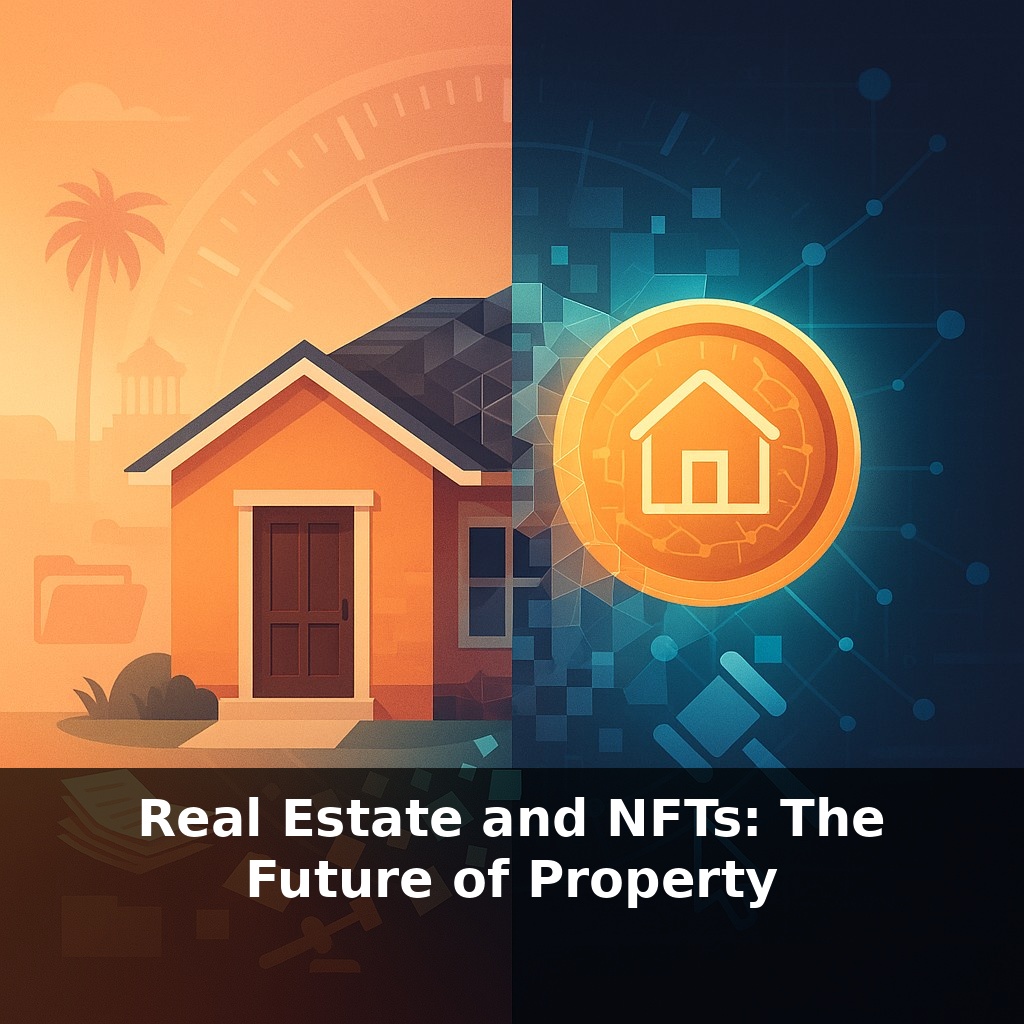
In the background of that 15‑minute Florida transfer, something more radical is being tested: the idea that a home’s ownership record could live as an NFT, not just in a filing cabinet at the county office. Instead of reshuffling PDFs and signatures, the “source of truth” would be a tamper‑proof entry on a public blockchain, checked by software in seconds rather than by humans over weeks.
Early experiments don’t put the house itself on-chain; they put the legal wrapper around it there. One common model: the property sits inside an LLC, and the NFT represents 100% of that company. Transfer the token, transfer the company—and with it, control of the home.
This opens surprising doors: programmable sales, automated lien checks, even fractional slices of ownership that could be traded as easily as shares, if regulators allow it.
That shift sounds clean in theory, but property law is less like software and more like a patchwork of local dialects. County land offices, banks, and courts still treat the paper trail—deeds, mortgages, liens—as the ultimate record. So even if an NFT changes hands in seconds, the sale only “counts” when the local registry and the legal system agree it does. That’s why pilots focus on narrow use cases: vacation homes, investment condos, or new developments where all parties can pre‑agree that the token’s history, signatures, and rules will govern how the asset can move.
Banks, insurers, and regulators care less about buzzwords and more about risk, speed, and cost. On those fronts, tokenized property quietly attacks some expensive bottlenecks.
One is verification. Today, confirming who owns what involves title searches, manual checks for old liens, and insurance in case something was missed. That caution is justified: the FBI tracks roughly a billion dollars a year lost to title and mortgage fraud in the U.S. alone. A well‑designed tokenization system doesn’t just show the current holder; it can surface every transfer, pledge, and restriction in a standard format that software can read. Instead of a bespoke investigation for each sale, you get near‑instant consistency.
Another bottleneck is time. A typical closing stretches over 30–60 days because many parties have to coordinate: buyer, seller, lender, escrow agent, county recorder. Propy’s Florida experiment collapsing a transfer into about fifteen minutes is an early hint of what happens when much of that choreography becomes automated—signatures, payments, and ownership updates linked in one programmable flow.
Liquidity is the third frontier. Real estate is famously “lumpy”: it’s hard to sell 7% of a house to free up cash. Tokenization makes it technically trivial to divide rights into smaller units and route them through regulated marketplaces. That doesn’t mean overnight day‑trading of homes; in most jurisdictions, these slices will look and behave like securities, with investor protections, disclosures, and limits on who can buy. But it does suggest new ways for owners to refinance, for small investors to participate in markets once gated to institutions, and for developers to raise capital in stages.
Environmental concerns, once a major objection, are also shifting. Early blockchains burned large amounts of electricity per transaction. Newer proof‑of‑stake systems and upgrades on major networks have pushed energy use down dramatically—closer to running a lightbulb than a data center for each transfer—changing the sustainability calculus for large property players.
None of this works at scale if it lives in a legal vacuum. The crucial step is alignment between on‑chain records and the off‑chain authorities that courts already recognize. Some governments are cautiously experimenting: running pilots where the official registry mirrors blockchain entries, or even using a chain as the primary ledger and exposing a traditional interface on top. Others are watching from the sidelines, uneasy about locking critical infrastructure into a still‑evolving technology.
That lag creates a gray zone. On one side, innovators argue that clear, programmable histories can reduce disputes and democratize access. On the other, cautious voices worry about new forms of speculation, the risk of bugs in smart contracts, and the social impact of turning shelter into an even more fluid financial product. Between them lies the practical question: who bears responsibility when a token’s record and a county’s records disagree?
Your challenge this week: map the ownership “stack” of the place you live. Trace who would actually need to sign off if your home changed hands tomorrow: lenders, condo or HOA boards, local recorders, insurers. Then, ask a pointed question: which of those roles is about local judgment—and which are just slow, expensive data checks that could, in principle, be automated?
In practice, tokenized property starts to look less like a sci‑fi concept and more like a new kind of real‑estate “stack.” On the surface, the buyer still tours a unit at a Miami condo or a co‑living project in Berlin; beneath that, the developer might issue 10,000 digital shares, each tied to a small slice of rental income. Platforms like RealT or Lofty experiment with this, letting investors buy exposures to single‑family rentals much as they’d pick stocks. A tenant keeps paying rent in dollars; behind the scenes, software routes those flows to hundreds of small holders. Think of a stadium where each seat’s sightline and price are pre‑mapped: once the blueprint exists, ticketing, resale, and access control become coordinated instead of improvised. The same logic tempts city planners and housing funds: could they lock in affordability rules, green‑building standards, or resale caps directly into the asset’s digital rails, rather than relying on paperwork that’s easy to ignore?
Early adopters hint at wider social shifts. If access to buildings starts to feel more like subscribing to a service than signing a once‑in‑a‑lifetime mortgage, neighborhoods could turn over faster, with investors rotating in and out like players in a transfer market. Cities might experiment with tokens that bundle voting rights on local upgrades, turning streetlights, parks, or shared solar roofs into jointly managed “micro‑funds,” where residents back projects and share in savings or new revenue streams.
The real experiment isn’t just faster deals; it’s whether property can behave more like adaptable infrastructure than frozen stone. As land, rights, and cash flows get sliced and recombined, expect unlikely hybrids: mortgages that flex like gym memberships, community funds that own corners of skyscrapers, and city blocks upgraded by the very people who live on them.
Try this experiment: Pick one real property in your city (even your own home) and “mock-tokenize” it by breaking its value into 1,000 hypothetical NFTs, each representing a tiny ownership slice. Create a simple spreadsheet listing each NFT, its price, and what rights it would carry (rental income share, voting on renovations, access to a digital twin, etc.). Then, share this mock offering with 3–5 friends and ask who would “buy” which slices and why, and track their reactions. Notice which rights and price points actually make people interested—those patterns are your first real data on how NFT-based property might work in practice.