Understanding How Memory Works
📝 Transcript
Every day, our minds unconsciously reshape the memories we cherish. Think about being in a work meeting or on a first date, feeling certain you'll remember every detail. Meanwhile, your brain is actively editing, compressing, and rewriting these moments as they happen.
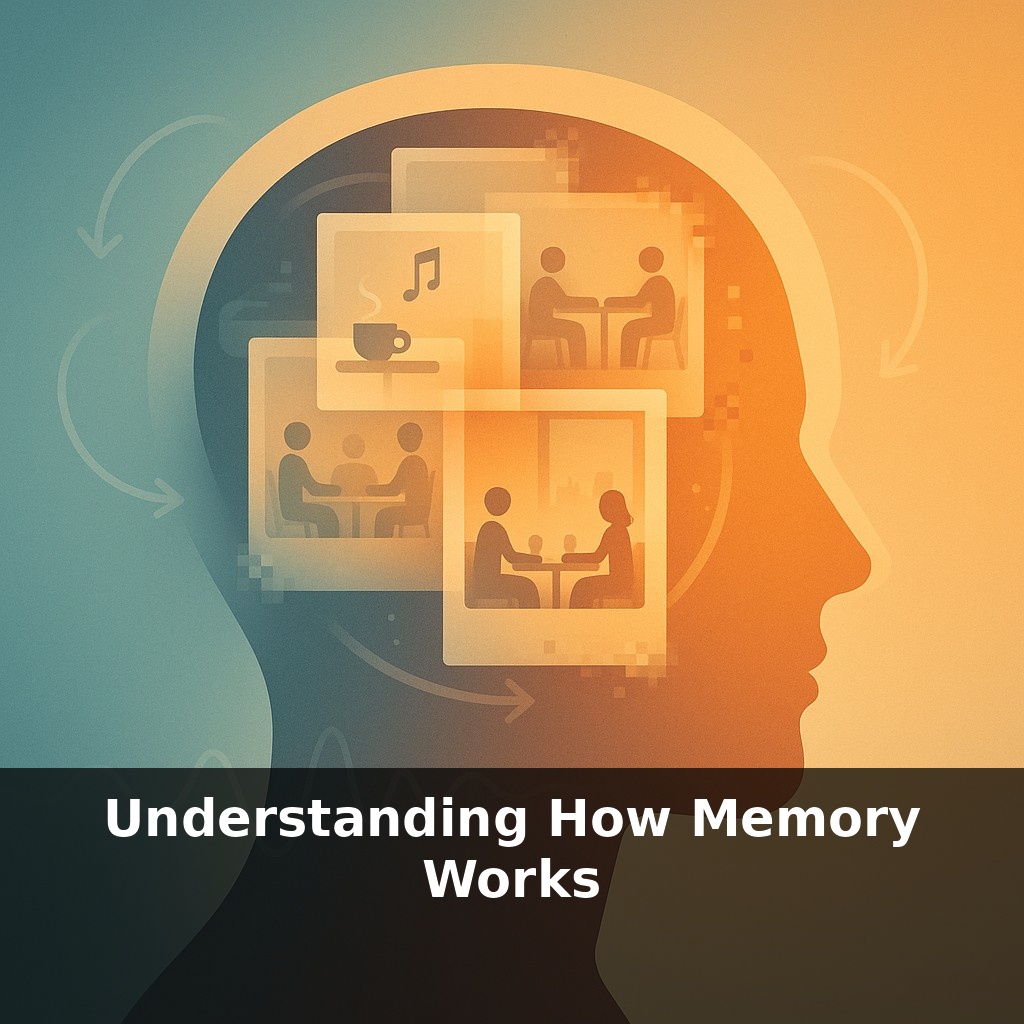
You notice this most on ordinary days. A song from years ago plays in a café and, suddenly, you’re back in a cramped apartment, tasting cheap takeout, feeling the weight of a decision you once made. The room you’re in fades; a whole scene boots up from almost nothing. Other times, you walk into the kitchen and can’t remember why you came—your intention evaporates between rooms like steam. These two moments reveal something crucial: memory isn’t one thing, but a set of different systems with different rules and failure modes. Some hold the thread of what you’re doing right now; others archive the stories you tell yourself about who you are. To understand how memory really works, we have to zoom in on what happens in the first few seconds, the first few hours, and then across the years of a life.
Some of these systems are brutally limited; others are almost absurdly vast. One handles the handful of details you can juggle while reading an email and listening to someone talk. Another gradually weaves experiences into the stories you’ll still tell twenty years from now. Between them lies a fragile middle zone where experiences either fade or start to stick. This is where attention, sleep, emotion, and repetition quietly vote on what stays. In the next sections, we’ll trace how a moment moves from raw sensation to something that can guide your choices, habits, and even your sense of purpose.
When something happens, your nervous system has to decide, in milliseconds, whether this is part of the background hum of life or a candidate for “keep this.” That first stage is encoding: converting raw sights, sounds, and internal reactions into patterns of neural activity that can be stabilized later. Encoding is picky. It favors things that are surprising, meaningful, or linked to goals you’re already pursuing. The dull, predictable parts of your day usually wash through with barely a trace.
Working memory is where this select activity is briefly held in place. Here, neurons in frontal and parietal regions fire in coordinated bursts, like a small project team holding a problem in mind. Capacity is tight: only a few “chunks” can be actively maintained. A phone number that happens to match your birth year and a familiar area code feels easy to retain because your brain fuses multiple digits into a single, meaningful unit. When information feels slippery, it’s often because it can’t be efficiently chunked, not because you’re “bad at memory.”
If a moment matters enough, those fleeting patterns trigger biochemical cascades in deeper structures. Synapses—the contact points between neurons—start to change their strength. With enough reinforcement, pathways that were once tentative become preferred routes. Later, when a partial cue appears—a smell, a phrase, a fragment of a scene—activity flows along those strengthened paths and a whole experience can reassemble from scattered pieces.
Crucially, every act of recall is also an act of re-encoding. When you tell the same story three times to three different audiences, each telling nudges the emphasis slightly: this part gets funnier, that part gets trimmed, another detail is added to make sense of it. The underlying trace is updated to match the latest version. This is why confidence and accuracy can drift apart; a vivid memory can be polished by retelling into something that feels solid but no longer matches what actually happened.
That same malleability is a weakness and a strength. It leaves recollections vulnerable to suggestion and bias, but it also allows painful experiences to be gradually integrated into a larger narrative. Over time, new learning can link an old event to different meanings, so that what once dominated your inner world becomes just one chapter in a longer story.
Think about how you handle information at work. A complex project brief arrives in your inbox: at first, you highlight a few key lines, then sketch a one-page summary, and finally build a polished slide deck for the team. Your brain treats lived experience in a similar tiered way, promoting a few details, demoting others, and gradually standardizing the “official version” that’s easiest to share.
This is why you and a close friend can argue over the same night out and both feel certain you’re right. You’ve each optimized your internal “brief” for different purposes—maybe you prioritized the joke that stung, they prioritized the moment everyone laughed. Over years, those tiny priorities add up, influencing what stories you reach for when you justify a risk, stay in a relationship, or walk away.
Even skills follow this path. The first time you drive a new route, you rely on GPS step by step. After enough trips, you simply arrive, with whole segments missing from conscious awareness—freed-up bandwidth you quietly invest elsewhere.
Your sense of self depends on what your mind keeps—and what it quietly lets fade. As tools emerge that can sharpen recall or dull specific traces, the boundary between “earned wisdom” and “engineered past” blurs. Relationships, justice systems, even job markets may shift if some people can fine-tune what they retain. Your future credibility might rest less on having a perfect record, and more on being transparent about how that record was shaped—and by whom.
Your past, then, isn’t a static archive but a draft that keeps accepting edits. The practical question becomes: who’s holding the pen? Algorithms that surface “memories,” legal records that freeze one version of events, even group chats that log your offhand comments—all steer which moments stay accessible, and which quietly slip below the search bar of your mind.
Try this experiment: Pick a short list of 10 unrelated words and study them three different ways today—once by just rereading them for 60 seconds, once by creating a vivid mental image or story that links them together, and once by spacing your review into three 20‑second sessions over an hour. At the end of the day, test yourself on all 30 words and note which method gave you the best recall. Then, tomorrow, test yourself again *without restudying* to see which method your long‑term memory favored. Apply the “winning” strategy to a real-world task, such as developing a detailed presentation or memorizing vocabulary for an upcoming language exam, using spaced repetition techniques.
Unlock all episodes
Full access to 6 episodes and everything on OwlUp.
Subscribe — $1.99/monthLess than a coffee ☕ · Cancel anytime