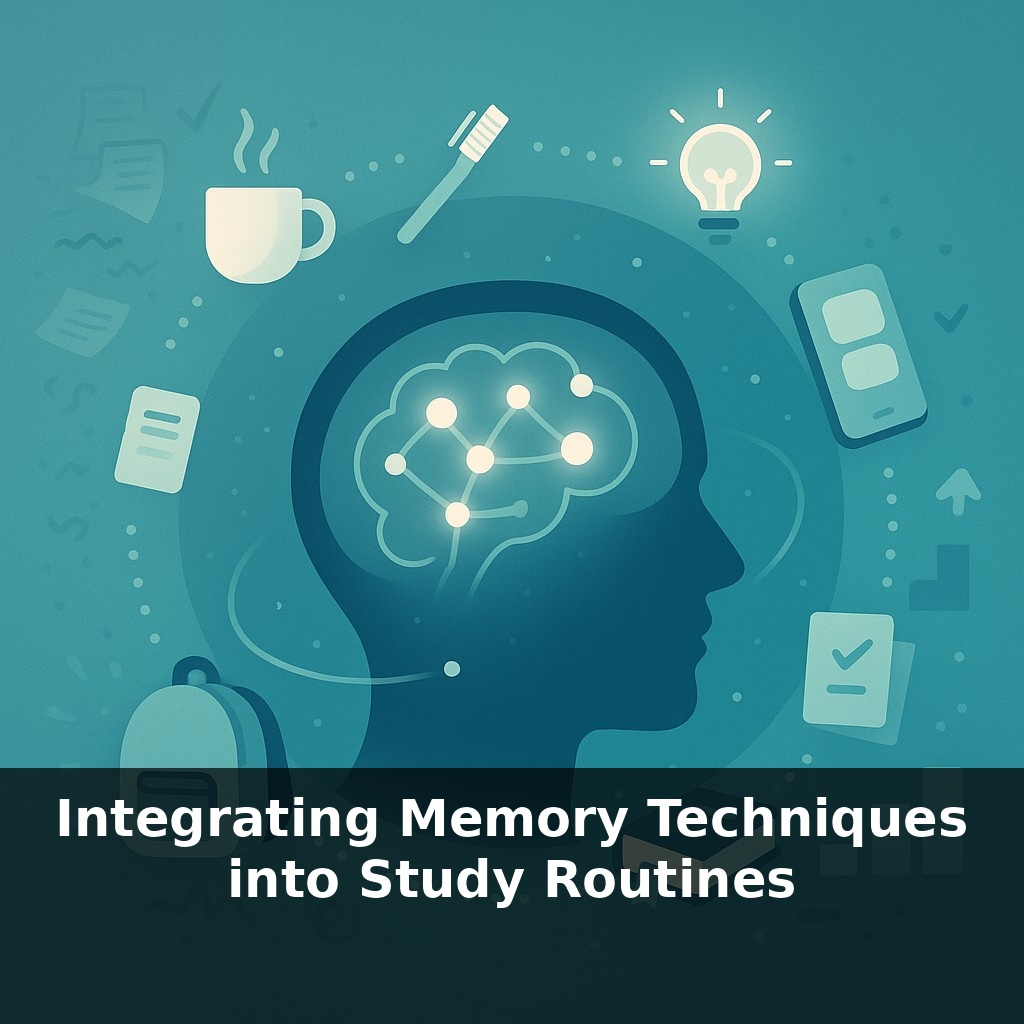
Midterms punish crammers. Yet research shows a small shift—short, spaced memory workouts baked into your normal day—can boost what you remember by roughly a third. You’re walking to class, waiting for coffee, brushing your teeth… and quietly rewiring how your brain stores knowledge.
Most people treat memory techniques like fancy extras—cool, but optional. Yet the research you just saw points to something quieter and more radical: you don’t need a new personality to remember more; you need a new *rhythm*. The real shift is moving from “study sessions” to a day that’s sprinkled with tiny, deliberate recalls tied to things you already do.
Think of it less like adding a second job and more like upgrading the “operating system” underneath habits you already have: note-taking, reviewing slides, doing practice problems. Each can be tweaked so it automatically triggers spaced reviews, quick self-quizzes, or a sketch to pair with a key idea. Walking out of lecture? Turn the hallway into a 90‑second recap zone. Opening your laptop? Let the first 5 minutes be a mini retrieval sprint instead of inbox drift.
The trick now is to *embed* these tools where they’ll actually get used: in your notes, your calendar, and the physical spaces you move through every day. Rather than bolting on one more app or “system,” think in terms of small switches: turning a highlight into a question, a slide into a sketch, a bus ride into a quick mental run-through of yesterday’s sticking points. This is less about discipline and more about redesign. You’re not trying to force longer hours; you’re quietly rewiring cues so that certain places, times, and actions automatically nudge you into tiny upgrades.
The next step is to decide *where* each technique lives, so you’re not relying on willpower every time. Start by mapping your day into “slots” that naturally repeat: walking between classes, waiting for apps to load, eating lunch, shutting down at night. Each slot gets a specific job.
For example, attach elaborative encoding to lecture *endings*: as the class wraps up, jot a single sentence in your notes that answers, “So what?” or “Why would this matter in real life?” You’re not adding an essay—just a quick link between the concept and something you already care about: a future job, a news story, a lab you’re in. That tiny bridge makes the idea stickier and easier to find later.
Give retrieval a different home: transitions. Standing up from your desk? Before you walk away, cover your notes and say out loud three things you want Future You to remember tomorrow. No notes, no phone, just a short verbal checkpoint. If you blank, *then* peek—but only after you’ve tried.
Dual-coding fits best during *first exposure*, not later. When you first meet a definition, theorem, or theory, pause for 30 seconds and sketch a rough diagram, flow, or timeline in the margin. It can be ugly. The point is to force yourself to decide: “What’s the input? What’s the output? What’s changing?” That visual skeleton gives your brain an extra path back to the idea when the words fade.
Method of loci works well for small, ordered sets—diagnostic criteria, proof steps, process stages. Reserve one familiar route (your walk to class, your kitchen layout) for a single course, then “place” each item at a specific stop. Keep it small at first: five to seven items, one route, one class. Later, reviewing becomes a quick mental walk-through.
You’re effectively turning your day into an architecture of cues: certain times and places are “assigned” to particular kinds of mental moves. Instead of asking, “Do I feel like studying now?” the question becomes, “What does this moment *do* in my system?”
Think of your day like a city grid you’re slowly rewiring for faster traffic. Each intersection—opening your laptop, walking into the library, closing a textbook—can host a different “memory job” if you assign it one on purpose.
For instance, pick *one* tough class and declare: first 3 minutes of every lecture = “preview round.” Before the professor starts, list three things you *expect* to hear based on the syllabus or last class. Afterward, put a check or “?” next to each. That small prediction loop trains your brain to notice structure instead of passively absorbing slides.
Or take problem-heavy courses: whenever you finish a set, don’t just submit and escape. Add a tiny “error post‑mortem” in the margin of your notebook: one line on what trap caught you and how you’ll spot it next time. Later, those one‑liners become high-yield prompts for quick review.
This is where the techniques stop being tricks and start behaving more like quiet defaults—baked into routes you walk and buttons you already press.
As careers shorten and skills expire faster, memory-efficient learning stops being a student hack and becomes basic survival gear. Offices may soon treat cognitive “upgrades” like they do software updates—scheduled, measured, and automated. AI tutors could quietly stretch or shrink your intervals the way noise‑cancelling headphones adapt to sound. Entire teams might coordinate shared review cycles so critical knowledge lives in people, not just documents, making organizations less fragile when key experts leave.
As you tune this new rhythm, expect some static: skipped reviews, messy sketches, half‑finished loci. That’s signal, not failure. Treat your routine like an app in beta—log glitches, patch one tiny thing, push a new version tomorrow. Over weeks, you’re not just passing exams; you’re quietly upgrading the kind of learner you are.
To go deeper, here are 3 next steps: (1) Open Anki today and build a 20-card deck using the Memory Palace method from the episode—map each card to a real location in your home, then test yourself twice using Anki’s spaced-repetition schedule. (2) Grab a copy of *Moonwalking with Einstein* by Joshua Foer and, while reading chapter 3, pause every few pages to turn one story into a vivid, ridiculous image chain (exactly like the visualization drills discussed in the show). (3) Install the Miro (or Google Jamboard) app and sketch out a weekly “memory training grid” that mixes 10-minute sessions of loci practice, peg system drills, and spaced recall of your actual course material—then set calendar reminders so those exact sessions fire at the same times your classes happen.