About half of everything you do online quietly passes through just three companies. Now, here’s the twist: the technology designed to avoid that kind of bottleneck is already running, nonstop, across the world. So why does your digital life still depend on a few giant switches?
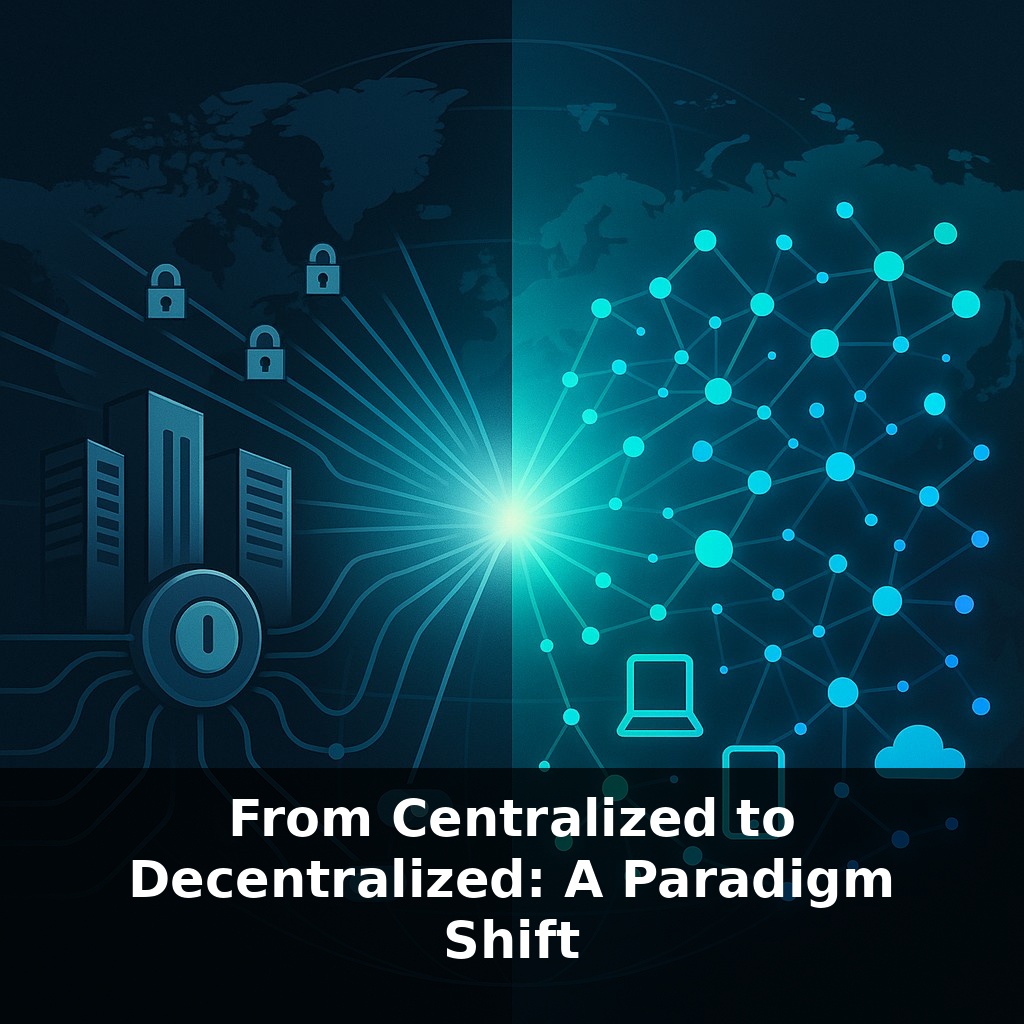
Maybe the real question isn’t “centralized or decentralized,” but “who gets to say no?” In a centralized world, a handful of platforms can silently reshape what you see, what you can ship, even whether your app or business is allowed to exist. In a decentralized world, that veto power is fractured, diffused into protocols, economic incentives, and communities instead of sitting on one corporate roadmap.
This shift isn’t just technical; it rewires power. A music platform can’t quietly slash artist payouts if payouts are enforced by code. A fintech startup can’t be cut off overnight if it’s plugged into open rails instead of a single provider. Even governance changes—from fees to features—can move from “executive decision” to “network proposal,” where users and builders actually vote, often with real money on the line.
That’s the paradigm shift we’re stepping into: from platforms you use, to networks you help steer.
That sounds abstract until you notice how many layers of your day already depend on “who gets to say no.” App stores decide which tools reach your phone. Payment processors decide which donations clear. Cloud providers decide which startups ever leave the garage. Each layer adds convenience, but also another invisible gate. Decentralized tools poke at those gates in specific ways: Bitcoin routes value without a bank’s blessing, Ethereum lets code, not contracts, settle deals, and DAOs experiment with letting contributors steer direction like shareholders in a live, constantly evolving company.
Here’s the strange thing about this shift: the more “decentralized” something is, the more *coordination* it actually needs. A single company can push a change overnight; a global network with no boss has to convince thousands of independent actors to move in roughly the same direction—without ever meeting in the same room.
That’s why most real-world systems aren’t purely centralized or purely decentralized. They’re layered. Bitcoin has a decentralized base layer (the nodes and miners that keep it running), but people still use centralized exchanges to buy and sell it. Ethereum smart contracts can run without a company, but the wallets people rely on are often built and branded by startups. Web3 isn’t just ripping out the old structure; it’s rearranging which parts *must* be trusted and which parts can be trustless.
A practical way to see the difference is to ask: where can this system break? When Facebook misconfigures something, billions feel it instantly. When a major Bitcoin node operator shuts down, the network barely blinks because there’s no single “off switch.” That doesn’t mean it’s invincible; it just means failure has to happen in many places at once to really matter.
The tradeoffs show up in everyday UX. Centralized services feel smooth because a product team can decide, test, and ship. Decentralized services often feel clunky because upgrades require rough consensus, on-chain votes, or incentive changes that thousands of people agree to run. You get censorship-resistance and user ownership, but you also get slower feature rollouts and more visible conflict.
And then there’s the big misconception: that decentralization means “no rules.” In reality, protocols are more like automated financial regulators—relentlessly enforcing the rules they’re given. Miss a requirement by one decimal place, and the contract will reject you with no appeal, no support line, no “manager override.”
So the frontier isn’t “destroy all centralization.” It’s deciding *where* we’re willing to trust humans, and where we’d rather lock behavior into code that nobody can quietly rewrite on a Sunday night.
Think of how you currently “log in to the internet.” For most people, that really means logging into a handful of dominant accounts—email, social, maybe a password manager—which then unlock everything else. In a decentralized model, identity can flip: instead of accounts living on specific platforms, your identity can live in a wallet or key you control, and apps temporarily plug into *you*.
We’re already seeing this play out. ENS names turn long wallet addresses into human-readable identities, so “alice.eth” can receive payments, hold reputation, or even map to a decentralized website. Lens and Farcaster experiment with social graphs that you carry between clients, so following someone isn’t locked to one feed. On-chain credentials like Gitcoin Passport or POAPs let communities verify “who contributed what, when” without trusting a private database.
This also changes exit options. Leaving a centralized platform often means losing followers, history, and data. Leaving a decentralized client can be more like switching email apps: your relationships and records don’t have to start from zero.
Decentralization’s weirdest implication may be psychological: it pushes us from “service as landlord” to “service as collaborator.” Expectations shift—users become partial operators, not just customBuilding on our discussion about decentralized mechanisms, that can feel like upgrading from passenger to co‑pilot: more control, more responsibility. As credentials, money, and reputation detach from single apps, new careers emerge around “orchestrating” many small protocols, like a chef combining simple ingredients into signature dishes.
The next step isn’t overthrowing old systems overnight, but quietly routing around them. Think less in terms of “single killer app” and more like layering small tools: a wallet here, a shared ledger there, a voting primitive on top. As these stack, everyday flows—getting paid, proving work, forming teams—can detach from gatekeepers and plug into open rails instead.
Before next week, ask yourself: 1) “If one decision or process in my world (team, project, or community) moved from a single ‘gatekeeper’ to a small, trusted, distributed group, which would have the biggest positive impact—and what would that experiment actually look like in practice?” 2) “Where am I still relying on ‘top‑down’ trust (titles, legacy systems, central approvals) instead of ‘earned’ or protocol-based trust (transparent rules, open visibility, shared access), and what’s one concrete rule or workflow I could redesign to shift that?” 3) “If I had to design a simple, decentralized mechanism for contribution tomorrow—like a shared repo, rotating decision council, or token-style voting—who would be invited in first, how would contributions be recognized, and what clear boundary would keep it from turning into chaos?”