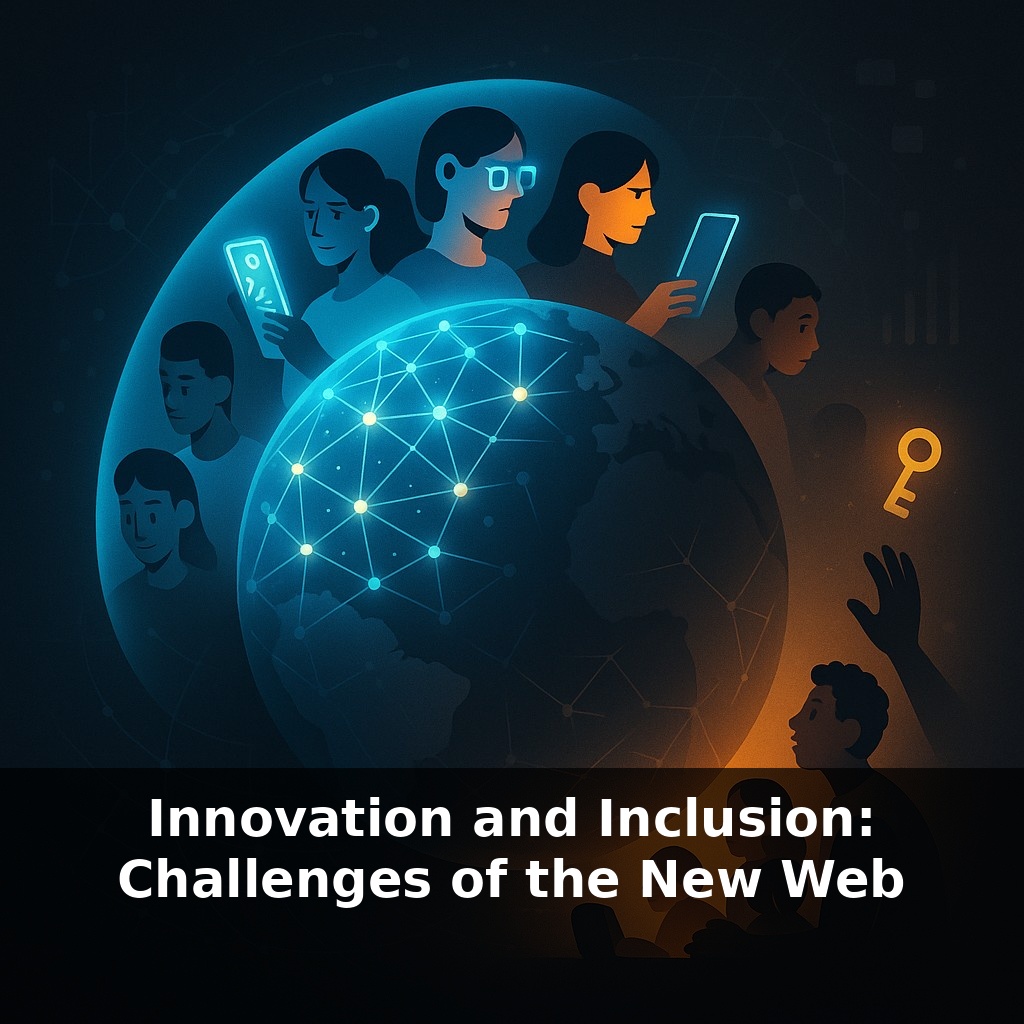
Roughly a third of humanity still isn’t online—yet we’re busy building the “next” internet. You’re scrolling through a slick Web3 app where users supposedly own everything… but the people who could benefit most aren’t even in the room. So who is this new web actually for?
A strange paradox sits at the heart of this “ownership revolution”: the people designing it are some of the most connected on earth, while billions still share phones, juggle data packs by the megabyte, or lose signal when it rains. In glossy decks, we hear about “banking the unbanked,” but many real users are still fighting to keep a cheap Android charged. Meanwhile, new systems for “participation” often assume you can pay gas fees that rival a day’s wages in some cities, read dense English-language docs, and navigate interfaces that feel like cockpit panels. It’s a bit like launching a gourmet food market where you need a chemistry degree just to read the labels: technically open to all, practically tailored to a tiny, over-served crowd. If this trajectory continues, Web3 doesn’t just risk leaving people out—it risks hard-coding exclusion into its foundations.
Here’s the quiet irony: while Web3 talks about global inclusion, fewer than 5% of its developers sit in Africa, Latin America, or the Middle East. The blueprints are being drawn far from the places they claim to transform. At the same time, projects like UNICEF’s CryptoFund are routing millions in crypto to startups tackling real-world problems, and networks like Helium prove communities can co-own critical infrastructure. Yet their growth patterns show familiar gravity: tools, capital, and decision-making concentrate where power already lives, unless we interrupt that default.
If the last decade of Web2 taught us anything, it’s that “open to everyone” can quietly become “optimized for a narrow slice of users.” Web3 is flirting with the same trap, just with fancier math.
Start with the most basic barrier: actually getting online. Around 2.7 billion people still lack regular internet access. For them, a dApp that assumes 24/7 connectivity, cheap data, and a recent smartphone is less a tool and more a taunt. Even where connections exist, power cuts, device sharing, and prepaid data plans reshape what “usable” really means. A wallet that breaks if you drop offline for a minute is already excluding huge swaths of the world.
Then there’s cognitive overhead. Many protocols still feel like debugging tools that escaped the lab: hex addresses, seed phrases, testnets, bridges, wrapped tokens. Each step is a failure point that selects for those with time, English fluency, and technical comfort. The people whose lives could change the most are often those least able to navigate that maze.
Regulation adds another filter. KYC rules meant to stop crime can also block refugees without documents, informal workers, or people living under hostile regimes. Meanwhile, unclear policies make local entrepreneurs hesitate to build at all, fearing a retroactive crackdown. Innovation clusters where lawyers and lobbyists are plentiful; everywhere else, people wait to see what’s “allowed.”
Energy use shows how quickly narratives can harden. Early blockchains deserved criticism for wasteful proof-of-work. But when proof-of-stake Ethereum slashed its estimated energy footprint by 99.95%, many still repeated the “boils the oceans” line. That’s not just a PR issue—it can shape policy that locks out newer, cleaner networks from public-sector experiments in places that might benefit most.
And even when inclusive things do get built—like grants paid in stablecoins or community-run connectivity—there’s a translation problem. UX, languages, and governance formats often mirror Bay Area norms more than Nairobi, Dhaka, or São Paulo. It’s the digital equivalent of exporting a financial product without localizing the fine print: technically compliant, practically misaligned.
The uncomfortable throughline: without intentional course correction, the new web risks reinforcing an old hierarchy—just with tokens on top.
UNICEF’s CryptoFund offers a glimpse of what a more inclusive direction can look like. A startup in Indonesia can receive support in minutes rather than months, then pay local contributors in stable-value tokens while traditional banks are still asking for paperwork. But even here, founders often rely on a technically savvy “bridge person” to handle wallets and compliance, which quietly recenters power in a single teammate. Helium’s trajectory tells a similar story: community members in Lagos or Medellín may want to deploy hotspots, yet documentation, governance calls, and forum debates often unfold in English and U.S. time zones, nudging them to the edges of decision-making. Think of Web3 like a community-owned public transit system: if scheduling meetings, setting prices, and updating maps all happen in one distant control room, riders may hold tickets—but they don’t really steer where the buses go.
Rough edges today will harden into rails tomorrow. If wallets stay opaque and governance favors insiders, norms will quietly calcify around whoever showed up early. But if design bakes in low-bandwidth modes, local languages, and consent you can actually read, the same tools could feel more like a neighborhood credit union than a hedge fund. The open question: who gets to write the defaults—global collectives, or a handful of well-capitalized labs?
So maybe the most radical move isn’t inventing new tokens, but rethinking who helps set the rules: translators, local organizers, UX designers who test on cheap phones, policymakers who grew up on scratch cards instead of credit cards. Like tuning a shared radio, the next web only becomes truly ours when more hands touch the dial.
Start with this tiny habit: When you open a new tab to browse the web, quickly ask yourself, “Whose voice is missing here?” and spend 30 seconds searching for one creator from an underrepresented group working in web3 or digital innovation (e.g., a woman-led DAO, a Black-owned NFT project, an accessible design advocate). Click “follow” or “subscribe” to just one of them. That’s it—no deep dive, no big commitment—just one intentional signal that the new web should be more inclusive every time you go online.