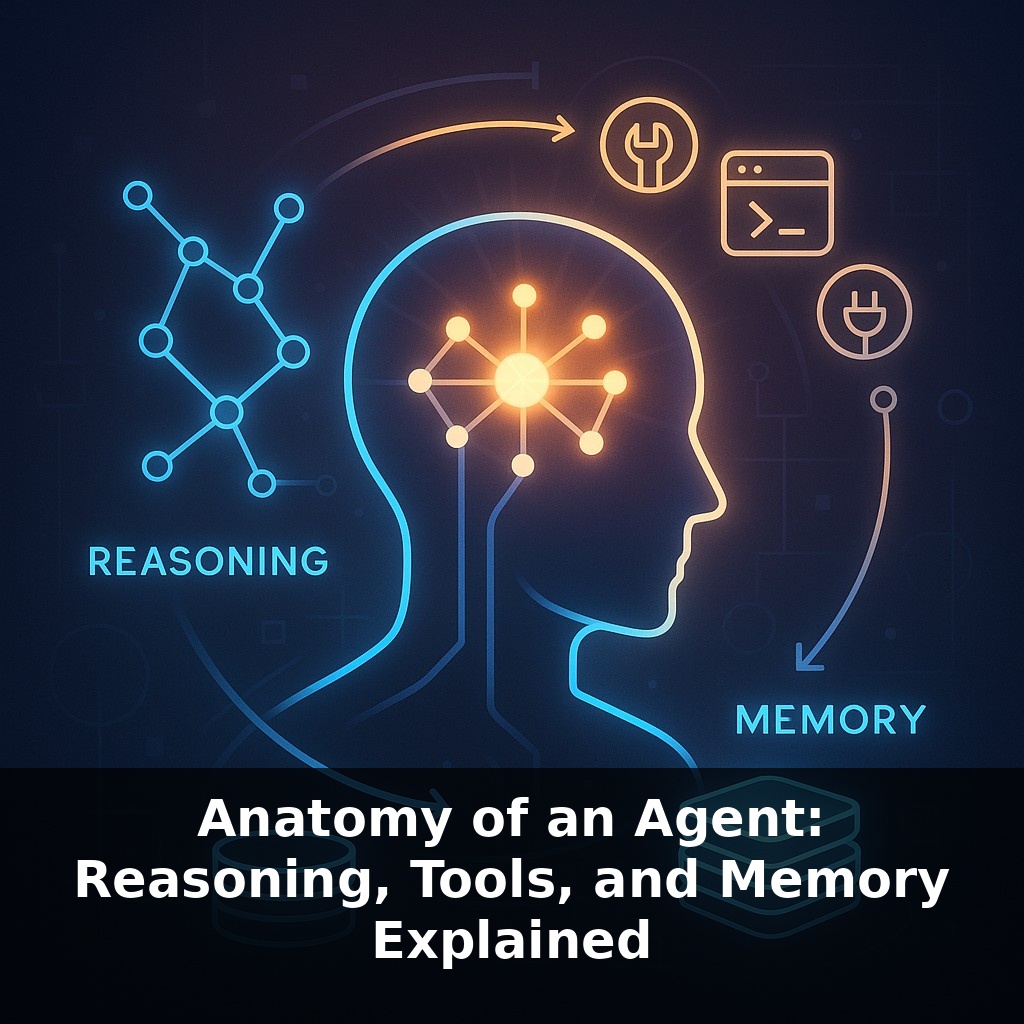
An AI tool launched last year hit tens of thousands of GitHub stars in barely more than a week—before most people even knew what “an agent” was. Today we’ll pause the hype and zoom in: what’s actually inside these agents, and why do they suddenly feel so different from chatbots?
That overnight success wasn’t just about better answers—it was about a new kind of *behavior*. Instead of stopping after one reply, these systems could loop: set a subgoal, call a tool, read the result, revise the plan, try again. Under the hood, that leap comes from wiring three capabilities into a tight circuit: reasoning that can break a vague objective into precise moves, tools that can actually affect the world outside the model, and memory that can carry lessons forward instead of resetting every time. Together, they form something closer to a decision-making process than a static response engine. In this episode, we’ll unpack that process piece by piece, and see how these ingredients already show up in products you might use—like data-analysis copilots, research assistants, and even early autonomous coding systems.
To make this concrete, we’ll stick to three questions throughout the episode: How does an agent *think* about a goal? How does it *reach beyond itself* when it gets stuck? And how does it *remember* enough to improve instead of repeating the same mistakes? We’ll trace those questions through real systems: a coding assistant that chains together API calls, a research bot that juggles web search and PDFs, and a data agent that can turn messy business exports into usable insight. Along the way, we’ll flag what’s actually working in practice versus what’s still mostly slideware.
Start with the part people overestimate: raw “intelligence.” In practice, most of the breakthroughs you’ve seen come not from smarter models, but from *structure* wrapped around them.
The first structural piece is a **planner**. Instead of dumping a big request into the model and hoping for magic, real systems give it a scaffold: slots for “overall objective,” “next action,” “why this action,” and “what to do if it fails.” That turns a fuzzy ask like “build me a sales dashboard” into something a machine can juggle: pick a data source, inspect its schema, draft code, run it, debug, then refine the visualization. Frameworks like LangChain or custom orchestrators in companies quietly do this all day, turning a single prompt into a directed sequence of calls.
The second piece is the **tool layer**, but wired with constraints. Tools come with typed inputs, rate limits, and safety checks. A research bot might be allowed to hit web search, a company’s internal wiki, and a citation database—but not random APIs or production databases. Each call is logged, scored, and sometimes vetoed by guardrails. That’s one reason Code Interpreter–style setups work so well: the environment is sandboxed, observable, and easy to reset if something goes wrong.
The third piece is the **memory stack**, which is rarely a single thing. Short-term context lives in the conversation window and scratchpads. Mid-term working notes go into lightweight stores—JSON logs, ephemeral vectors, temporary tables. Long-term patterns get promoted only when they prove useful, for example: “queries about revenue usually need this join and these filters.” Vector databases surged precisely because they give this promotion/demotion process a fast, fuzzy lookup layer at industrial scale.
Here’s the twist: these components only feel “agentic” when wrapped in a **feedback policy**—a loop that inspects results and decides whether to push forward, back up, or escalate to a human. Some teams handcraft that policy as if–then rules; others train it from traces of successful runs. Either way, success comes less from any single clever prompt and more from orchestrating many imperfect steps into a resilient workflow.
Your challenge this week: pick one task you repeat at work—reporting, triaging emails, cleaning data—and sketch how you’d redesign it *as a loop*, not a one-shot prompt. Write down: (1) the planner’s stages; (2) the tools you’d allow at each stage; (3) what should be remembered after each run. Don’t build it yet. The exercise is to see where structure, not just smarts, would change what’s possible.
Think about a data team that used to spend Mondays exporting CSVs, merging sheets, and sanity‑checking formulas. One startup wired an agent around that grind: the planner breaks the work into checklists, a code tool cleans and joins the data, and a narrow web search fills gaps like missing currency rates. The payoff wasn’t flashy AGI; it was getting an internal dashboard that closes by 9 a.m. instead of 3 p.m. Another case: a customer‑support group feeds transcripts into an agent that drafts reply templates, then watches which ones agents edit or discard. Over a few weeks, the system quietly updates its own playbook—promoting phrasing that survives human review and retiring what doesn’t. In both cases, the “intelligence” isn’t a single brilliant step; it’s the accumulation of tiny, logged adjustments, much like a chef who gradually tweaks a house recipe until regulars stop sending dishes back and start ordering seconds.
As these systems mature, they won’t just handle isolated chores; they’ll start stitching together whole workflows across apps and organizations. Think of a freelancer whose AI quietly syncs invoices, drafts follow‑ups, and adapts to each client’s quirks. Now scale that to companies: agents negotiating meeting times across firms, reallocating cloud resources on the fly, or tailoring training paths for every employee. The open question isn’t “Can they?” but “Who sets the boundaries—and who gets a say when they shift?”
We’re still early; today’s “agents” resemble toddlers learning to navigate crowded rooms. Next comes coordination: many small systems passing tasks like runners in a relay, dropping only what we fail to design for. Your role isn’t just to use them, but to choose which decisions they’re allowed to touch—and which must always land back in human hands.
Try this experiment: Pick one narrow task (like “summarize my last 20 emails” or “draft a trip plan from my calendar”) and turn it into a mini-agent by explicitly separating its reasoning, tools, and memory. First, write a 3-step “thinking ladder” for the agent (how it should reason through the task), then give it one real tool (e.g., your email client, calendar, or a docs search API) and one simple memory store (like a Google Sheet or Notion page). Run the task twice: once with just the model “thinking out loud” (reasoning only), and once with the full setup (reasoning + tool + memory), then compare how the quality, speed, and usefulness of the output change.