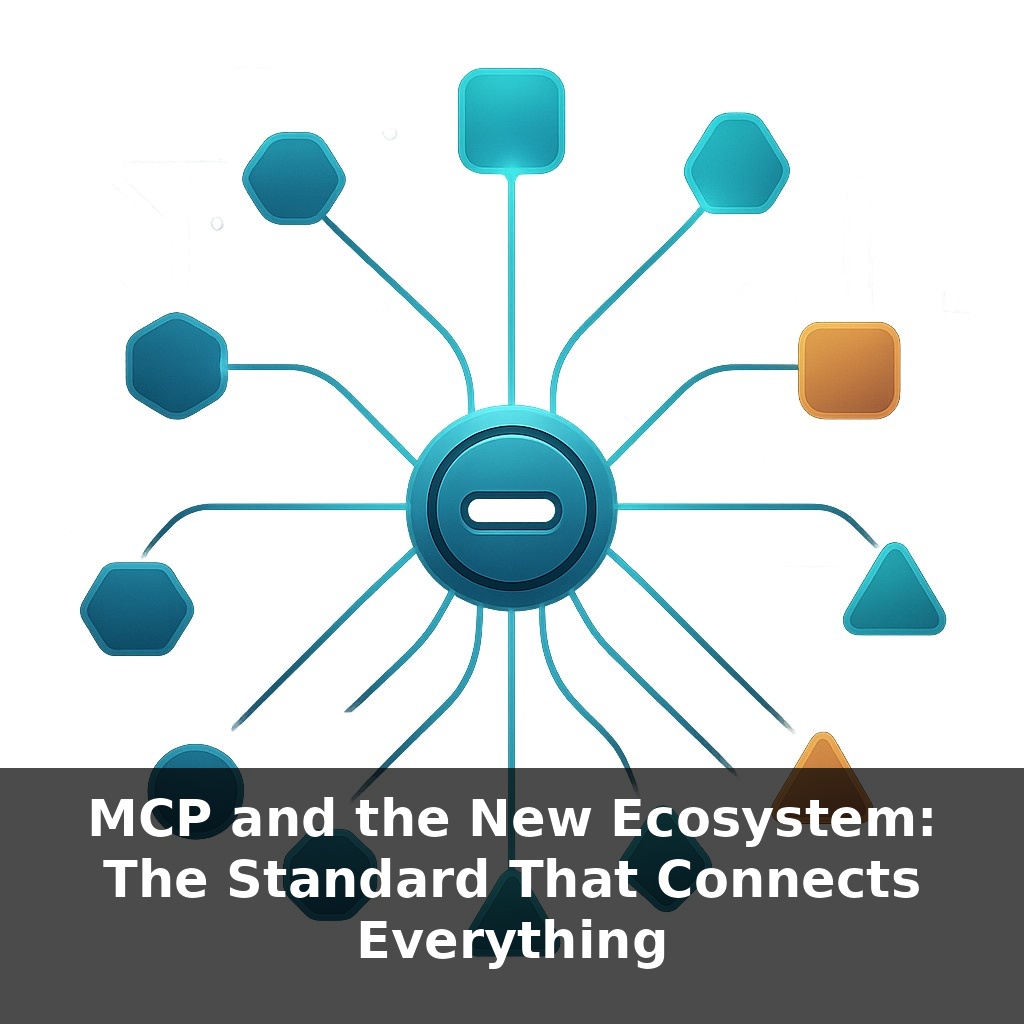
A quiet software update at Siemens cut a new AI pilot from two weeks to just four days—without rewriting the model, the app, or the network. In this episode, we’re stepping into that moment and asking: what happens when AI tools start recognizing each other… by default?
That Siemens shortcut wasn’t a one-off hack—it was an early glimpse of a new rulebook. Behind the scenes, teams weren’t arguing about SDK versions or whose API style was “more RESTful.” They were agreeing on something more basic: how their agents talk, what a “task,” a “result,” or a “permission” even *means* when code starts making requests on its own.
We’re entering a phase where the main bottleneck isn’t raw model power, but coordination: dozens of specialized agents, legacy systems that refuse to retire, edge devices on flaky networks, compliance constraints that don’t care how clever your prompt is. MCP steps into exactly that mess.
In this episode, we’ll explore how a shared message standard changes incentives: who builds what, who controls trust, and how fast entirely new workflows can crystallize around a single, well-formed message.
Instead of wiring one-off integrations, MCP shifts the focus to defining roles and expectations. A vision service doesn’t need to know if it’s talking to a cloud planner, a factory edge node, or a mobile app; it just publishes what it can do and how to talk to it. That changes hiring plans, vendor contracts, even which experiments a small team can afford to run. A solo developer at a midsize manufacturer can now orchestrate cloud analytics, on-prem sensors, and a supplier’s scheduling agent the way a chef layers ingredients from different regions into a single, coherent dish.
Here’s where the new rulebook gets concrete. The MCP draft isn’t a manifesto; it’s 68 pages of “when an autonomous thing says X, it must also say Y.” At its core are three moves that quietly change how agent ecosystems form.
First, capability discovery shifts from slide decks and sales calls into the protocol itself. An agent can publish a machine-readable list of what it can do, which inputs it accepts, which constraints it respects, and how it prefers to be called—across text, voice, or machine-to-machine channels. Another agent can query this catalog and negotiate: “I need defect detection under 200 ms, on this camera type, with this privacy policy.” That negotiation happens before anyone writes glue code, which is why pilots stop stalling at the “integration workshop” stage.
Second, MCP treats transports and formats as interchangeable pipes, not existential choices. Today, teams argue over REST vs. gRPC vs. MQTT; with MCP, they agree on the semantics once, then let a reference layer translate across HTTP, WebSocket, fieldbus gateways, or low-bandwidth IoT links. This is where the reported 60% reduction in custom adapters comes from: you’re not hand-coding the same status, error, and progress patterns in four different styles.
Third, the security stance assumes that agents may not fully trust each other, even inside the same company. Identities, scopes, and policy checks are woven into every exchange, aligning with Zero Trust guidance rather than bolted on later. That makes it realistic to let a supplier’s scheduling agent talk to your planning system, or a startup’s forecasting model operate inside your edge network, without quietly punching holes in your perimeter.
Notice what’s missing here: anything about “replacing APIs” or forcing a single interaction style. Legacy REST endpoints, proprietary SDKs, and domain-specific protocols don’t vanish; they’re wrapped, labeled, and exposed in a consistent way. A warehouse robot doesn’t care that its routing service lives behind a decades-old interface; it just sees a capability with clear contracts, performance hints, and risk boundaries it can reason about.
In practice, this starts to feel less like “systems integration” and more like curating a menu. A hospital could expose an imaging triage agent, a billing verifier, and a bed-assignment planner as distinct capabilities. A weekend hackathon team then mixes them to build a “one-click discharge” flow: when a doctor signs off, one message fans out to confirm scans, clear insurance, notify family, and book transport—without anyone emailing CSVs around.
Or consider a logistics startup that wants to trial three routing engines from different vendors during peak season. Instead of begging for custom dashboards, they announce a new “route-evaluation” channel. Each engine subscribes, runs its own scoring, and replies with comparable metrics. The startup swaps models in and out mid-week, then keeps the winner—not because of a glossy pitch, but because the shared protocol made a live A/B test an operational, low-risk default.
If MCP hardens into the default fabric, “integration” shifts from one-off projects to an ongoing market game. A small studio could ship a niche agent—say, for optimizing energy use in cold-storage warehouses—and have it instantly testable across many fleets. Cities might wire traffic lights, charging stations, and grid forecasters into a shared channel, letting them co‑schedule flows like a jazz ensemble improvising in real time, instead of today’s scripted, siloed choreography.
As this fabric thickens, the interesting question isn’t “can I connect this?” but “what *emerges* when everything can listen and respond?” Think less about wiring boxes, more about setting rules for a living market. The frontier moves to governance: who sets priorities, who audits behavior, who can pause the music when agents start improvising too well?
To go deeper, here are 3 next steps: 1) Install the Claude desktop app (or your preferred MCP-capable client) and connect a real MCP server from the ecosystem list on GitHub (e.g., the GitHub MCP server) so you can literally browse repos and issues from inside your AI. 2) Read the MCP specification and best-practices docs on Anthropic’s developer site, then clone one open-source MCP server (like the filesystem or web-search server) and run it locally to see how tools, prompts, and resources are registered in practice. 3) Build a tiny custom MCP server in your favorite language—something concrete like a “personal knowledge base” connector to your notes in Notion or Obsidian—and test it live in Claude, treating this as your first building block in the new MCP-centric ecosystem you just heard about.