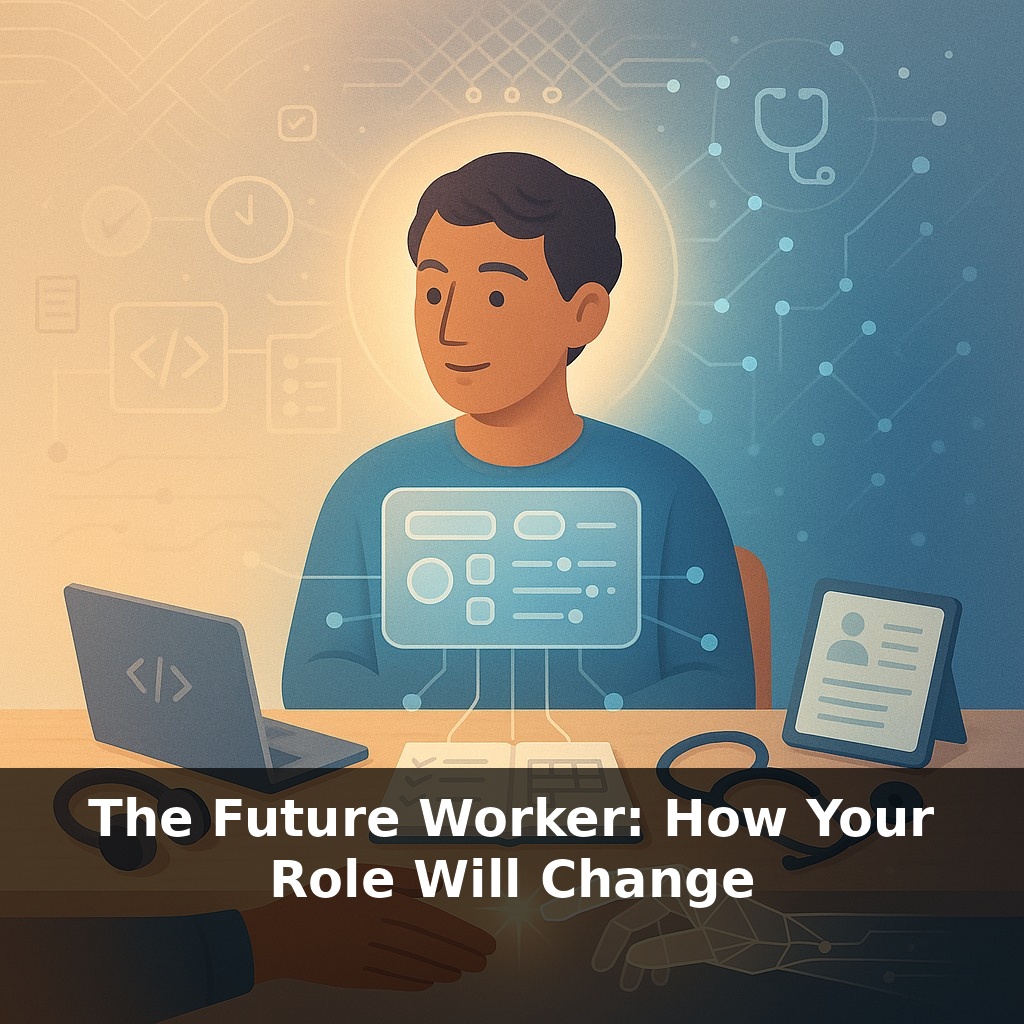
About half the tasks in your job could be automated today—yet most companies are hiring, not firing. A software engineer, a nurse, and a project manager all start their day the same way: by asking an AI for help. But by lunchtime, their roles have quietly changed.
Your job description is slowly going out of date—and not because your company is changing, but because the *texture* of knowledge work is being rewoven. The real shift isn’t “humans vs. AI,” it’s *which* human strengths become scarce and valuable when software can draft, summarize and optimize on demand. In meetings, the person who can frame a fuzzy problem so AI can meaningfully assist will quietly gain influence over the person who can only “do the task faster.” In negotiations, empathy and narrative will matter more because everyone has access to the same facts. And across industries, careers will look less like climbing a fixed ladder and more like actively managing a portfolio of capabilities—digital, analytical, and interpersonal—that you rebalance as AI reshapes what “good work” looks like.
Many “future of work” debates miss a quiet detail: it’s not just *what* you do that’s shifting, but *when* and *why* you get involved in a workflow. Instead of owning an entire process, you’ll increasingly drop into the stages where judgment, context and coordination matter most. Think of how a chef runs a kitchen: they aren’t chopping every carrot; they’re designing the menu, tasting, adjusting, and orchestrating timing. Likewise, your value will concentrate around defining objectives, interpreting edge cases, and stitching together inputs from humans and machines across disciplines.
Start with the numbers: McKinsey estimates roughly 60% of occupations have at least 30% of their activities that *could* be automated with today’s tools. That sounds like a threat—until you look at how organizations are actually using these tools. IBM’s recent pilots in customer service show 30–50% productivity gains not by swapping people out, but by changing *which* parts of the work people do. The script isn’t “job eliminated”; it’s “workflow rewritten.”
What does that rewrite look like from the inside?
First, roles stretch across more disciplines. A marketer is suddenly expected to read basic analytics dashboards. A nurse spends more time interpreting AI-flagged risks and coordinating with specialists. A lawyer reviews AI-drafted clauses but must understand how the model may have missed jurisdictional nuance. Jobs are becoming bundles of micro-activities that cut across data, tools and teams.
Second, the “entry-level” is moving upstream. Routine drafting, basic research, and first-pass analysis are increasingly handled by systems. That means humans are pulled earlier into sense-making: deciding which problem is worth solving, which data to trust, which trade-offs matter. Your first years in a field may involve far more decision support and far less rote production than your predecessors saw.
Third, quality control is being redefined. Instead of checking only your own output, you’ll monitor and tune the performance of the systems you work with. Spotting subtle failure patterns, escalating edge cases, and closing feedback loops becomes part of the job. In many companies, this is quietly turning into a new speciality: AI operations and oversight embedded inside regular teams, not just in IT.
Finally, learning is shifting from episodic to continuous. PwC found that by 2022, 75% of employers were already investing in upskilling around data and AI literacy. The signal for workers is clear: static credentials matter less than your visible ability to adopt new tools, adapt your process, and collaborate across boundaries as those tools evolve. Your “role” is no longer a fixed box; it’s a moving frontier between what machines do well and where human judgment still changes the outcome.
A product manager at a retail startup begins her day by asking an AI agent to cluster thousands of customer reviews. Ten minutes later, she’s not reading charts; she’s on a call with logistics and design, translating patterns into a decision about whether to redesign packaging or adjust shipping partners. The mundane sorting vanished, but cross-team negotiation and judgment intensified.
A teacher uses an agent to propose three lesson variations based on last week’s quiz data. Instead of spending Sunday night on prep, he spends class time running a live “choose your own path” exercise, watching where students struggle, then asking the agent for targeted follow‑ups. The role tilts from content delivery toward orchestrating real‑time learning experiences.
Think of an AI agent as a GPS for your career journey: it rapidly proposes routes (solutions) based on vast data, but you, the driver, still decide the destination, adjust for roadblocks and remain accountable for the trip. Over time, the most valuable workers won’t be those who “use AI,” but those who redesign the map around it.
As tools mature, your value may hinge less on “what’s my job?” and more on “which problems can I responsibly take on?” New roles will cluster around translating messy goals into testable experiments, stress‑testing models, and stitching together human and machine contributions across teams and time zones. Career paths may look more like lattices than ladders: you’ll pick up short, intensive skill blocks—like seasonal gigs—then recombine them into new specialties as needs shift.
The next step isn’t predicting which jobs vanish, but asking: *Which questions could only I have asked today?* Treat each project like a prototype of your future role—tweak who does what, which tools you test, how you share thinking. Over time, those small experiments compound like interest, quietly reshaping both your career and your confidence.
Try this experiment: For the next 5 workdays, treat yourself as a “talent marketplace worker” instead of a job title. Each morning, list one task you’re doing that could be unbundled into a skill (e.g., “run weekly status meeting” becomes “facilitate cross‑functional alignment”) and post a short, skill-focused offer in a public place your team uses (Slack channel, Teams, Confluence, Notion) like: “For anyone stuck on X, I can help with Y this afternoon.” Track who responds, what kinds of problems people bring you, and how your “internal clients” change over the week. At the end, review which skills created the most pull from others—those are your strongest currency in the future-of-work marketplace, and you can double down on them next week.