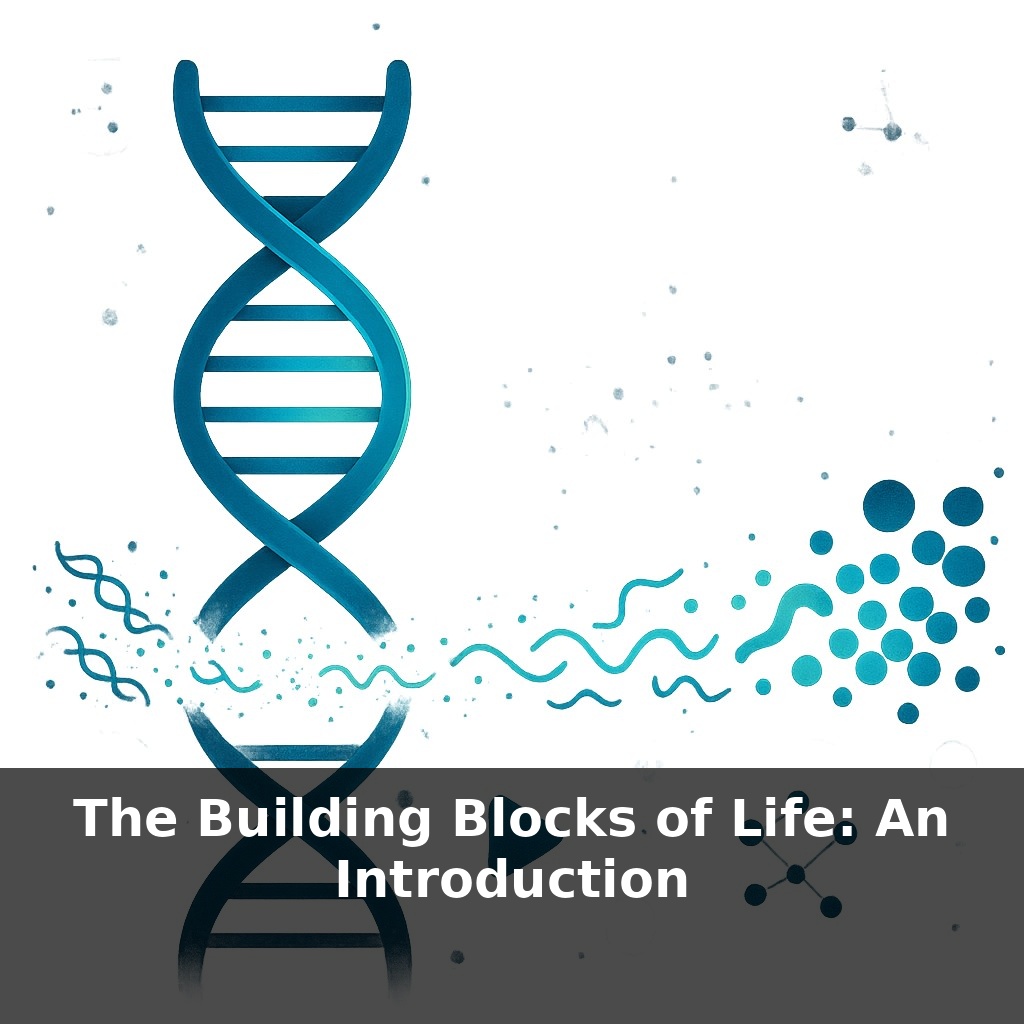
The Building Blocks of Life: An Introduction
📝 Transcript
Right now, inside your body, tiny molecular machines are building you in real time—stitching together several thousand new molecules every second. In this episode, you’ll step inside that hidden workshop and learn the simple rules that all life on Earth quietly follows.
Those molecular machines aren’t freelancing—they’re following instructions encoded in matter itself. Biologists call this flow of information the “central dogma”: DNA instructions are copied into RNA, and RNA guides the construction of proteins. From there, proteins run the show, controlling everything from how fast you burn energy to how your neurons fire when you read this sentence.
This isn’t abstract theory; it’s engineering at nanometer scale. A single human cell stores its blueprint in about 2 meters of DNA, packed into a nucleus only around 6 micrometers wide. That blueprint includes roughly 20,000 protein‑coding genes, yet through clever editing steps cells can generate well over 100,000 distinct proteins. In this episode, you’ll learn how this information system works, why it’s so conserved across life, and how modern biotechnology is starting to rewrite the code.
Zoom in further and those same rules play out inside highly organized spaces. Even a “simple” bacterium carries all its essential parts in a volume of about 1 femtoliter (10⁻¹⁵ liters), while a human cell is often 1,000 times larger and packed with specialized compartments. Ribosomes—tens of thousands per cell—each crank out roughly 3–5 amino acids per second, coordinating like a factory floor. Meanwhile, chemical reactions that would crawl along in a test tube are pushed forward up to a billion‑fold faster by proteins precisely shaped for their jobs.
Life’s shared toolkit becomes even more striking when you compare wildly different organisms. A yeast cell and a human neuron both use the same four DNA bases and the same 20 standard amino acids. Line up a human gene next to the corresponding mouse gene and you’ll often find 80–90% of the letters are identical. In core processes like copying DNA or making ATP, some proteins are more than 98% conserved between bacteria and humans. That level of reuse is why a mutation in a single gene can be studied in a fly or a worm and still tell us something meaningful about human disease.
But “shared parts” doesn’t mean “simple outcomes.” Cells decide which segments of DNA to use through layers of control. Chemical tags can be added to DNA or to the proteins it’s wrapped around, changing how tightly specific regions are packed. In humans, over 1,000 enzymes and accessory factors participate in placing, removing, or reading these tags. Some marks can persist through cell division, helping a liver cell stay a liver cell across decades, even though it carries the same genome as a skin cell.
Viruses exploit this system rather than carrying full toolkits of their own. An average coronavirus genome has only about 30,000 bases—roughly 0.0015% of the length of the human genome—yet can hijack a host cell in hours. Over evolutionary time, bits of viral sequence have been copied into host DNA. In humans, around 8% of the genome traces back to these ancient invasions. At least dozens of these viral remnants have been repurposed: one helps form the placenta, others influence gene regulation in the brain and immune system.
Modern biotech leans on such universality. The bacterial enzyme Cas9, central to CRISPR editing, can be guided by a 20‑base RNA to cut human DNA at a chosen site out of roughly 3,000,000,000 bases. mRNA vaccines use a ~4,000‑base RNA strand to direct human ribosomes to make a single viral protein, training the immune system without an actual infection.
Your challenge this week: treat news about “genes,” “mutations,” or “DNA breakthroughs” as engineering updates. Each time you encounter such a story, ask three concrete questions: What molecule is being changed (DNA, RNA, or protein)? How big is that change (one letter, a whole gene, or more)? And which cell types are supposed to respond? By forcing yourself to answer with specific mechanisms, you’ll start seeing the hidden hardware of life in every headline.
A practical way to see these principles in action is to look at specific projects. In industrial biotech, microbes are re‑tooled to make chemicals we used to extract from oil. One strain of engineered yeast now produces over 100,000 tons of bio‑based farnesene per year for fuels and cosmetics. In medicine, a single‑gene defect in the CFTR gene causes cystic fibrosis; recent therapies tweak the resulting protein’s shape just enough to restore up to 40–50% of normal channel activity, which is often enough to transform symptoms.
Use one analogy to tie this together: think of a software repo. A “patch” might flip 1–2 bits (a point mutation), a “feature branch” might add 2–3 kilobytes of new code (a synthetic gene), and a “fork” might bring in 1–2 megabytes from another project (a viral sequence). Modern bioengineering operates across all three scales—sometimes in the same cell line.
As genomes become editable, biology starts to look like long‑term infrastructure. Within 10–20 years, hospitals may routinely sequence 3–5 million patients annually, feeding AI models that predict which of your 20,000+ genes most affects drug response. Cities could deploy engineered microbes in 1,000‑km sewage networks to track outbreaks in real time. Your task isn’t to memorize pathways, but to ask of every new “bio‑upgrade”: Who controls it, who benefits, and who carries the risks?
In the next episodes, you’ll zoom from molecules into systems: how ~37 trillion cells coordinate, how edits in just 10–20 key genes can reshape traits, and how labs compress years of evolution into 30‑day experiments. As you listen, keep asking: if we can redirect even 1% of these pathways, which futures are we quietly choosing—and for whom?
Here’s your challenge this week: choose **one basic cellular process** mentioned in the episode—like **protein synthesis, cellular respiration, or DNA replication**—and track where it “shows up” in your real life at least **three times** in three different contexts (for example: during a workout, while eating, or when you’re healing from a small cut). Each time, **say out loud** which process is at work and what specific molecules are likely involved (like glucose, ATP, or amino acids). By the end of the week, explain in **one 2–3 minute voice note** (to yourself or a friend) how that single process quietly keeps you alive all day long.
From this course
Biohacked: The Future of Biotechnology
6 episodesUnlock all episodes
Full access to 6 episodes and everything on OwlUp.
Subscribe — $1.99/monthLess than a coffee ☕ · Cancel anytime

