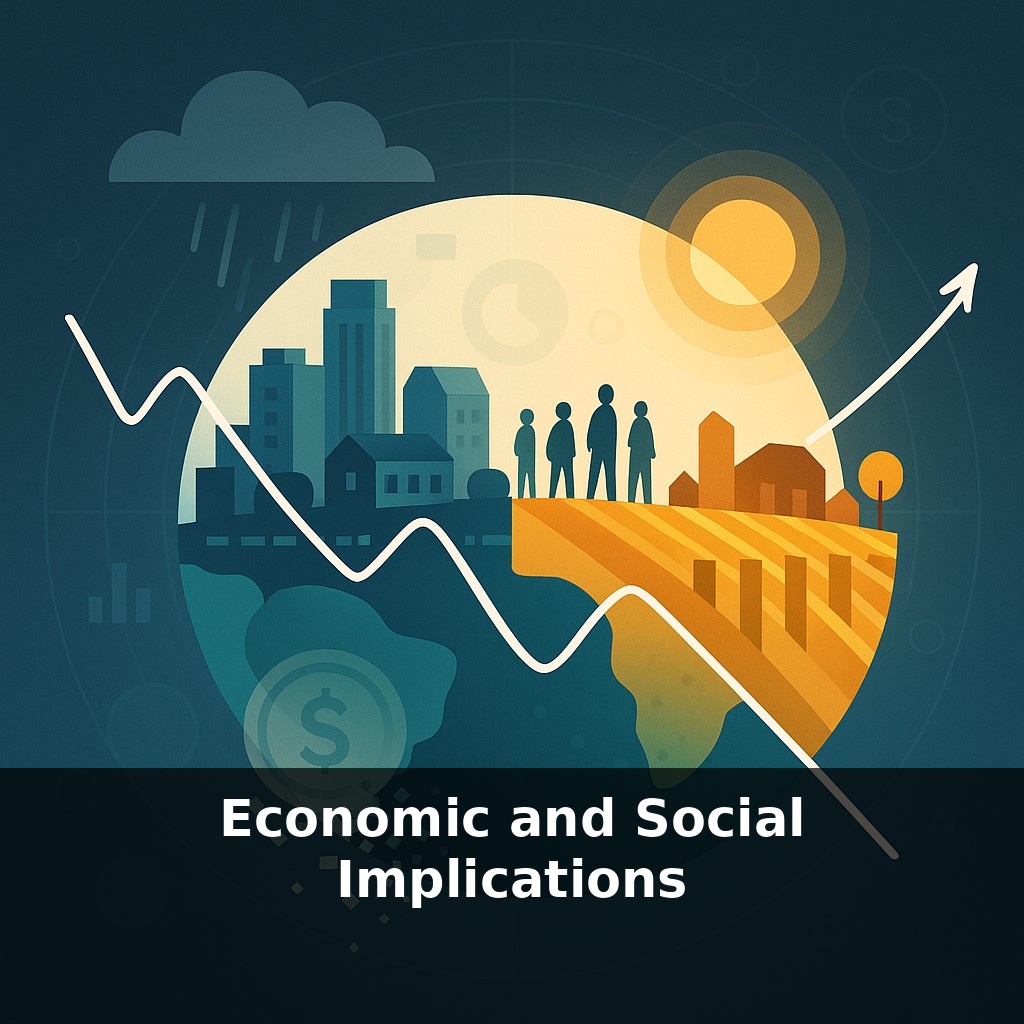
A storm that lasts one night can erase years of economic progress. A heatwave can quietly shut down factories, schools, and harvests at the same time. In this episode, we follow the money: how a warming planet is already rewriting paychecks, prices, and entire city budgets.
When economists run the numbers on climate change, they don’t just see “bad weather”—they see a slow rewrite of who wins, who loses, and who gets left out entirely. Farms that once had predictable seasons now juggle droughts and floods in the same decade. Supply chains that looked efficient on paper start to wobble when a single flooded port can stall factories half a world away. It’s not only harvests and shipping schedules on the line: hospitals face new waves of heat-related illness, insurance companies redraw risk maps, and schools close more often as extremes become routine. Think of a city’s economy like an orchestra: when climate shocks knock out the violins (transport), then the drums (housing), then the brass (healthcare), the whole performance changes, not just one section. In this episode, we’ll trace how those disruptions ripple from fields and coastlines into daily life and long-term opportunity.
As temperatures and seas rise, the basic “rules” of earning a living begin to shift. Some jobs move indoors or into cooler hours; others disappear when outdoor work becomes unsafe for weeks at a time. Insurance premiums climb like rent in a trendy neighborhood, quietly reshaping which homes and shops can afford to stay put, especially near coasts and rivers. Food doesn’t just get pricier; diets and local cuisines change as certain crops struggle and others move in. Public budgets feel the squeeze when money once earmarked for schools or parks must be diverted, again and again, into rebuilding, cooling, and flood defenses.
When you zoom out from individual storms or bad seasons, a pattern appears: climate stress keeps showing up where money is made and where security is already thin. Start with work itself. Outdoor labor in construction, mining, and small-scale farming can become unsafe during long stretches of extreme heat. That doesn’t just mean discomfort; it means fewer safe work hours, more breaks, and rising health costs. In many low-income regions, these are the very jobs that keep households afloat, so lost work days quickly turn into skipped meals or missed school fees.
Food systems feel the pressure from several sides at once. Yields can swing wildly, pests and diseases shift into new zones, and fishing grounds move or shrink as oceans warm. Large agribusiness firms may adjust by switching crops, investing in irrigation, or buying up cooler land. Smallholders often lack that flexibility. When governments respond with export bans or sudden subsidies to protect their own populations, it can send price shocks through international markets, leaving import-dependent countries scrambling.
Finance and insurance act like the nervous system of the global economy, and climate disruptions send sharp signals through it. Insurers raise premiums or withdraw from high-risk areas after repeated floods or wildfires. That can strand whole neighborhoods: if you can’t insure a home or factory, banks hesitate to lend, projects stall, and property values sink. At the same time, investors begin to reassess fossil-fuel-heavy assets, wary that future regulation or social pressure could devalue them. This “transition risk” can shake pension funds, municipal budgets, and energy-intensive industries well before physical damages peak.
Cities, where most people now live, have to rethink how and where they grow. New transport lines, housing blocks, and industrial zones built without climate risk in mind may lock in future losses. Yet retrofitting drains, cooling public spaces, and elevating critical infrastructure costs serious money—especially for rapidly growing cities in low- and middle-income countries that already juggle housing shortages and limited tax bases.
Socially, these pressures don’t land evenly. Households with savings, air conditioning, and diversified income can buffer shocks. Those living in informal settlements on floodplains or working in heat-exposed jobs cannot. As repeated climate hits erode assets—livestock, equipment, even documentation—families may migrate, pull children from school, or turn to riskier work, setting back human development indicators that took decades to improve.
Think of a local marketplace on a busy weekend. One surprise downpour doesn’t just leave stalls wet; it changes what gets sold next month. A vegetable seller whose stock spoils might switch to packaged goods that tolerate humidity. A tailor who loses customers on too many scorching days could move online—if reliable electricity and internet exist. If not, income just shrinks. Now scale that market up to an entire country: sectors that can “move online” or automate adapt faster; those rooted in land, water, or outdoor labor have far fewer exits.
Concrete examples are already visible. In South Asia, some factories are shifting work to nighttime to protect workers, which then strains public transport and childcare. In the Sahel, herders travel farther for pasture, raising the chance of conflict with farmers over water points. Tourists reroute from coral-bleached reefs to cooler destinations, pulling revenue from coastal towns that built hotels and roads for visitors who no longer come. Step by step, livelihoods, migration routes, and even cultural traditions bend around new climate realities.
Policies will have to evolve as quickly as the risks. Central banks are beginning to “stress test” financial systems against climate shocks, much like doctors monitoring patients with multiple conditions. Labor laws may shift to protect outdoor workers, while unions bargain for cooling, healthcare, and retraining. At the same time, investors are hunting for resilient assets: elevated housing, drought-tolerant crops, shaded transit—turning adaptation choices into tomorrow’s blue-chip bets.
Your challenge this week: pick one everyday setting you use often—a supermarket, a bus route, a local park, your school, or your workplace. Walk through it (physically or via map/street view) and list 3 ways a hotter, wetter, or drier future could disrupt how it works, and 3 upgrades that would make it fairer and more resilient. If possible, share one idea with a local group, union, tenants’ association, or city contact form.
The bigger story is how we redesign the rules of the game while it’s still in motion. Taxes, subsidies, and zoning can either lock us into brittle systems or nudge us toward sturdier ones, like tuning an instrument between songs. The next decades won’t just be about counting losses, but about deciding whose security, health, and time we choose to protect first.
Before next week, ask yourself: Which economic or social trade-off from the episode (like prioritizing GDP growth vs. reducing inequality, or protecting local jobs vs. embracing automation) shows up most clearly in my own workplace, community, or daily spending—and what’s one concrete decision I’ll make differently because of it? When I think about the social impacts they described (like access to education, housing, or healthcare), whose experience in my city or neighborhood am I not seeing, and how can I deliberately expose myself to their perspective this week (for example, by attending a local meeting, talking to a frontline worker, or reading a community group’s posts)? If I had to choose one policy idea or social change mentioned in the episode to publicly support or challenge, what specific step could I take in the next few days—such as emailing a representative, showing up at a council meeting, or changing where I spend my money—to move from “concerned observer” to “active participant”?