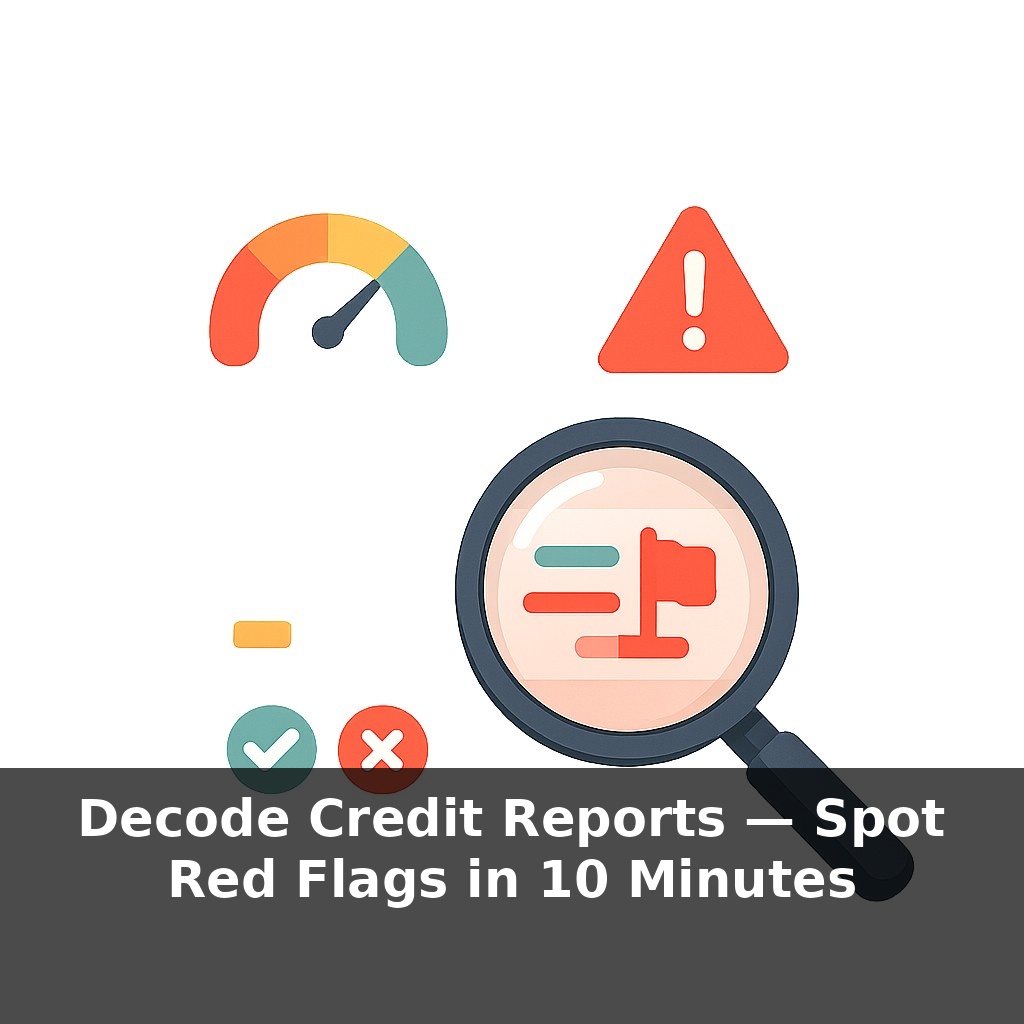
Roughly one in five credit reports contains a serious mistake—yet most people glance at theirs for seconds and move on. In this episode, we’ll drop you into a real-life style scenario and explore how to spot silent credit “time bombs” in under ten minutes.
One in five reports hiding a major error sounds abstract—until you realize that could be the difference between “approved” and “denied” on your next apartment, auto loan, or even job offer. In the last episode, you pulled your reports; now we’re going to actually use them. Think of this as learning to read the “fine print” of your financial story, fast.
You don’t need spreadsheets, color-coded systems, or hours of free time. You just need a structured top-to-bottom scan: start at your name and addresses, then sweep through each account, negative mark, and inquiry like you’re reviewing a contract before you sign it. In under ten minutes, you’ll be able to spot three big red-flag categories that lenders care about immediately—so you can decide what needs fixing, what’s harmless, and what’s just noise.
Think of this step as learning to read a busy city map: you’re not memorizing every street, you’re spotting the highways, dead ends, and construction zones that change how you travel. Now that you’ve pulled your reports, we’ll zoom in on how lenders “read” them at a glance. They don’t care about every tiny detail equally—they scan for patterns: do you pay on time, do your debts ever go bad, and does the file clearly belong to you? As you follow along, you’ll practice that same lens, so your ten‑minute review mirrors how an underwriter sizes you up.
Start at the top, but this time you’re not just “checking it’s you.” You’re hunting for anything that doesn’t line up with your real life. In the personal‑info section, move down the list and ask three quick questions:
- Do all versions of your name look familiar? Middle initials or misspellings you’ve never used can hint that someone else’s data slipped into your file. - Are there addresses or employers you don’t recognize at all? One weird old address is often just sloppy reporting; a city you’ve never lived in deserves a sticky note. - Is your birthdate correct on every bureau? A wrong year is especially important to flag.
You’re not fixing yet—you’re circling possible problems for later.
Next, glide into the account list. Don’t try to absorb every number; just do a fast filter pass:
1) “Mine or not?” Credit card you never opened, a random store account, a personal loan from a lender you’ve never heard of—those are front‑of‑the‑line issues.
2) “Open, closed, or weird?” An account you know was closed but shows as open with a balance can affect how much debt lenders think you’re carrying. A card you still use showing as closed could be a simple reporting lag or a sign the issuer shut it down.
3) “Does the story make sense?” Look at each account’s high credit or original loan amount versus the current balance. If you paid off a car last year but the balance still shows thousands, note it. If a limit is missing on a major credit card, that can distort your utilization calculations.
Now slide to the “Negative” or “Derogatory” sections. Here, think in two layers:
- Status: Is this actually yours, and does the label match reality—collection, charge‑off, repossession, bankruptcy? - Timeline: Each derogatory entry should have dates: when it first went bad and when it’s expected to fall off. Anything older than seven years (or ten for certain bankruptcies) is a candidate for removal.
Finally, scan inquiries. Group them mentally: auto, mortgage, credit cards, “other.” One auto‑loan shopping burst last month? Probably fine. A dozen small‑dollar lenders hitting your file over several months when you never applied? That’s a pattern to investigate.
By the end of this pass, you should have a short list of “doesn’t match my life,” “status seems wrong,” and “feels out of date.” That list becomes your roadmap for cleaning and, eventually, boosting your score—not in theory, but line by line.
Think of this ten‑minute scan like a triage nurse’s first pass through a crowded waiting room: you’re not doing surgery, you’re deciding who needs attention now, who can safely wait, and who’s already fine. As you work through your report, try tagging items in three buckets: “urgent,” “important,” and “monitor.” An urgent item might be a card you don’t recognize with a big balance, or a very recent late that you’re certain didn’t happen. Important could be an old collection that looks paid but still shows unpaid, or an account balance that doesn’t match your latest statement. Monitor covers things like clustered hard inquiries from a recent auto‑loan search, or an address you vaguely remember from years ago. This simple tagging keeps you from getting overwhelmed and helps you see patterns across all three bureaus. If the same lender, date range, or type of error appears more than once, that’s a clue: the issue might come from a single data source you can tackle with one focused dispute instead of scattered, one‑off fixes.
Future shifts could turn this quick scan into more of a “credit radar” than a one‑time check. A public credit registry might smooth out bureau quirks, like switching from three weather apps to one trusted forecast. Real‑time data—utilities, BNPL, even rent—could show up as new, fast‑moving streaks on that radar. And as fintechs refine AI error‑spotters, you may get pinged the way banks now flag odd card charges, catching issues before they harden into score damage.
Treat this quick review like checking your mirrors before changing lanes: small, steady habits prevent ugly surprises. Over time, you’ll start noticing subtler clues—like dates that don’t line up across bureaus or limits that quietly shrink. Your challenge this week: repeat a 10‑minute scan, but focus only on dates and balances. See what new patterns jump out.