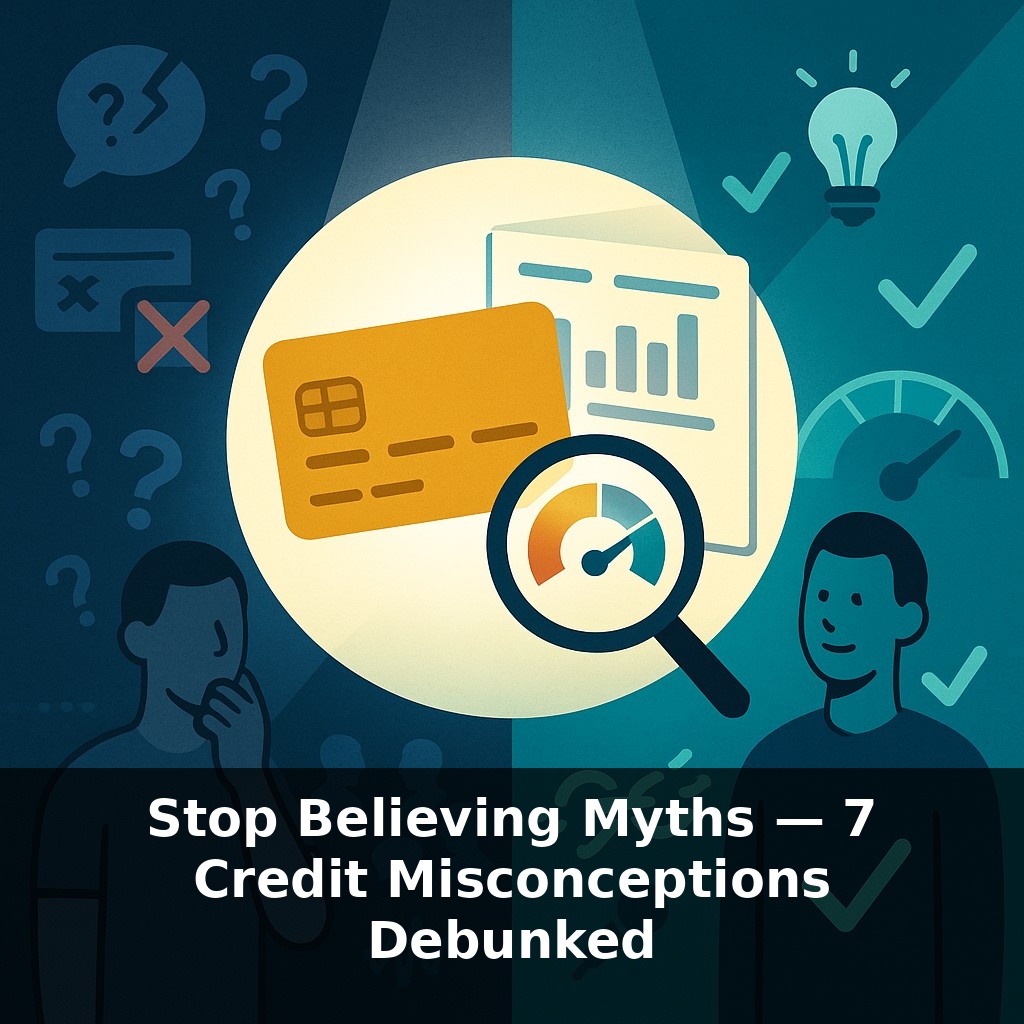
About half of Americans believe checking their own credit can hurt their score—yet the companies behind those scores openly say it has zero impact. So why do these myths survive? In this episode, we’ll step into the moments where bad credit advice sounds the most convincing.
Roughly 40% of people think they need to “carry a balance” to build credit—a belief so common it shows up in bank call scripts and money blogs. In reality, FICO, the CFPB, and multiple industry studies all say the same thing: interest is just money you didn’t have to spend. In this episode, we’ll zoom out from any one myth and look at the larger pattern: how half-true rules of thumb turn into expensive habits. We’ll walk through seven of the biggest misconceptions—about balances, closing cards, score shopping, “too much” available credit, and more—and compare them to what the data actually shows. If Episodes 2 and 3 were about seeing your credit file clearly, this one is about cleaning up the mental file cabinet in your head, so your decisions match how the system really works, not how social media says it does.
Some myths are harmless; credit myths usually aren’t. They quietly change how you use cards, choose loans, or react to a dip in your score. In Episodes 2 and 3, you pulled your reports and learned to spot obvious errors; now we’re zooming in on subtle traps: beliefs about “too many” cards, “perfect” utilization, or “starting from zero after a setback.” Think of this as tuning a musical instrument—you’re not rebuilding it, just adjusting the parts that throw everything off-key. Once you see which ideas don’t match how scoring models actually behave, it’s much easier to stop paying for other people’s confusion.
Myth #1: “Using most of your limit shows I can handle credit.” Scoring models see high utilization as risk, not confidence. Across CFPB and FICO data, consumers who regularly sit above ~50% of their limits are far more likely to miss payments later. What matters isn’t how bravely you “push” your limit, but how predictably you stay well below it by the time the statement closes.
Myth #2: “There’s a magic utilization number—like 30% or 10%.” Those numbers are guidelines, not switches. FICO and VantageScore look at ranges and patterns: both individual-card utilization and overall utilization. A card at 80% with others at 5% can still drag you down. The lower and steadier you keep both, the less your score will swing month to month.
Myth #3: “Opening a new card always ruins your score.” Hard inquiries and a brand‑new account can shave off points in the short run, but studies show that used responsibly, extra available credit often improves scores over time by lowering utilization. The key is purpose: opening a card to spread debt is very different from opening one to consolidate and then pay down faster.
Myth #4: “After a late payment, there’s nothing I can do.” Lenders sometimes grant “goodwill” adjustments when you’ve otherwise paid on time for years. Even if they don’t, the impact of a single late mark usually shrinks with age and a clean record going forward. Data FICO has published shows that recent behavior carries more weight than old mistakes.
Myth #5: “All debt is equally bad for your score.” Installment loans (like auto or student loans) and revolving accounts (like cards) are scored differently. A paid‑down car loan with on‑time payments can be neutral or even mildly positive, while a card at 95% of its limit sends a stronger red flag.
Myth #6: “If I’m rebuilding, I should avoid credit completely.” Scores need data. Many people with past problems rebuild faster by using a secured card or credit‑builder loan lightly and reliably than by disappearing from the system altogether.
Myth #7: “After seven years, I’m reset to ‘perfect.’” Most negatives drop off around then, but old accounts, good or bad, still shape the age and depth of your file. Time helps, but habits do the heavy lifting.
Your challenge this week: pick ONE myth you’ve believed, then run a personal experiment that directly contradicts it—like paying cards down before the statement, requesting a goodwill adjustment, or opening a low‑fee secured card—and watch how your score responds over the next 60–90 days.
Think about someone training for a race using rumors instead of a coach: “Sprint until you almost pass out, that proves you’re serious,” or “Never take a rest day, it makes you weaker.” They might work brutally hard and still stall—or get hurt—not because they’re lazy, but because their strategy is misaligned with how the body actually adapts. Credit works similarly: effort only pays when it matches the real mechanics behind the score.
Take two people with the same income and total card limits. One spreads purchases across three cards and pays most of it before each statement. The other rotates a single maxed‑out card, then transfers the balance every few months “for the bonus.” On paper, their debt looks similar; in practice, the first person often glides through approvals while the second hits friction.
You’ll also see this in rebuild stories: the folks who improve fastest aren’t always the ones who pay the most money, but the ones who aim each dollar where scoring formulas are listening the loudest.
Myths fade, but new ones grow back fast—especially as rent, utilities, and “buy now, pay later” creep into mainstream scoring. Think of it like the weather getting weirder: old rules of thumb (“it never snows here”) stop working. As open‑banking tools let you control which accounts and data streams lenders see, you’ll be able to shape your “credit climate” more deliberately—but you’ll also need to keep scanning the horizon for shifting rules, not headlines.
Treat what you learned here as a starting map, not final truth. Models change, lenders tweak rules, and new products blur old lines, like rain shifting into sleet mid‑storm. Stay curious: skim updates from the CFPB, peek at your score trends, test small changes. Over time, you’ll trade superstition for evidence and guesswork for quiet control.
Here’s your challenge this week: Log into your actual credit accounts (not just Credit Karma or a score app) and pull your full credit reports from AnnualCreditReport.com, then list every open account, its credit limit, balance, and due date in one place. Next, pick ONE card with a balance and make an extra payment of at least $20–$50 specifically targeted to that card (not just the minimum) to start lowering your utilization. Finally, set up automatic payments for at least the minimum due on every card so you never miss a payment date (which matters far more than whether you carry a small balance “for your score”).