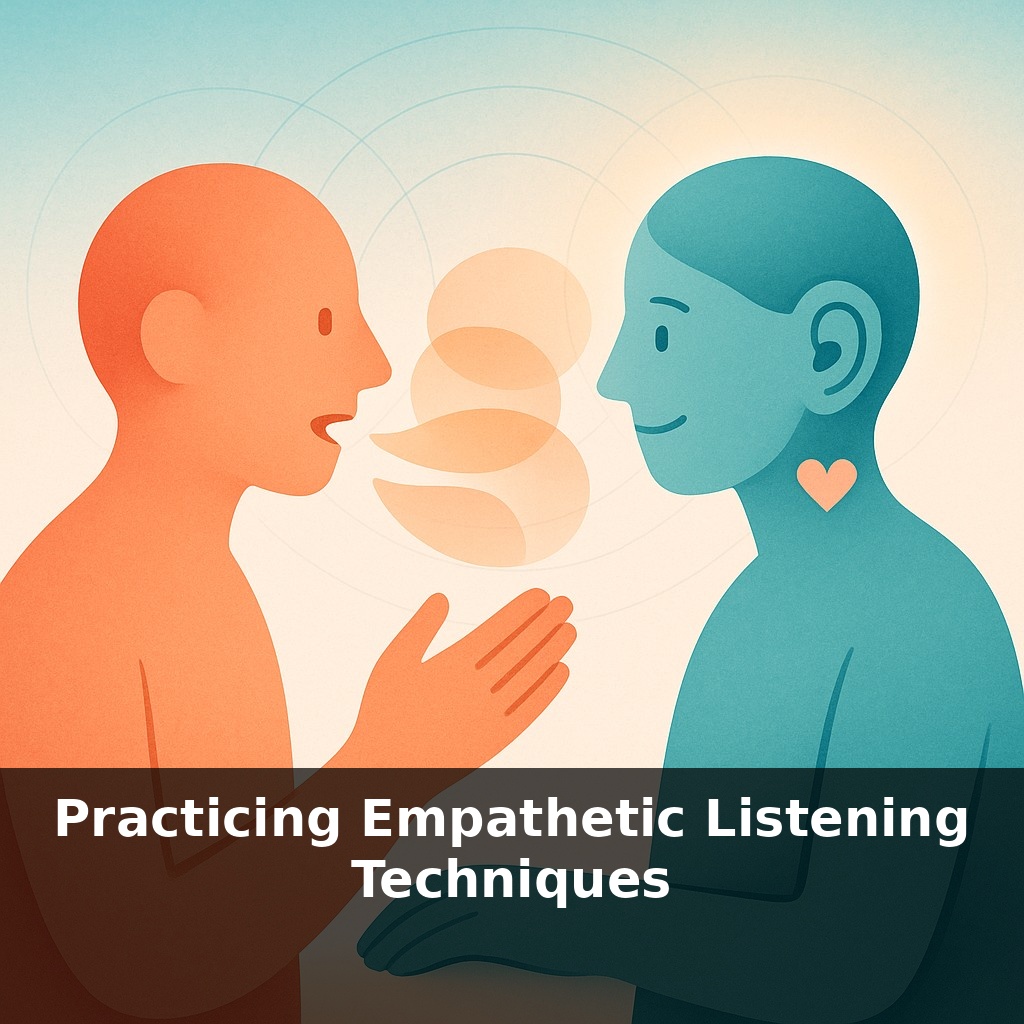
“Most of us spend about half our waking communication time listening—yet almost none of us were ever taught how to do it.” Now picture two meetings: in one, tension spikes with every sentence; in the other, shoulders drop, voices soften. The only difference? How one person chose to listen.
Here’s the twist: the hardest part of empathetic listening usually isn’t staying quiet—it’s staying curious. Most of us silently prepare our response, diagnose the “real problem,” or hunt for where we disagree. Meanwhile, the other person is scanning our face, posture, and tone, asking a simple question: “Is it safe to be honest with you?”
Empathetic listening shifts your goal from “respond well” to “understand precisely.” That means getting interested in the *felt* experience behind the words: the pressure under a teammate’s frustration, the disappointment under a partner’s sarcasm, the fear under a child’s anger.
In this episode, we’ll zoom in on three trainable micro-skills—questions, reflections, and emotion-labeling—that turn everyday conversations into low-friction spaces where people can actually exhale.
In practice, these skills feel less like a script and more like learning a new rhythm in conversation. At first, it’s clumsy: you’ll miss emotional cues, overuse a question, or reflect something that doesn’t quite land. That’s normal. What matters is treating each interaction like a mini “feedback loop.” Did the other person open up more or shut down? Did their body language ease or tense? These micro-reactions are your real-time dashboard. Over time, you’ll start to notice patterns—who needs more silence, who responds to gentle questions, who relaxes when you name what they’re feeling.
Start with open-ended questions, but treat them like doorways, not interrogations. Narrow questions (“Did you finish the report?”) keep people on a single track. Open ones (“What’s felt most stressful about this project?”) invite them to choose what matters. Notice the difference between “why” and “what/how”:
- “Why are you upset?” often sounds like a challenge. - “What’s been weighing on you about this?” signals interest, not judgment.
You’re not trying to extract information; you’re offering the other person control over the story they tell.
Once they walk through that doorway, shift from detective to mirror. Let your paraphrases zoom in on *meaning*, not just content. If someone says, “No one ever tells me anything until the last minute,” you might say, “So lately it’s felt like you’re the last to know, and that’s wearing on you.” You’re testing a hypothesis out loud. If you’re off, they’ll usually refine it: “It’s not just lately—it’s been months.” That correction is progress; it means they’re engaging, not withdrawing.
Emotion words are your precision tools. Generic labels (“You’re stressed”) can feel flattening; more specific ones (“overloaded,” “boxed in,” “let down”) often land closer to the mark. You’re not diagnosing; you’re tentatively naming the emotional *shape* you’re sensing. A simple stem like, “I’m wondering if part of this is feeling…” keeps it collaborative rather than authoritative.
Timing matters as much as wording. Sprinkle silence between their sentences and your responses. A two-second pause after someone finishes often pulls up the “second layer” of what they really needed to say. If they look away, fidget, or give clipped answers, treat that as a signal to slow down and simplify: fewer questions, shorter reflections, gentler labels.
Different contexts call for different mixes of these moves. In a 1:1 with a direct report, you might lean heavier on questions to surface constraints. With a close friend, you might rely more on reflections and emotion words, because the history between you is already dense. In conflict, your first job is de-escalation: longer reflections, minimal probing, and very modest labels (“a bit frustrated,” “kind of cornered”) to avoid inflaming things.
Over time, you’ll notice your default pattern. Maybe you over-question when anxious, or you label emotions too strongly when you’re trying to “prove” you understand. Treat those tendencies as data. Adjust one variable at a time—fewer questions in one conversation, more specific emotion words in another—and watch what happens to tension, openness, and trust in real time.
Think of a tense 1:1 with a colleague who missed a deadline. They say, “It’s been chaos at home and I’m just doing my best.” You could reply, “Okay, but we still need the report,” and move on. Or you could try: “What’s been the hardest part of juggling all this?” Then: “So you’re pulled in ten directions, and work keeps asking for ‘just one more thing.’” Followed by, “I’m wondering if part of this is feeling like you can’t afford to drop *anything* without something important breaking.”
In a family setting, your teenager snaps, “You don’t get it. School sucks.” Instead of lecturing, you ask, “What part of school has been hitting you the hardest lately?” Then, “Sounds like every day is a performance review you can’t opt out of.” Finally: “Maybe there’s some mix of pressure and embarrassment when things don’t click as fast as they ‘should.’”
Across roles—manager, friend, parent—you’re not fixing. You’re offering small, accurate “checkpoints” so the other person doesn’t feel alone on their internal map.
Empathy practice today looks small-scale, but its ripple effects are systemic. As meetings shift to screens and voices route through servers, the “soft” skill of attuning to others starts shaping hard outcomes: who gets promoted, whose ideas survive, which teams stay intact under pressure. Policies may soon treat empathic missteps like safety violations—less about punishment, more about system redesign—so that how we listen becomes as measurable as what we deliver.
Your challenge this week: in one recurring conversation—a standup, a nightly check‑in, a weekly call—pick one person and act as if you’re “debugging” their experience, not their logic. Offer one curious question, one short reflection, and one tentative emotion word. Notice not just what they say next, but how their posture, pacing, or eye contact subtly shift.