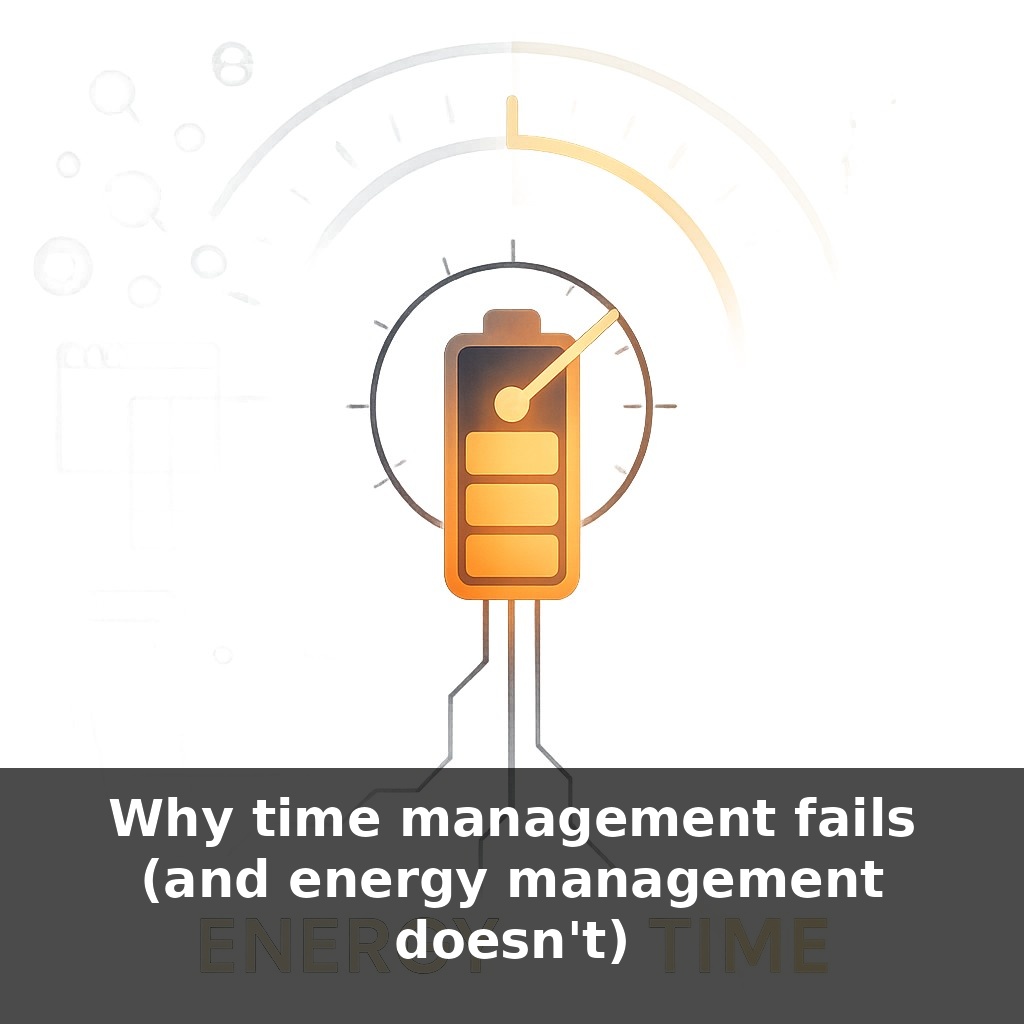
You’re probably wasting your best thinking hours on email. Research shows our brains are sharpest just a few hours after waking—yet that’s when many of us are in meetings. Picture two mornings: one drained by inbox pings, one spent on deep work. Same clock time, totally different results.
Most people try to fix their productivity by rearranging calendars, not by upgrading the “battery” that powers everything on those calendars. That’s why you can color‑code your week, hit inbox zero, and still end most days feeling fried and strangely unaccomplished. The problem isn’t your schedule; it’s the mismatch between *when* you do things and *how much* usable energy you actually have.
Look at your past week: how many hours were technically “available,” yet you were mentally lagging at 40% capacity? That gap is where traditional time management fails. Research from chronobiology and occupational health shows that your ability to focus, resist distractions, and make good decisions can swing dramatically in just a few hours. Two tasks may both take 60 minutes on paper, but in a low‑energy block one will cost you double the effort and produce half the quality.
Think of your day in three types of hours: high‑stakes (strategy, coding, writing), medium‑stakes (planning, 1:1s, problem‑solving), and low‑stakes (email, approvals, status updates). In a typical 9–6 day, you might only get 2–3 genuinely high‑stakes hours, 3–4 medium, and the rest low. Yet many calendars reverse this, stuffing mornings with low‑stakes work and pushing demanding tasks to 3 p.m. or later, when error rates are higher and rework quietly expands a “1‑hour” task into 90–120 minutes of slog and silent frustration. Energy management corrects that mismatch.
Most knowledge workers still plan days like a Tetris game: find an empty slot, drop a meeting in, repeat. Energy management starts from a different question: *what can my brain and body actually do well at 9:30 a.m. vs 3:30 p.m.?* The science says: not the same things.
Across studies, people’s capacity for complex reasoning, error detection, and creative insight varies by 20–60% within a single day. That’s not a small drift; it’s the difference between “this is trivial” and “why is this so hard?” In one experiment, judges gave significantly harsher rulings just before breaks than after—same laws, same cases, different energy states.
Three levers matter most:
1. **Biology (chronotype + cycles).** Roughly 80% of adults fall into “morning‑better” or “evening‑better” types. Add ultradian rhythms—90–120‑minute peaks and dips—and you get a repeating pattern: about 60–90 minutes of strong capacity followed by 20–30 minutes where quality quietly drops. Pushing through those dips doesn’t double output; it increases mistakes and rework.
2. **Task‑type fit.** High‑stakes work (architecture decisions, hard bugs, original writing) can demand 2–4× more cognitive resources than routine updates. A 45‑minute design review at 10:00 can replace three meandering 60‑minute reviews held at 16:00 across a week, just because the thinking is cleaner and the decisions stick.
3. **Recovery inputs.** Micro‑recoveries—5 minutes of walking, a snack with actual protein, two minutes of slow breathing—shift physiology in measurable ways. Higher HRV is associated with better adaptability; short breaks spaced every 60–90 minutes can keep HRV from crashing across the day. The NASA nap study (26 minutes → 26% alertness bump) is one extreme example; the same principle applies to smaller resets.
Now contrast two schedules with the *same* 8.5 hours:
- Schedule A: 9–12 meetings, 12–1 lunch at desk, 1–4 “real work,” 4–5:30 email. - Schedule B: 9–11 deep work, 11–12 meetings, 12–12:30 real break, 12:30–2 medium‑stakes work, 2–3 low‑stakes admin, 3–5 focused but lighter creation.
Total time is identical: 510 minutes. Yet teams that adopt patterns like B routinely see 10–20% more throughput and fewer defects, because they stop spending peak energy on low‑stakes tasks and stop attempting high‑stakes work in physiological “brownout” periods.
At one SaaS company, a 12‑person engineering squad ran a 4‑week experiment: 10:00–12:00 was reserved for “high‑stakes” work, 14:00–15:00 for “low‑stakes” tasks. No extra hours, just rearranged. Their metrics: code review turnaround dropped from 26 to 17 hours, defect density in new features fell 18%, and weekend Slack messages declined by 32%. Same team, same projects—different energy matching.
You can run a lighter version solo. For 5 consecutive workdays, block a single 90‑minute window when you *suspect* you’re most mentally effective. Protect it from meetings and notifications and assign exactly one demanding task that normally stretches across half a day. Track: (1) actual minutes to finish, (2) number of context switches, (3) quality issues you find in review. Then schedule a similar task in a known “slump” window and compare. Many people discover a 90‑minute high‑energy block beats 180 minutes of scattered effort.
Within 3–5 years, expect “energy calendars” to sit alongside your usual schedule. Wearables will flag red, yellow, and green zones based on sleep debt, HRV, and workload, then suggest *specific* blocks: 09:40–11:10 for coding, 14:20–14:35 for recovery. Early pilots in two European banks showed error rates dropping 17% when traders followed similar guidance. Your edge won’t be working more hours, but deploying your sharpest 120 minutes where they change results most.
Treat this as an ongoing systems upgrade, not a one‑week hack. Over the next 30 days, test just two changes: move one complex task into your best 90‑minute window, and insert a 5–10 minute reset before your worst slump. If, after 4 weeks, your error rate isn’t down ~10% or your output per hour up ~5%, adjust and retest—don’t abandon the experiment.
Start with this tiny habit: When you glance at your to‑do list in the morning, put a tiny lightning bolt (⚡) next to just ONE task that feels energizing instead of important. Then, spend exactly 3 minutes working on just the first micro-step of that energizing task (like opening the doc, outlining 2 bullet points, or sending 1 email) before touching anything “urgent.” After those 3 minutes, you’re free to go back to your regular schedule—no guilt, no pressure.