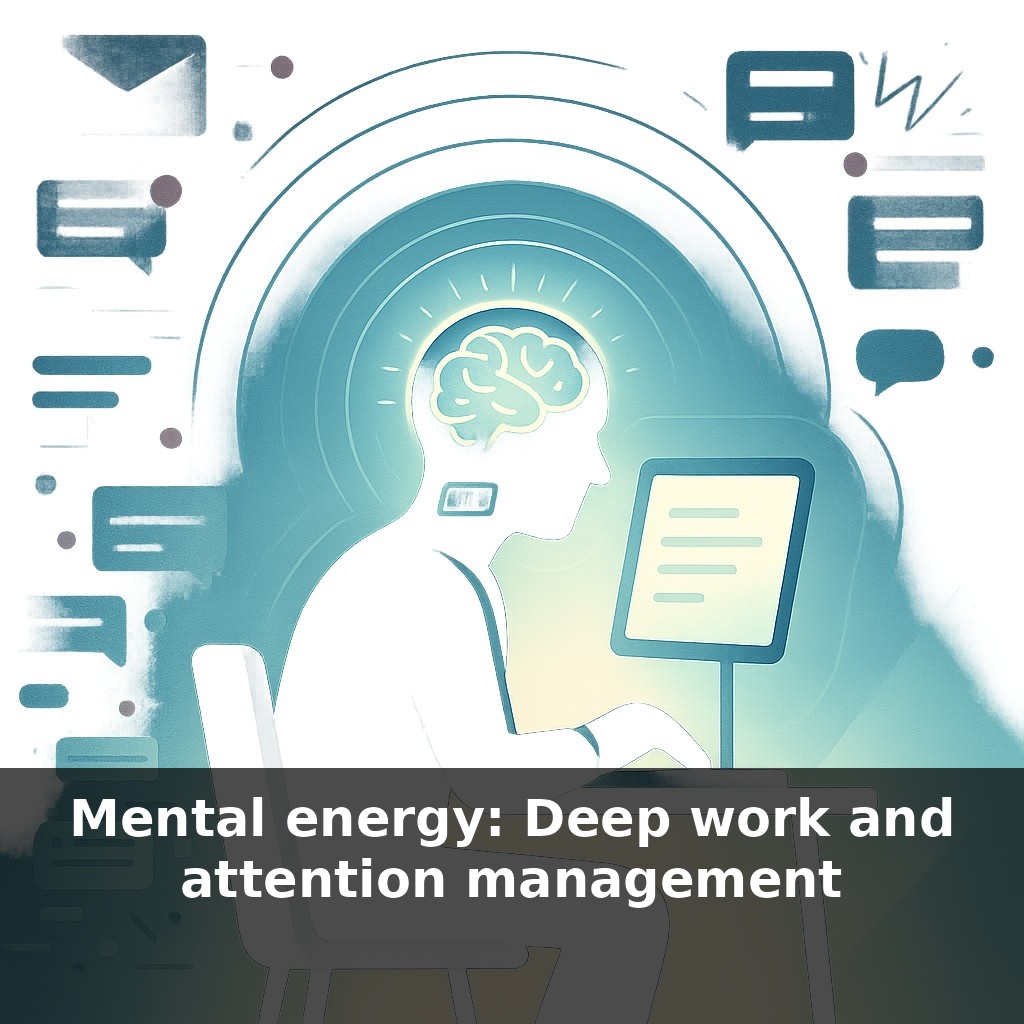
Your brain can burn through about a fifth of your body’s energy even when you’re just answering email. Now drop yourself into a day of nonstop pings, meetings, and open tabs. You feel busy every minute—yet your most important project never really moves. Why?
Cal Newport calls it “deep work”: long stretches of undiluted focus on a single, cognitively demanding task. But most days, your schedule is engineered for the opposite. The average knowledge worker checks email 77 times and uses 10+ apps a day. That’s not a personal failing—it’s an environment designed to splinter attention. The cost is measurable: a study from UC Irvine found that once interrupted, it takes about 23 minutes to return to full focus. Multiply that by a dozen interruptions and you’ve effectively deleted hours of high-quality thinking time without noticing.
Here’s the shift: instead of trying to “squeeze in” important work around messages and meetings, you’ll design your day around 60–120 minute focus blocks, and let everything else fit in the margins. In this episode, you’ll learn how to protect those blocks, prove their value with data, and make them a default—not an exception.
Your brain’s not just fighting distractions—it’s managing fuel. Functional MRI studies show that rapid task-switching burns more glucose in the prefrontal cortex without increasing output. That’s why a day of “small tasks” can leave you oddly exhausted. Meanwhile, time-tracking data from tools like RescueTime show that people rarely get more than 60–90 consecutive minutes on a single task. Add in the 28–33% of work hours lost to email and chat, and it’s clear: deep focus isn’t just a habit problem, it’s a systems problem. You’ll fix it by redesigning three levers: time, tools, and environment.
Deep attention is a logistics problem: you’re allocating scarce cognitive resources across competing demands. Start by quantifying those demands. Take a typical 8‑hour workday. If 2.5 hours go to email/IM (the 28–33% range), another 2 hours to meetings, and at least 1 hour to admin (forms, scheduling, status updates), you’ve already spent 5.5+ hours on low- to medium-intensity work. That leaves, at best, 2–2.5 hours for anything that requires real concentration—and that’s before interruptions.
So instead of vaguely “trying to focus more,” you’ll assign your sharpest mental slots to your hardest problems. Research on circadian rhythms and “chronotypes” shows that about 75–80% of people hit their cognitive peak within roughly 2–4 hours of waking, and then again in a smaller bump later in the day. If you burn that first peak in reactive work, you’re effectively doing your most important thinking with your second-best brain.
Here’s a concrete structure that fits inside most knowledge-work schedules:
- One 90-minute deep block during your natural peak - One 60-minute deep block later in the day - Two 25-minute “shallow sprints” for email and admin - Meetings batched into 1–2 clusters, instead of scattered
To make this real, you’ll constrain inputs. That means: turning off noncritical notifications for the 90- and 60-minute blocks; using “do not disturb” on your calendar; and pushing email into those two sprints instead of “always on.” It also means simplifying your tools. Each additional open app is a potential context switch. For a coding session, for example, you might allow only your editor, documentation, and a single browser window with a capped number of tabs (say 5). For writing, one document and one reference manager.
Think of your attention like a touring musician’s voice on a long run of shows: the pros don’t sing at full volume all day; they plan their sets, protect their recovery, and save peak effort for the moments that count most. You’ll do the same with your mental energy: design for 2–3 intentional “sets” of hard thinking, and treat everything else as support, not competition, for that work.
At a product team at Shopify, a manager ran a 4-week “focus sprint” with 12 engineers. They carved out 2 × 90‑minute blocks, 4 days a week, for their most complex tickets. They also capped Slack checks to 3 windows: 11:30, 14:30, 16:30. Bug resolution time for P1 issues dropped from a median of 14 hours to 9.5 hours, and the team closed 18% more story points without adding overtime.
You can treat your calendar the same way. Take a single high‑stakes deliverable—a report, prototype, or client deck. Estimate it needs 6 hours of deep attention. Instead of “finding time,” pre‑book four 90‑minute sessions over 7 days. In each, define a narrow sub‑goal: outline only, draft section A only, revise data only, polish visuals only. Track two numbers: minutes spent in uninterrupted focus and concrete output (pages written, test cases completed, slides finished). After one week, compare this to a similar project you tackled without this structure. The contrast in both speed and mental fatigue is usually stark.
By 2030, companies that treat attention as infrastructure will redesign a full workday. Expect norms like: 3–4 hours/day of meeting-free “maker time,” <2 meetings back-to-back, and explicit “no Slack” focus windows. Early pilots at large firms already show 20–40% faster project throughput when teams adopt shared deep-work blocks. Your edge: practice these habits now so when tools auto-schedule around your ideal focus patterns, you’re already operating at that higher standard.
Treat this as a data experiment. For the next 10 workdays, log one metric: minutes of *planned* focus vs. minutes *actually* protected. Aim for a 60% “kept promise” rate at first, then push toward 75%. Over a month, that’s roughly 30 extra high-value hours—enough to ship an MVP, write a 20-page brief, or close 3–5 stuck projects.
Here’s your challenge this week: Block off one 90-minute Deep Work session every day for the next 5 days, scheduled at the same time, and protect it like a meeting with your boss—no phone, no email, no tabs open except what you need for the task. Before each session starts, choose ONE cognitively demanding task (like writing a report, coding a feature, or designing a presentation) and commit to working only on that. During the session, every time you feel the urge to check something (email, messages, social media), put a tally mark on a sticky note instead of giving in, and keep going. At the end of the week, count your tallies and decide one distraction you’ll deliberately remove from your next week’s Deep Work sessions.