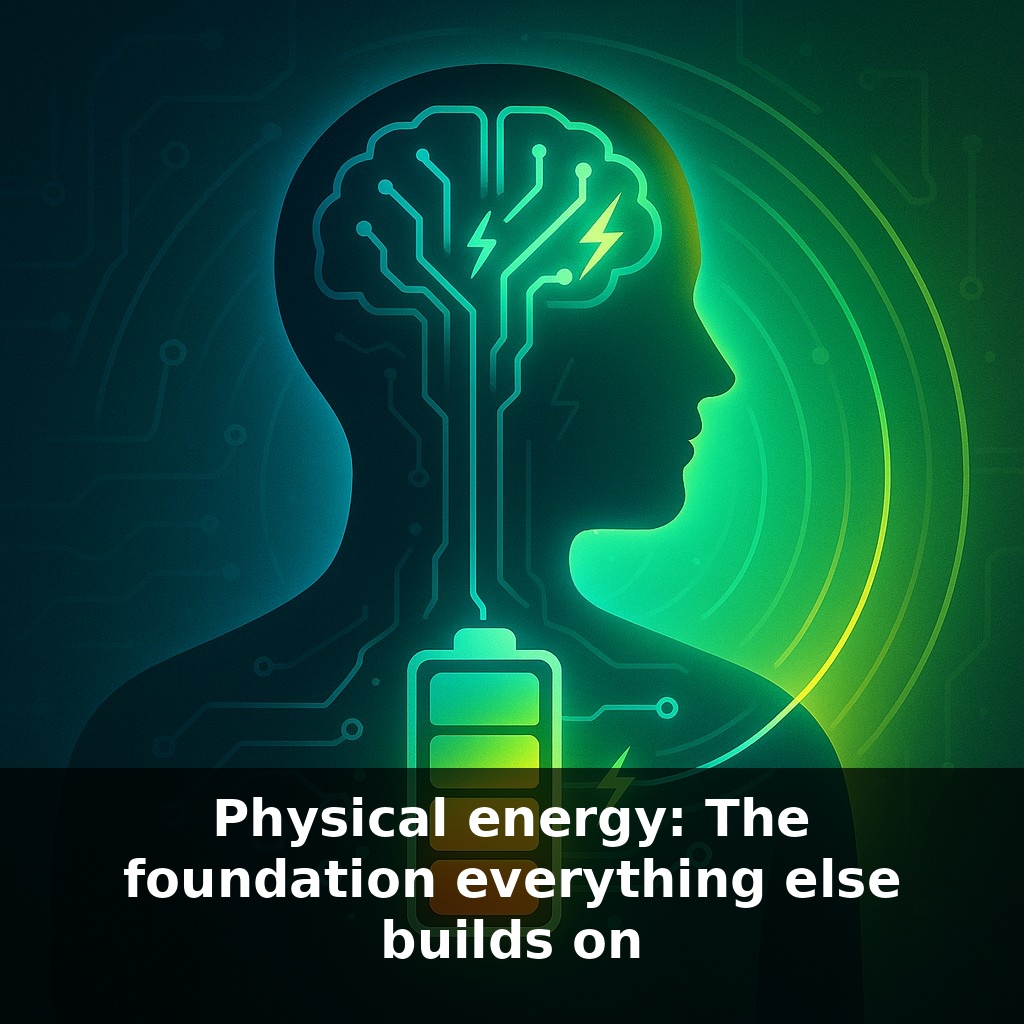
You don’t need more motivation. You need more voltage. Right now, your body is making and spending energy like a company that never checks its accounts. One skipped meal, one short night, one “I’ll exercise later”… and your brain is running on low-power mode all day.
Most people try to “push through” fatigue with willpower, caffeine, or guilt. Biologically, that’s backwards. Your cells either have the raw materials to create energy—or they don’t. At the smallest level, you’re running on ATP, tiny packets of chemical energy your mitochondria manufacture nonstop. When supply drops, your brain doesn’t care about your to‑do list; it starts quietly cutting costs: slower thinking, weaker self‑control, more cravings, less emotional stability.
Here’s the part most productivity advice skips: physical energy is not random. It’s predictable and trainable. With the right inputs, you can raise your daily energy “ceiling” just like you’d improve a fitness metric. Over the next episodes, we’ll focus on three controllable levers: nutrition timing and composition, sleep depth and consistency, and movement that upgrades—not drains—your system.
Here’s the frame for everything that follows: your body runs three linked “systems” that decide how much usable energy you have in any given hour. First, metabolic capacity: how efficiently you turn food into work. VO₂ max, for example, can jump 15–20% in 12 weeks, which is like upgrading your engine size. Second, resource quality: micronutrients, hydration, and glycogen stores; drop just 2% of body weight in water and mental performance can fall by 30%. Third, regulation: hormones and circadian rhythms that decide *when* you feel sharp or dull. We’ll target all three, systematically.
There’s a simple diagnostic question that cuts through the noise: “When, exactly, does my body *reliably* give me its best?” Not when you *wish* you felt great, but when you actually do. Most people can’t answer this with any precision—yet they expect consistent high output from a system they’ve never measured.
Start with hard boundaries. Your muscles can store about 2,000 kcal of glycogen, but that capacity is meaningless if you’re running half‑empty by 11 a.m. because you under‑ate, over‑caffeinated, or skipped fluids. Your brain pulls ~20% of your resting energy budget; even mild dehydration—just 2% of body weight—can cut perceived energy and cognitive performance by up to 30%. That’s the difference between sharp strategic thinking and staring at the same slide for 20 minutes.
Zoom out to weeks, not days. Adults who average 6 hours of sleep, compared to 8, show a 24–30% reduction in glucose clearance. Practically, that means the same breakfast produces a bigger blood sugar spike, a steeper crash, and more afternoon lethargy. No mindset trick compensates for this. Your “productive self” simply doesn’t come online as often.
Now add the training lever. A 12‑week aerobic block that raises VO₂ max by 15–20% doesn’t just help you on a treadmill test. It increases how much work you can do before you dip into those limited glycogen reserves and how quickly you recover between tasks. Think: back‑to‑back meetings without that 3 p.m. collapse.
Micronutrients are the quiet constraint. Around 25% of the global population is iron‑deficient; if you’re in that group, every cell is handicapped at the level of ATP synthesis and oxygen transport. The outcome feels vague—“I’m tired, unfocused”—so people blame laziness instead of a solvable bottleneck.
Here’s the shift: stop treating “tired” as a character flaw and start treating it as a data point. Over the next episodes, we’ll turn these biological limits into knobs you can adjust: when you fuel, how you hydrate, what type of training you choose, and how you align them with your natural daily peaks so high performance becomes the default, not the exception.
Think of two professionals with the same job and schedule. Person A wakes at 7, gulps coffee, first real meal at 1 p.m., sits 9+ hours, and collapses into bed at midnight. Person B wakes at 7, drinks 300–500 ml of water, eats 20–30 g of protein within 2 hours, walks 10 minutes mid‑morning and mid‑afternoon, and protects a 30‑minute wind‑down before 11 p.m. After 30 days, A still feels like every task is “hard.” B reports the same workload feels 20–40% lighter—not because of motivation, but because the body’s baseline has shifted.
Elite performers do this deliberately. Olympic endurance athletes often schedule 2–3 micro‑rests of 15–20 minutes between hard efforts to keep quality high. Top surgeons are obsessive about pre‑procedure routines: specific meals, hydration targets, and sleep the night before a long case. They’re not chasing “hacks”; they’re standardizing the conditions under which their system produces its best results, then defending those conditions like they’re non‑negotiable meetings.
Your challenge this week: run a 7‑day “energy conditions” experiment. Each evening, score your physical energy for the day from 1–10. Then log *only three* variables:
1) Wake time and bedtime (to the nearest 15 minutes) 2) First calorie intake after waking (time + rough size: “small/medium/large”) 3) Total walking minutes outside of “incidental” steps (e.g., deliberate 5–10 minute walks, note how many)
At the end of 7 days, circle the *two* days with the highest energy scores. Ask:
- What was consistent about sleep timing on those days? - How soon after waking did you eat something non‑trivial? - How many minutes of deliberate walking did you get?
Then, design a “repeatable conditions” template for yourself for the next week: one target wake/bed window (e.g., 11 p.m.–7 a.m. ±30 minutes), one default first‑fuel window (e.g., within 90 minutes of waking), and one walking minimum (e.g., 15 minutes before lunch, 10 minutes mid‑afternoon).
You’re not aiming for perfection; you’re testing how much control you already have over the hours when your system naturally runs hottest—then making those hours less accidental.
Treat your body like a system you can instrument. In the next decade, consumer tools will move from “steps and sleep hours” to real‑time load management. You might get a prompt at 2:10 p.m.: “Based on the last 14 days, a 7‑minute walk plus 300 ml water now raises your 4–6 p.m. output by 18%.” Teams could schedule deep‑work blocks only in each member’s top 2‑hour window, measured over 30 days, cutting meeting bloat by 20–30% while raising meaningful work per person.
The payoff for instrumenting your body is leverage. Shift just 3 variables by 10%—bedtime consistency, daily steps, and fluid intake—and most people see a 15–25% bump in usable hours each week. That’s like gaining an extra workday without working longer. Treat those gains as budget: pre‑assign your best 90 minutes to the hardest problem you care about.
Try this experiment: For the next 3 days, set a timer for a 10-minute “energy block” right after your first meal, and do brisk walking or light mobility drills (hip circles, arm swings, toe touches) instead of scrolling or working. Before you start, rate your physical energy from 1–10, then rate it again immediately after and once more 90 minutes later. Keep your caffeine, bedtime, and wake time the same as usual so you can really see how this one change affects your focus, mood, and afternoon crash. If your energy scores consistently bump up by at least 2 points, you’ve found a simple, repeatable lever for physical energy you can lock in as a daily ritual.