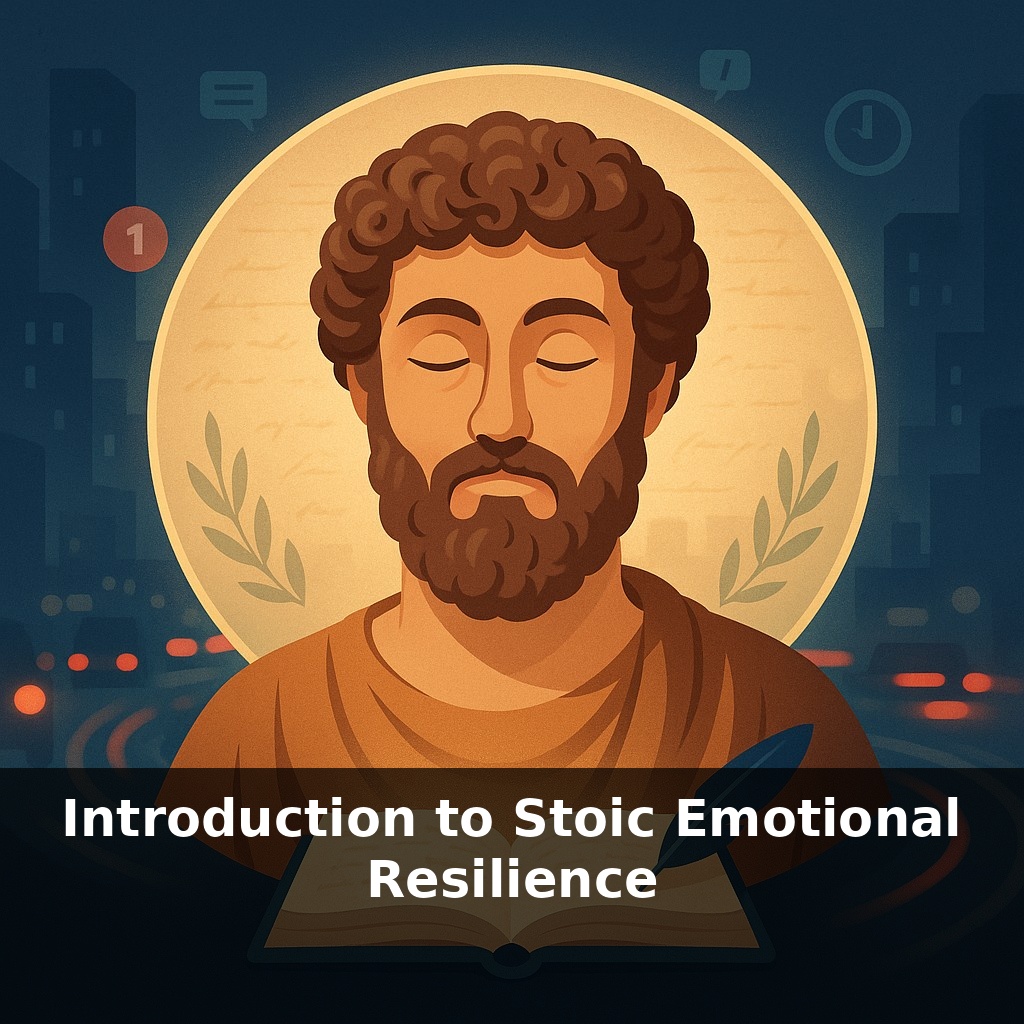
Introduction to Stoic Emotional Resilience
📝 Transcript
A Roman emperor kept a private journal so raw and honest it’s guided soldiers, CEOs, and therapists for nearly two thousand years. Now, you’re stuck in traffic, deadline looming, pulse racing. Same species, same stress system. What did he know about staying steady that we don’t?
Marcus Aurelius wasn’t writing for history; he was writing to stop himself from snapping at people, panicking in crises, or drowning in anger and regret. That’s the core of Stoic emotional resilience: not a grand philosophy for ivory towers, but a practical toolkit for “not losing your cool” when life gets loud and unfair.
Stoicism starts with a sharp move most of us skip: separating what’s truly ours to shape from what isn’t. Your reputation? Partly outside. Your effort and honesty in this hour of work? Completely inside. That split sounds abstract, but it quietly changes everything from how you answer an aggressive email to how you cope with layoffs, illness, or uncertainty.
In this episode, we’ll unpack what the Stoics actually trained—clear perception, grounded judgment, and deliberate action—so emotions become signals to work with, not storms that run your day.
Modern research quietly backs up what those old philosophers were doing. Psychologists talk about “locus of control”: people who focus on what they can influence tend to cope better and feel less helpless. Military survival courses, elite sports teams, and leadership programs borrow similar drills: rehearsing worst-case scenarios, reframing setbacks, training calm responses under pressure. Stoic practice fits right into this: it treats emotional steadiness as a skill you condition, the way a musician repeats scales—not to avoid mistakes, but to recover faster when they happen.
When people first hear “Stoic resilience,” many assume it means clamping down on feelings. The ancient sources show almost the opposite: they cared obsessively about *how* emotions start, grow, and can be redirected.
A Stoic sees every emotion as beginning with a “first impression”: a flash of “this is bad,” “this is a threat,” “this is an insult.” That flash is automatic; the choice comes a split-second later—do you sign off on it, or question it? The anger, panic, or shame that follows isn’t just caused by what happened, but by the story you silently told yourself about what it meant.
That’s where techniques like negative visualization come in. Instead of only hoping things go well, you deliberately rehearse losses, delays, criticism, even illness—not to wallow, but to puncture the illusion that these possibilities are unthinkable. When you’ve already pictured a project failing, or a relationship ending, and asked, “How would I respond with dignity if this happened?”, the real event lands on prepared ground. You still feel pain, but less shock and less “this *cannot* be happening.”
The same goes for voluntary discomfort. Skipping a comfort, taking a cold shower, walking instead of driving—those small, safe frictions train a quiet confidence: “I can handle less than perfect conditions.” Over time, this shrinks the distance between “how life is” and “how I demand it to be,” and that gap is where a lot of frustration lives.
Notice how this approach differs from endlessly venting or endlessly distracting yourself. Instead of trying to erase difficult feelings, you turn toward them with curiosity: What exactly am I afraid of losing? What standard am I secretly enforcing? Is this truly in my hands, or partly in the hands of time, chance, and other people?
Think of it as learning to hike in variable weather rather than waiting for the perfect forecast: you pack better, watch the sky more closely, and stop treating every dark cloud as a personal attack. You still get wet sometimes; you just don’t quit the trail at the first drop of rain.
You can test this in the most ordinary frictions of your day. A delayed train, a colleague missing a deadline, a friend replying curtly to your text—each is like a small bell ringing, asking, “What story are you about to tell yourself about this?” One person reads “They don’t respect me” and spirals; another reads “They’re having a rough day” and moves on. Same event, different inner script, radically different evening.
Negative visualization and voluntary discomfort become easier when tied to concrete roles you care about. As a parent, you might briefly rehearse a teen rejecting your advice—and picture yourself responding with patience rather than defensiveness. As a manager, you might walk through a worst-case presentation flop, then design how you’ll own the mistake and repair trust.
This way, you’re not trying to become unfeeling; you’re drafting better “if-then” responses, so when tension hits, your values have already spoken before your impulses do.
The next frontier is making this inner work more visible. Wearables already flag raised heart rate; soon they may pair that spike with a prompt like, “Pause: What are you adding to this event?” Remote workers could get end‑of‑day “reaction maps” that show which meetings or messages most pulled them off‑center. Over months, you’d watch your reactivity shrink like a retreating tide, while steadier patterns of response gradually come into view as your new emotional coastline.
Treat this as ongoing fieldwork on yourself. Each surge of irritation, worry, or envy is fresh data: proof that your mind is still rehearsing certain plots. With practice, you become both actor and director—able to stay in the scene *and* adjust the script—so daily hassles turn from pure noise into clues about what to refine next.
Start with this tiny habit: When you notice a small irritation (like a delay, a rude comment, or a tech glitch), quietly say to yourself, “This is outside my control,” and take one slow breath in and out. Right after that breath, ask yourself one super-specific Stoic question: “What’s the smallest thing I *can* control here—my words, my tone, or my next move?” Then choose just one of those (often your tone) and adjust it by 1%—softer voice, slower reply, or simply pausing before you speak.
From this course
Everyday Stoicism: Mastering Emotional Resilience
8 episodesUnlock all episodes
Full access to 8 episodes and everything on OwlUp.
Subscribe — $1.99/monthLess than a coffee ☕ · Cancel anytime