One ancient book was once required reading for future Navy officers—and modern therapy is now proving it was onto something. A single thought like “I’m a failure” can spike your heart rate, while a small shift in wording can calm your whole body. So what’s really in charge: feeling or thinking?
Epictetus claimed, “Men are disturbed not by things, but by the views which they take of them.” For centuries that sounded like philosophy’s opinion. Now, lab data is quietly backing him up.
When researchers train people in “cognitive reappraisal” for just eight weeks, their heart-rate variability—an indicator of how flexibly the body responds to stress—can improve by nearly 18%. That’s not just feeling a bit better; that’s the nervous system learning a new rhythm.
Stoics weren’t promising a life without strong emotions. They were proposing a skill: to notice the split-second story the mind adds to events, and to reshape that story so it serves your values instead of hijacking them. Think of it less like suppressing a storm and more like learning to sail in rough water—same waves, different response, much more control over where you end up.
Modern CBT researchers went one step further than the Stoics: they catalogued the most common thinking patterns that reliably stir up distress. Not external disasters, but inner habits like catastrophizing (“this will ruin everything”), mind-reading (“they all think I’m incompetent”), or all‑or‑nothing thinking (“if I’m not perfect, I’m useless”). Each is like a smudge on a pair of glasses: the world hasn’t changed, but what you see has. The power move isn’t to “be positive,” but to see the smudge clearly enough that you can clean it—and then decide, on purpose, how you want to respond.
Here’s a practical twist: the Stoics weren’t content with merely spotting distorted thoughts—they treated them like hypotheses to be field‑tested.
Modern therapists do something similar using what’s called a “thought record.” You don’t just write “I’m terrible at my job” and then slap on a happy slogan. You break the episode into parts: situation, automatic thought, emotion, evidence for, evidence against, and a more balanced conclusion. It’s closer to how a good scientist works than how a motivational poster sounds.
Epictetus would have approved. He urged students to interrogate impressions: “Wait, let me see what you are, and where you come from.” Instead of fusing with a thought, you put it on the table and turn it over. Is it a fact, or a prediction? A memory, or a story built around the memory? Just that tiny bit of distance often softens the emotional spike enough that you can choose a response instead of being dragged by one.
CBT refines this with patterns like “should” statements (“I should always be calm”) or labeling (“I’m a loser”), then asks: compared to what? Based on which standard? If a friend used this logic on themselves, would you call it fair—or brutal? That perspective shift matters; people are surprisingly better at spotting irrationality in others than in themselves.
Over time, this kind of questioning trains a quiet inner editor. The first thought still appears, but it no longer gets automatic approval. It has to pass a brief review.
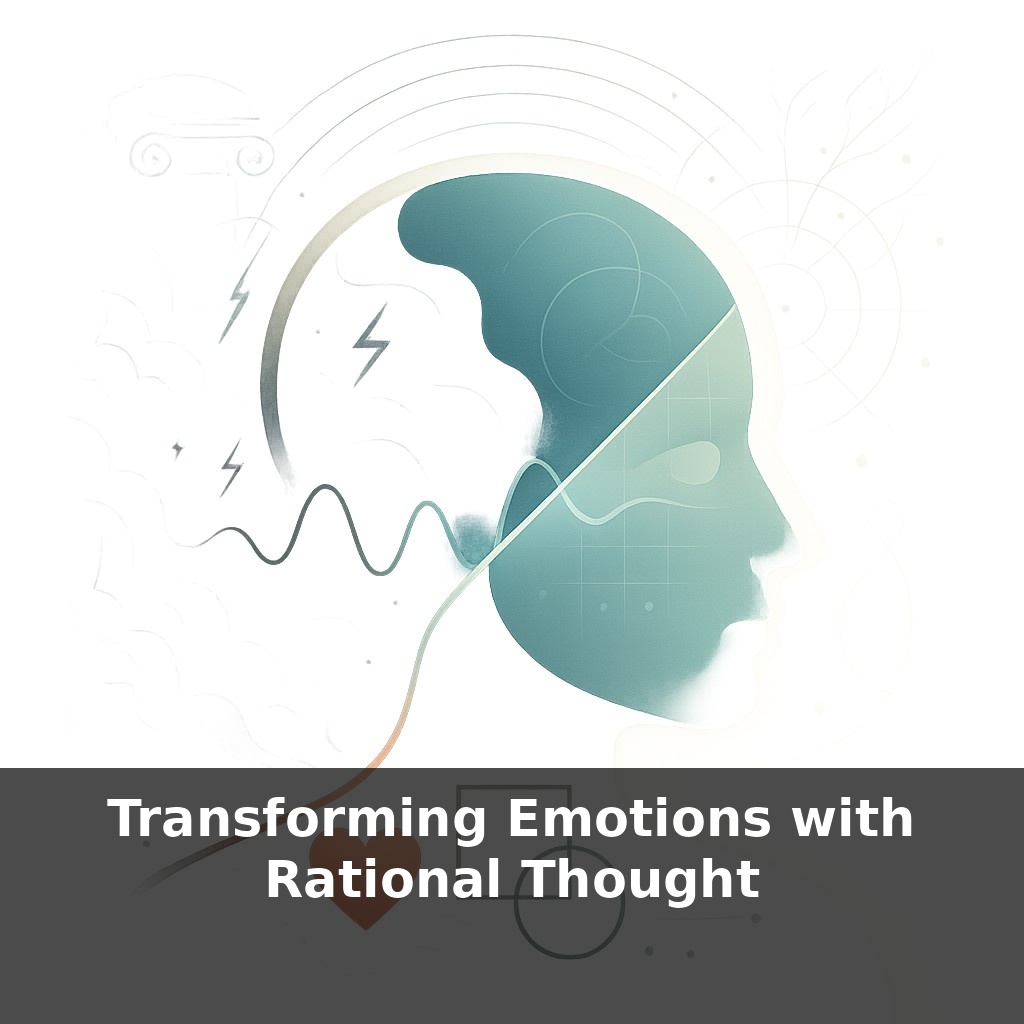
Think of the mind as an airport: emotions are incoming flights that can’t be stopped, but rational thought is the control tower that directs each plane to land safely instead of crashing on the runway. The Stoic‑CBT approach isn’t to shut down air traffic; it’s to prevent one panicked arrival from turning into a pileup.
Crucially, this doesn’t erase feeling. When you challenge the belief “If I’m criticized, it means I’m worthless,” what tends to remain is a cleaner signal: “That feedback stings because I care about this work.” The noise drops. The message sharpens. And instead of defending your worth, you can decide—calmly—what to improve next.
You’re in a tense meeting. Your manager frowns at your slide and says, “This section isn’t clear.” The auto‑thought fires: “I’m screwing this up; they’ll never trust me again.” Your chest tightens, your focus narrows, and suddenly you’re defending every tiny detail instead of listening. Now rewind the same scene with a different inner response: “That landed badly. Good—now I know what to sharpen.” Same words from your manager, but your next move changes: you ask a clarifying question, jot notes, and leave with a concrete edit list instead of a shame spiral.
Or take a friend who replies to your long message with a single “k.” Version one of your story: “They’re annoyed; I’m too much.” You pull back for days. Version two: “Could be busy; if it matters, they’ll say so.” You carry on with your day and check in later if needed. In both cases, the external trigger is tiny. The inner commentary is where the emotional weight—and your real leverage—lives.
As brain‑computer interfaces mature, they may flag distorted thoughts the way browsers warn about unsafe sites—“This belief looks exaggerated; review before proceeding?” Classrooms could treat mental habits like languages: kids practicing daily “translations” from raw reaction to reasoned response. Over decades, cultures might evolve shared norms for reality‑testing emotion, the way we now expect people to fact‑check news, making inner clarity a collective civic skill.
Your challenge this week: when a strong emotion hits, pause long enough to name one concrete value you want to protect—respect, learning, honesty, connection—then let that value pose a single question: “Given what I care about, what’s my next move?” Over time, it’s like tuning a guitar: less random noise, more deliberate music shaping each response.