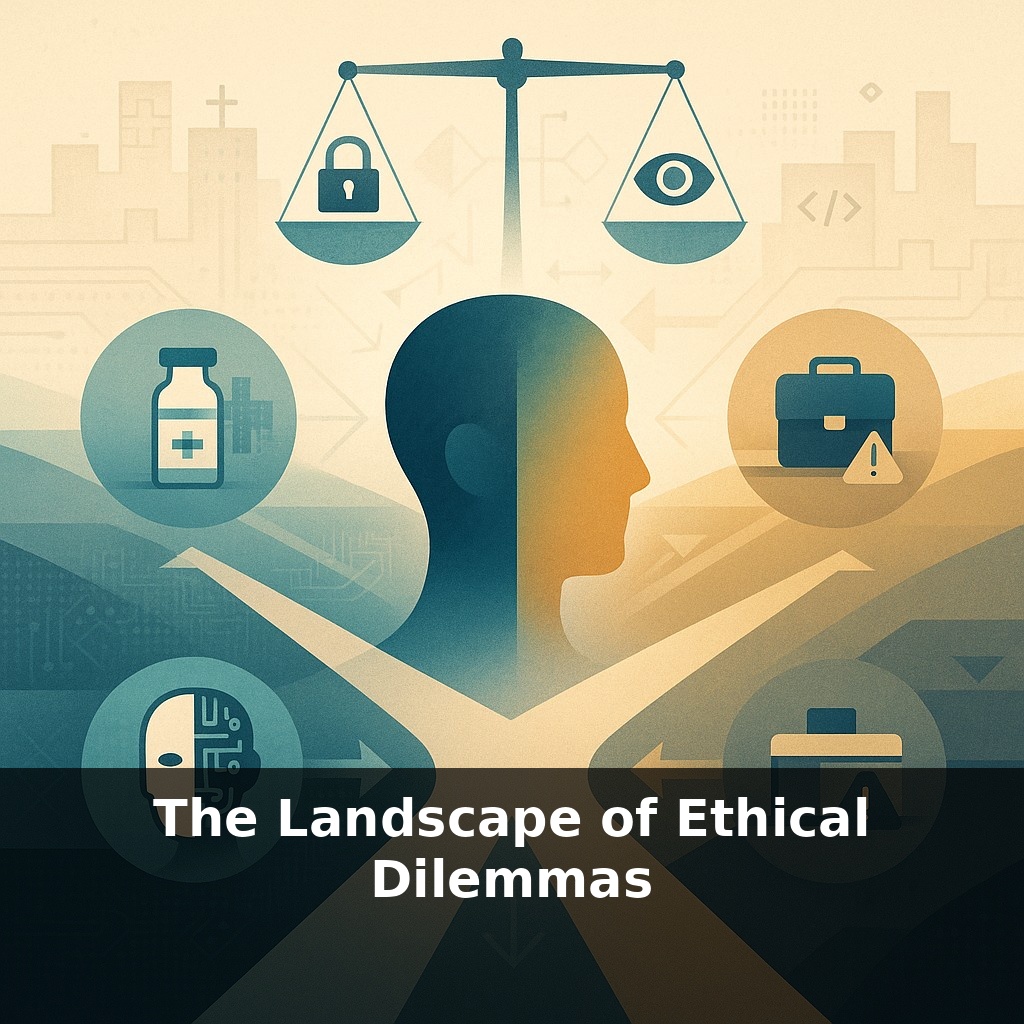
The Landscape of Ethical Dilemmas
📝 Transcript
About half of workers say they’ve seen something at work that felt wrong—but many stayed silent. Now drop yourself into three moments: a doctor with one vaccine left, a manager spotting quiet fraud, a coder training biased AI. Which “right thing” wins when rights collide?
Ethical dilemmas don’t just show up in dramatic crises; they creep into routine choices that feel annoyingly “gray.” You’re weighing privacy against transparency when you’re deciding whether to copy your boss on a sensitive email. You’re juggling fairness and loyalty when a close colleague breaks a minor rule. You’re torn between honesty and kindness when feedback could hurt someone who’s already struggling.
Philosophers give us tools, but they don’t hand out answer keys. One framework pushes you to ask, “Who will be helped or harmed?” Another insists, “What rule must I refuse to break?” A third circles back to, “Who am I becoming if I choose this?”
In real life, culture, law, and technology twist these questions into new shapes. Deepfakes, data leaks, and algorithmic bias add layers of uncertainty—forcing us not just to choose, but to justify how we chose.
Now the landscape gets messier: legal codes, company policies, and public opinion all layer onto your personal compass. A social media manager weighs brand image against giving an unfiltered apology. A nurse confronts hospital rules when a family begs for more information. A product designer must choose between a lucrative dark pattern and a clearer, slower-selling interface. Add AI systems that learn from flawed data, and you’re no longer just deciding for yourself—you’re shaping defaults that quietly steer thousands of future choices.
Ethics gets especially tense when values stop being abstract and start costing something concrete: time, money, reputation, influence, even your job. That’s when “I value X” quietly turns into “I value X…unless it jeopardizes Y.” The real landscape of dilemmas is mapped not by what people say they believe, but by what they’re willing to lose for those beliefs.
Consider three recurring fault lines. First, outcome versus principle. A safety engineer might be urged to “accept a small risk” so a product launches on schedule, knowing a delay could hurt the company and its employees. They’re not just weighing numbers; they’re deciding whether any level of preventable harm is acceptable under pressure.
Second, loyalty versus broader responsibility. A research lead discovers data massaged to make a drug look slightly better. No one is dying, and colleagues insist it’s “within norms.” Reporting it could crater years of work and damage relationships. Not reporting it could mislead regulators and patients. The conflict isn’t between good and evil; it’s between competing goods.
Third, short-term relief versus long-term integrity. A government official might soften a report to avoid public panic, hoping to “fix things quietly.” But temporary calm can plant seeds of deeper distrust if the truth later surfaces. Many scandals start as attempts to “protect” people from discomfort.
These conflicts aren’t isolated. They’re shaped by the systems around you. The survey numbers showing more people speak up when strong ethics programs exist hint at something crucial: we’re braver when we’re not alone. Codes of conduct, ombuds offices, and clear whistleblower protections don’t replace moral judgment, but they change the risk calculation behind using it.
Technology multiplies both stakes and speed. When a single tweak to an algorithm can tilt loan approvals, bail decisions, or medical triage, hesitation has real-world fallout. Yet rushing can lock in bias. That’s why so many countries are drafting AI ethics guidelines: they’re trying to slow down certain choices just enough that people can see the trade-offs before they harden into infrastructure.
Your own landscape is a network of these pressure points: bosses, peers, users, laws, headlines. The question is less “What is the rule?” and more “Where does pressure quietly bend my rule, and when do I refuse to bend?”
A junior lawyer is asked to “clean up” a contract that quietly shifts more risk onto a small vendor. No law is clearly broken, and a promotion hangs in the balance. The choice isn’t between legal and illegal; it’s between being the kind of professional who exploits gray areas and one who pushes for informed consent.
A game designer sees data showing that late-night players spend more after a certain fatigue point. Marketing wants pop-ups tuned to that window. On paper, revenue climbs. Off paper, some players are students or people already in debt. The dilemma sits in how much you’re willing to benefit from someone else’s weakened judgment.
A researcher training a health app notices that the model underperforms for a minority group because there’s less data. Shipping now helps many, but leaves some at greater risk of misdiagnosis. Waiting means delaying care tools for thousands. The question becomes: when is “good for most” good enough to act—and what do you owe to those left out?
Looming choices will rarely announce themselves as “big moral moments.” They’ll show up as interface tweaks, hiring shortcuts, quiet data uses, gene edits for “just this one condition.” As tools grow more powerful, your influence stretches further from your direct line of sight—like planting seeds in someone else’s garden. You may never see what grows, but you helped shape the soil. That distance can numb responsibility or sharpen it, depending on what habits you’ve built now.
Ethics rarely offers tidy endings; it’s more like learning to read shifting weather than following a fixed map. New roles, like Chief Ethics Officers, and AI guidelines are early trail markers, not final destinations. Your challenge this week: notice one small choice each day where comfort pulls one way and conscience another—and pause long enough to name that tension.
From this course
Facing Ethical Dilemmas: A Personal Journey
5 episodesUnlock all episodes
Full access to 5 episodes and everything on OwlUp.
Subscribe — $1.99/monthLess than a coffee ☕ · Cancel anytime