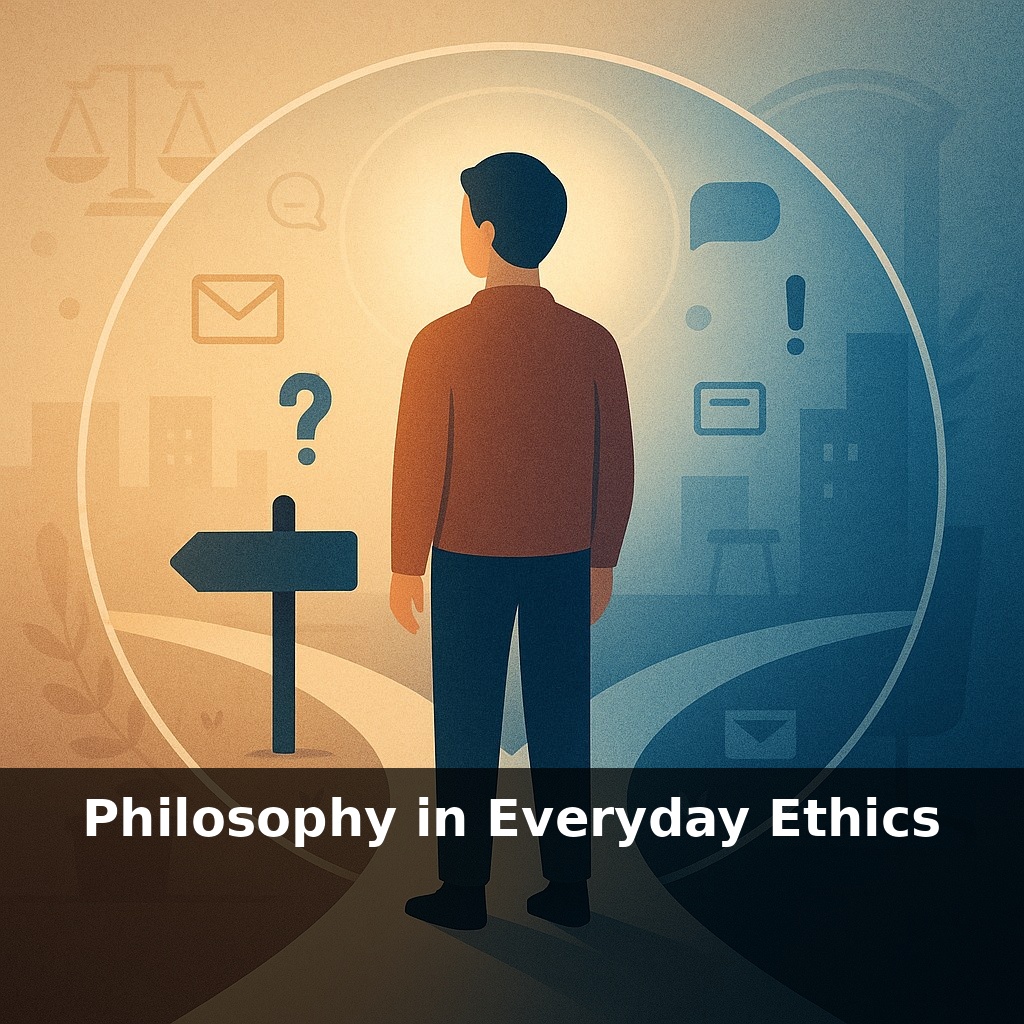
A judge once asked a defendant, “If everyone did what you did, what kind of world would we live in?” Now jump to your day: choosing whether to report a small mistake at work, bend a rule for a friend, or ignore a coworker’s crude joke. In each moment, you’re quietly answering that same question.
You already do philosophy every time you choose between replying to a harsh email or cooling off first, sticking to a promise or backing out when it’s inconvenient, closing a browser tab that feels “off” or letting curiosity win. Those split-second choices quietly reveal what you *really* value: rules, results, character, relationships, or agreement with others.
This series takes five big traditions—duty, outcomes, character, care, and fair agreement—and presses them right up against ordinary life: group projects, family obligations, social media, office politics, and how your purchases affect people you’ll never meet.
Instead of hunting for a single perfect answer, we’ll treat these philosophies like distinct “lenses” you can swap in and out, testing how each one sharpens or distorts the situation in front of you.
Think about your last ordinary disagreement—over splitting a bill, reusing a password, or working late “just this once.” Under the surface, you were likely negotiating between several quiet voices: one warning “that’s not right,” another asking “who gets hurt,” another asking “is this who I want to be.” Classical and contemporary thinkers have spent centuries sharpening those voices into tools you can actually use. In this episode, we’ll trace how ideas from Aristotle, Kant, Mill, care theorists, and contractualists already shape workplace policies, friendships, online behavior, and even how you judge strangers’ choices.
Walk through a single, ordinary choice and you’ll see the major traditions quietly lining up with different questions.
You open your inbox and find a client has drastically overpaid an invoice. No one else has noticed. Keeping the extra money would smooth over budget stress this month. Returning it means more hassle, awkward emails, and maybe your manager asking hard questions.
One approach presses you to ask: “What rule would I be willing for any honest professional to follow here?” Another: “If I keep it, who’s better or worse off in the long run—me, my team, the client, our industry?” A third: “What kind of professional am I becoming if I normalize tiny pockets of dishonesty?” A fourth: “How would this land in the client’s world—on their stress levels, their trust in us, their sense of being respected?” And a fifth: “Could reasonable people, given the same information and power, accept a norm that allows me to quietly benefit from their mistake?”
You don’t need to name the theories to feel their pull. Each one highlights a different *risk* you run if you ignore it: betraying consistency, causing harm, eroding integrity, neglecting relationships, or exploiting unfair advantage.
Organizations build all of this into structures. Hospital ethics boards wrestle with resource allocation using outcome-focused tools alongside concern for vulnerable patients. Corporate codes of conduct write down rules about conflicts of interest, then supplement them with values statements about integrity and inclusion. Environmental pledges—like Patagonia’s long-standing commitment to funnel profits into climate efforts—signal a willingness to treat the planet and future generations as moral stakeholders, not just externalities in a spreadsheet.
Even your phone nudges you into these frameworks. The “report” button on a social platform invites you to weigh harm to others. Privacy settings invite you to think about what strangers may reasonably expect you *not* to do with their data. Content warnings and “are you sure you want to post this?” prompts quietly assume that a moment’s reflection on who might be hurt can change behavior.
The more fluent you get with these different questions, the less you’re stuck with “I just had a feeling” and the more you can say, “Here’s the kind of world this choice is building—and whether I can live with that.”
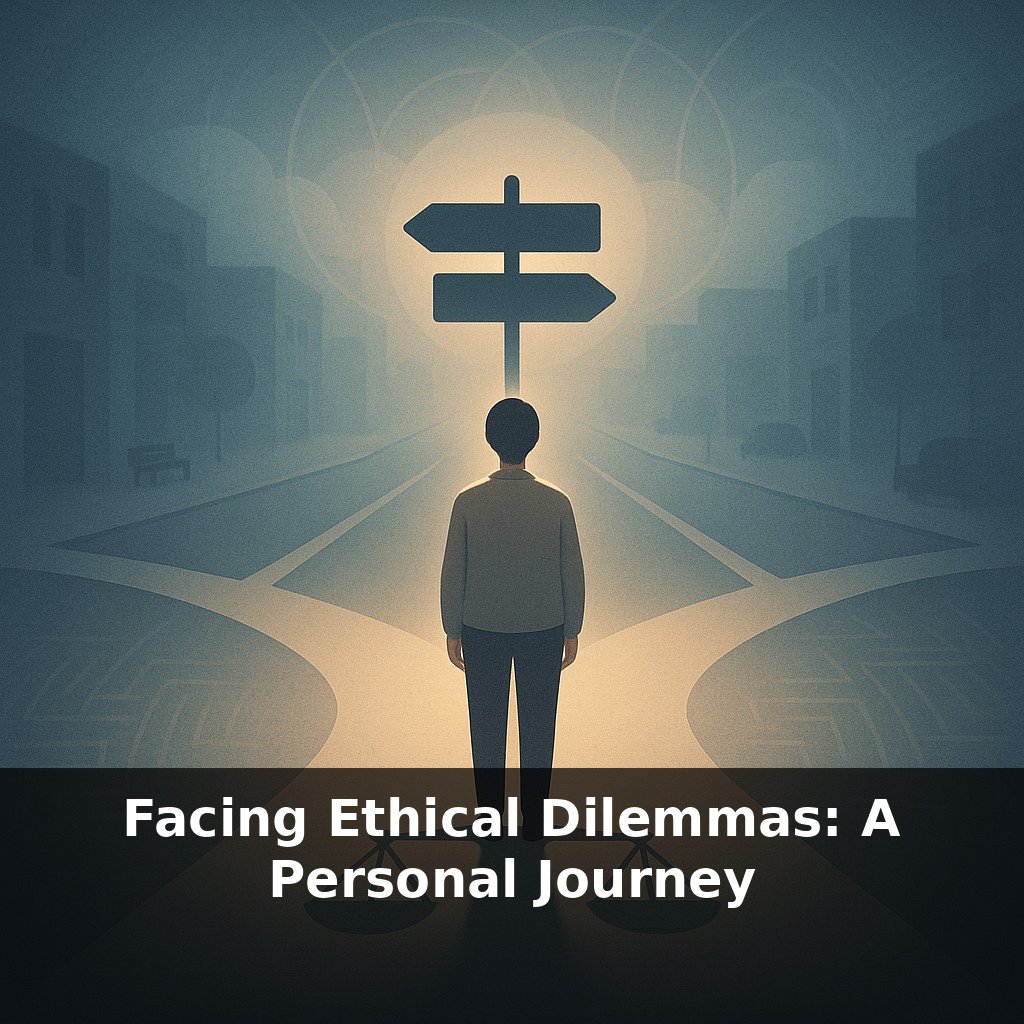
You’re scrolling through an online store and see a “too good to be true” deal from a sketchy-looking seller. That tiny hesitation—click or close?—is the same crossroads you hit when a friend asks to “borrow” your streaming login, or when you consider tossing a recyclable cup into the trash because the bin is farther away.
Think of these as micro-experiments in everyday ethics. When you weigh whether to ghost a group chat instead of saying you’re overloaded, you’re not just managing awkwardness; you’re testing what you treat as non‑negotiable, what trade‑offs you’ll accept, and whose perspective “counts” in your head.
A team meeting can turn into a live lab: one colleague argues for “following policy,” another for “what helps the most people,” another for “being decent to the intern stuck with the fallout.” You’re quietly choosing which of those pulls gets priority—and noticing which one you habitually ignore.
Your future ethical calls may be shared with machines. As cars learn when to brake and platforms learn what to hide, our scattered instincts become training data. If only one style of reasoning dominates those datasets, its blind spots harden into code. Schools and workplaces are quietly reacting—bringing diverse ethical questions into design reviews and project briefs—so tomorrow’s systems inherit debate, not dogma, and can flex when new dilemmas appear.
Ethics won’t hand you a perfect script; it’s more like a set of instruments you’re still learning to play. Some days you miss notes, other days the melody clicks. Over time, patterns emerge: which notes you avoid, which you lean on. Paying attention there is where growth hides—not in always being right, but in getting more curious about why you chose that path.
Start with this tiny habit: When you catch yourself making a quick judgment about someone (like a coworker, stranger on the street, or family member), silently ask yourself, “What might be the best version of their story?” and imagine one generous explanation for their behavior. The next time you’re about to click "buy" on something non-essential, pause for one breath and ask, “Would I still choose this if I had to explain my reasons to a thoughtful friend?” At dinner or during a snack, take just one bite and briefly wonder, “Who all had to be involved for this to get to my plate?” and picture one real person in that chain (a farmer, driver, or grocery worker).