Awakening the Inner Leader
📝 Transcript
You’re probably not leading your own life as much as you think. Research suggests only a small slice of people actually see themselves clearly. Yet your tone in one hard conversation, or one small choice at lunch, can quietly steer the whole “team” of your day in a new direction.
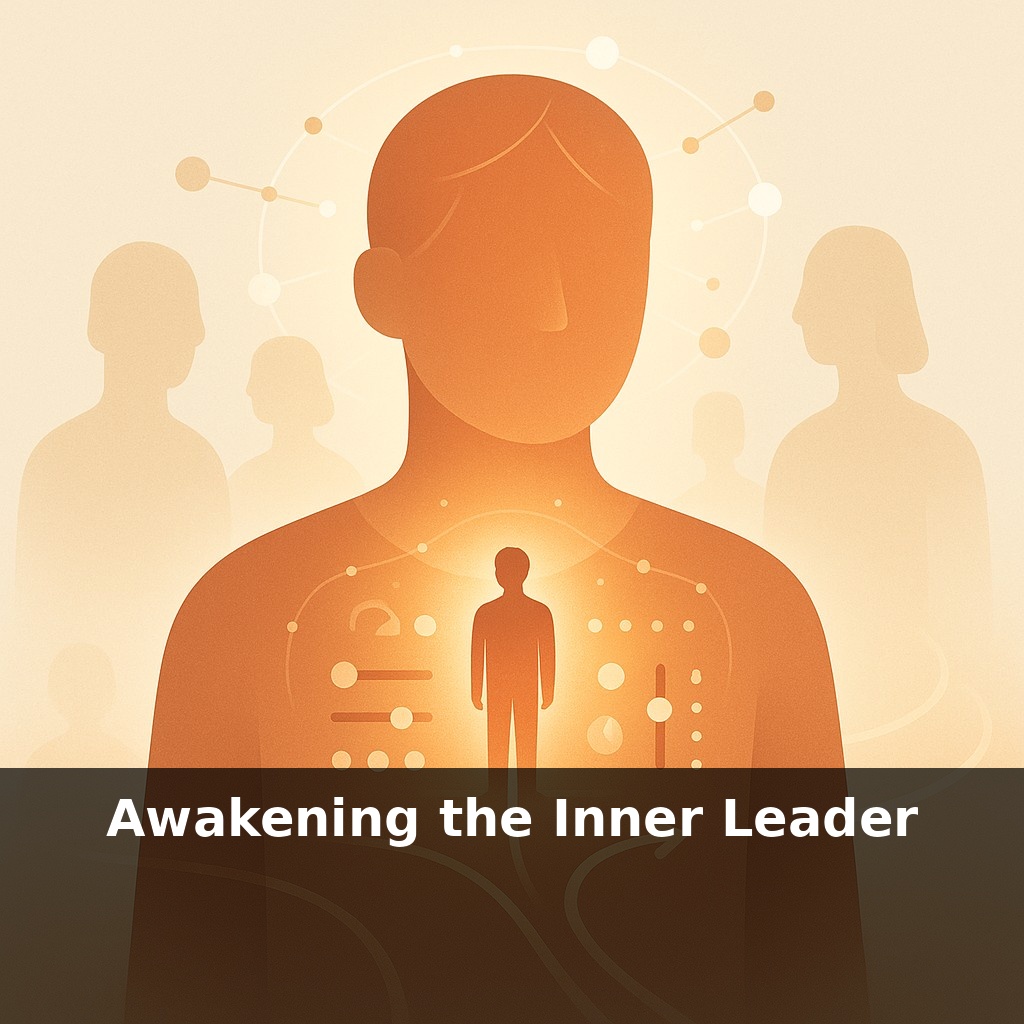
Leadership, in this series, isn’t a job title; it’s how you direct your inner “command center” when no one’s watching. Modern research is blunt about this: people who train their inner world—thoughts, emotions, habits—end up shaping their outer world more effectively, whether they’re running a company or just trying to have less awkward Friday nights. Psychology and neuroscience now show that skills like emotional regulation and a growth mindset aren’t personality traits you’re stuck with; they’re more like languages you can become fluent in with practice. That’s what “awakening the inner leader” really means: deliberately building the mental muscles that let you stay grounded in a tough social moment, curious instead of defensive in conflict, and steady enough to guide a room’s energy instead of absorbing it. In this episode, we’ll turn that from theory into something you can actually train.
Most people try to “fix” their social life from the outside—collecting scripts, hacks, or confidence tricks—while the real leverage sits quietly on the inside. The data is blunt: only a fraction of us see ourselves accurately, yet those who do handle complexity better, bounce back faster, and bring out more in others. Instead of forcing yourself to be “more social,” you’ll get farther by learning to notice what actually happens inside you right before you go quiet, ramble, or overthink. Think of this as shifting from judging your reactions to getting curious about them, like a scientist running a live experiment in real time.
When you think about “being more social,” your attention usually jumps outward: who to talk to, what to say, how others see you. Inner leadership flips the camera angle. It asks: What’s happening inside you in the 5 seconds before you decide, “Nope, I’ll just stay quiet”?
Those 5 seconds are where your real leverage lives.
Psychologists would call this a micro-moment: the tiny, often invisible gap between a trigger and your response. In social situations, triggers might be a new person joining the group, someone glancing at their phone while you talk, or a pause in conversation that feels a bit too long. Your body reacts first—tight chest, faster heartbeat, a rush of heat in your face—then your mind scrambles to make sense of it: “They’re bored,” “I’m awkward,” “I’m saying it wrong.”
Inner leadership doesn’t mean those reactions disappear. It means you start noticing them early enough to offer yourself a different option.
This is where research on mindfulness and emotional intelligence stops being abstract and becomes deeply practical. You’re training your attention to catch the first flicker of discomfort instead of only noticing once you’ve already shut down or started over-explaining. Self-aware people don’t have fewer uncomfortable moments; they just recognize the “early warning signals” sooner and course-correct with less drama.
A concrete example: you’re at a coworker’s birthday gathering. Someone makes a joke, people laugh, and your brain quietly whispers, “You don’t really belong here.” Instead of arguing with that thought or obeying it, inner leadership sounds like: “Oh, that’s my ‘outsider’ story again,” while you take one slow breath and stay present. One micro-choice: stay in the circle, ask a simple follow-up question, let the moment be slightly awkward without making it mean something terrible about you.
Think of this process less like fixing yourself and more like an artist learning to work with a new medium. At first, your brushstrokes (reactions) are clumsy and automatic. Over time, you start to see patterns in how the paint spreads—“When I’m tired, I withdraw; when I feel judged, I talk faster”—and you adjust in real time. What used to feel like one big blur of “I’m just bad at this” becomes a series of small, workable steps you can actually influence.
Think about the last time you were in a group and hovered at the edge of a conversation. On the surface, nothing dramatic happened—you just “didn’t feel like talking.” Inner leadership zooms in on the tiny sequence underneath: you noticed a topic you care about, felt a tug to speak, then a quick inner “nah,” and the moment slid past. That sequence is trainable.
For example, at a friend’s dinner, the topic shifts to travel. You feel a spark—your recent weekend trip—but also a flash of “they’ll find it boring.” Instead of obeying that flash, you silently label it: “doubt.” You don’t fight it; you add one beat of curiosity: “What if I share one small detail anyway?” You mention a funny mishap with the train tickets, then pass the ball: “Has anyone else messed up travel plans like that?” Now you’re not performing; you’re co-creating.
Over time, these micro-experiments stack. You start trusting that you can ride out a shaky voice, a half-formed sentence, an awkward silence—and still stay in the game with others.
Inner leadership will quietly reshape who gets listened to in groups. As tools take over routine tasks, the people others turn to won’t just be the loudest, but the ones who stay steady when tension rises and curious when opinions clash. Micro-skills you practice at a friend’s dinner—holding eye contact a bit longer, asking one sincere follow-up—become the same signals managers, collaborators, even strangers read as “I can rely on you when things get uncertain.”
You don’t need a reinvention to begin; you need a few deliberate experiments. Treat each social moment like adding one brushstroke to a canvas you’re still discovering. This week, let “better” mean “slightly braver than yesterday.” In those brief hesitations before you shrink back, you’re not stuck—you’re standing at a small, repeatable doorway.
To go deeper, here are 3 next steps: (1) Block 25 minutes today to do the “values sorting” exercise using the free Personal Values Card Sort PDF from the Motivational Interviewing Network, then compare your top 5 values to how you led in the last week and circle 1 mismatch you’re willing to change. (2) Queue up Simon Sinek’s “Start With Why” TED Talk and, as you listen, pause twice to jot concrete examples of how your own “why” could show up in your next team meeting, client call, or family conversation—aim to test one example within 48 hours. (3) Download a simple mindfulness app like Insight Timer and try a 10-minute “self-leadership” or “inner compass” meditation, then immediately open your calendar and schedule a recurring 5-minute daily “inner leader check‑in” where you ask yourself, “What would the leader I’m becoming do next?”

Unlock all episodes
Full access to 5 episodes and everything on OwlUp.
Subscribe — $1.99/monthLess than a coffee ☕ · Cancel anytime