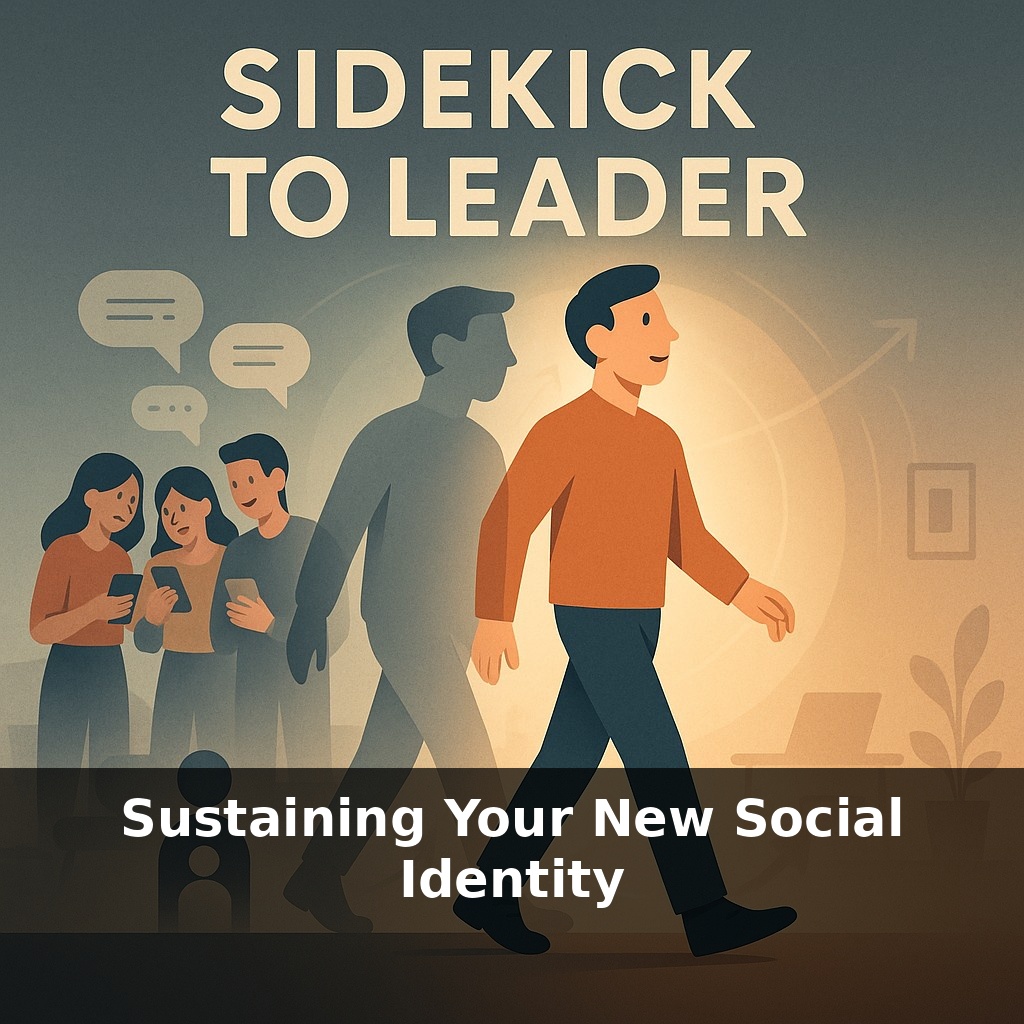
Laughter at the group chat—your friends teasing you for “being so serious now.” At work, your boss jokes, “There’s the old you I know.” How do you stop drifting back? Alex felt this tug the week after deciding to be seen as a leader, not the dependable sidekick.
The WEF says almost half your core skills will change in just four years. That means your social identity can’t be a one-time decision; it has to be an ongoing practice. The real challenge isn’t “becoming” more visible, respected, or socially confident—it’s staying that way when life, work, and people around you keep shifting.
Think about Maya, who decided to be known as someone with sharp ideas at work. For two months she spoke up more, shared drafts early, and colleagues started seeking her input. Then a new manager arrived, her team reorganized, and old habits quietly returned. Or Jamal, who became “the reliable organizer” in his friend group—until he burned out and started dodging invitations.
This episode is about not snapping back to your old social role when context changes, but instead learning how to deliberately update and protect the new one.
Research shows people who see identity as a flexible “project” adapt better to career changes, new teams, and shifting friend groups. The goal isn’t to fake a new persona; it’s to keep your values, behaviors, and relationships in sync as your life evolves.
Take Rina, who moved cities and joined a more competitive workplace. Her old “helpful teammate” reputation didn’t follow her—she had to actively signal it to new colleagues. Or Leo, who became more socially active offline but still looked distant and unengaged on his social media, confusing classmates.
In this episode, we’ll turn your new identity into a system you can actually maintain.
Here’s the practical engine behind sustaining who you’re becoming: a repeatable cycle you can actually run in daily life, not just in your head.
**1. Micro self-monitoring (without obsessing)** Instead of asking “Am I still this new version of me?” once a month, build tiny checkpoints into situations that matter.
- In meetings or group chats, notice 1 thing: *Did I act like the old me or the current me when it counted?* - Right after a key interaction, give yourself a 10-second rating: “How aligned was that with how I want to be seen—1 to 5?” Over a week, patterns show up: certain people or contexts pull you backward; others make the new role feel easy.
**2. Use feedback as data, not judgment** You’ll get reactions—jokes, silence, enthusiasm, resistance. Treat those as information, not verdicts.
Real scenario: - When Priya started contributing bolder ideas, one coworker rolled his eyes, but two others messaged her privately: “That was actually helpful.” Instead of fixating on the eye roll, she doubled down on speaking up when at least one ally was in the room. You’re looking for *where* the new you lands, not whether everyone approves.
**3. Align offline, online, and “overheard” versions of you** People form impressions from three places: what they see you do, what they see you post, and what others say about you.
- Offline: Choose 1 signature behavior that becomes predictable (e.g., you’re the one who summarizes next steps, or the one who checks in 1:1 after tense conversations). - Online: Adjust your LinkedIn, group bios, or visible activity so they match what you’re practicing in person. Share small wins or reflections in the new direction, not just big announcements. - Overheard: When someone describes you in a way that clashes with who you’re building, gently redirect: “I still care about that, but lately I’ve been focusing more on X.”
**4. Install reinforcing rituals** Rituals keep you from relying on willpower.
Examples: - Before social events: a 2-minute script—“In this room, my job is to do X at least once” (ask 3 people questions, share 1 opinion, introduce 2 people). - Weekly: 15-minute review of your calendar and chats: *Where did I show up as the current me? Where did I shrink? What’s one tweak for next week?* - Monthly: choose 1 small risk that stretches the new identity—a tougher conversation, a new group, a visible contribution.
Over time, these loops—monitor, interpret, align, ritualize—turn your new identity from a fragile phase into your default setting.
Naomi decided she wanted to be seen as someone who asks sharp questions, not just nods along. Instead of waiting for big moments, she started with one predictable move: in every meeting, she’d ask for clarification on *impact*—“How will we know this worked?” Within a month, teammates began pausing and turning to her when projects felt vague.
Omar wanted his friends to stop treating him like the “backup plan.” He didn’t announce a change; he quietly shifted patterns. When invited, he either committed fully—showing up on time, suggesting a plan—or declined early instead of “maybe.” After a few weeks, people checked with him first when organizing.
Anya joined a hobby group where no one knew her history of hanging back. She used that clean slate to test a new pattern: volunteering for small visible roles like timekeeper or note-taker. That low-stakes practice made it easier to carry the same behavior back to work.
Like a trail you walk often, each repeat of the new pattern makes it easier for others to expect—and respect—the newer version of you.
Building on that cycle, here’s why treating your identity as a project really matters.
You gain steadier confidence—less “am I faking it?” and more “I know what I’m practicing.” You draw clearer boundaries—what you say yes or no to stops feeling random. You grow real influence—people start adjusting to the *current* you, not the old script.
Expect some pushback; old roles are sticky. That’s not failure, that’s data.
Quick reflection: - When was the last time someone treated you like your “old” self? - For your next big change, which one arena—work, relationships, or community—most needs this identity cycle?
With that foundation, let’s land this in something you can actually do. Think of this as your tight, three-part loop.
First, here’s the recap: notice how you’re showing up, align your behavior and context, then reinforce with small rituals.
Now your challenge this week:
1. In the next 24 hours, write 2–3 sentences that start with: “The version of me I’m building is someone who…” Keep it simple and concrete. 2. Choose one tiny move for this week that fits that story—maybe asking one clear question in a group, giving one honest “no,” or initiating one check‑in instead of waiting to be invited. 3. Decide one person you’ll quietly involve—someone you’ll either tell this mini‑goal to, or later ask, “Did you notice anything different about how I showed up?”
Here’s the core thing to remember: your identity stays solid when you treat it like an ongoing project, not a finished product.
And when you slip—and you will—that’s not a verdict on who you are. It’s just fresh data. Notice it, adjust one small behavior, and step back into the cycle.