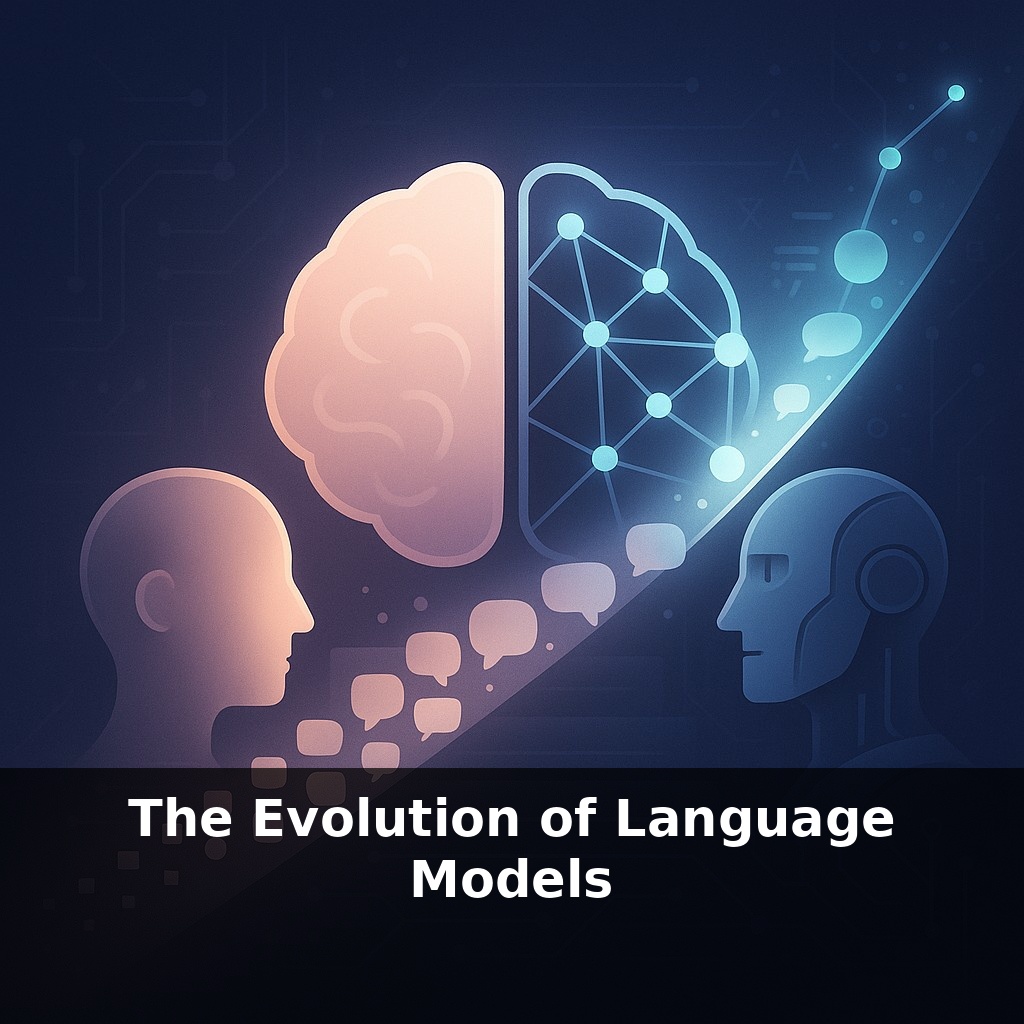
The Evolution of Language Models
📝 Transcript
Right now, there are AI systems that write code, draft essays, and pass exams—yet they’ve never “understood” a single textbook the way you do. In this episode, we’ll trace how simple word counters turned into these uncanny, almost conversational machines.
Language models didn’t start out ambitious. Early versions just tried to guess the next word using tiny windows of text. Then researchers began asking a bigger question: how much of language’s complexity can we capture if we keep increasing data, model size, and compute—relentlessly? That question set off a steep acceleration curve.
Instead of hand-crafting grammar rules, we started letting models discover patterns in massive text collections: news archives, open-source code, online discussions, digitized books. Each generation looked less like a specialized tool and more like a general-purpose text engine: translating, summarizing, debugging, brainstorming.
This shift quietly blurred boundaries. Spellcheck evolved into writing assistance; autocomplete expanded into code collaboration; translation turned into cross-lingual reasoning. And underneath it all, the same core idea kept scaling up: predict the next token well enough, and a surprising range of abilities falls out.
Soon, researchers hit a wall: squeezing more accuracy from tiny context windows felt like trying to understand a movie by staring at a single frame. The breakthrough came when models started to track relationships across whole documents, not just nearby words. This meant they could follow characters through chapters, arguments through essays, bugs through long code files. Suddenly, the same underlying mechanism that powered autocomplete began to support tasks that look a lot like planning, reasoning, and revision—blurring the line between “statistical text” and something that behaves unnervingly like thought.
The old n‑gram approach treated text as short, disconnected fragments. The next step forward was to represent words not as isolated symbols, but as points in a shared mathematical space. Techniques like word2vec and GloVe learned that “doctor,” “nurse,” and “hospital” should land near each other; “Paris” and “France” should relate the way “Tokyo” and “Japan” do. This shift from counting to mapping turned language into geometry: relationships became distances and directions that models could manipulate.
Once words and phrases lived in this continuous space, neural networks could start to operate over them more flexibly. Recurrent architectures like LSTMs and GRUs tried to process sentences one token at a time, carrying a hidden state forward. They were better at handling nuance, but they still strained with very long passages and parallel computation. Training them at scale was expensive and slow.
The Transformer architecture changed that by letting models look at many positions in a sequence at once through self‑attention. Each token can directly “attend” to others it finds relevant, rather than waiting for information to flow step by step. This architecture made it practical to train very large models on massive corpora, because it parallelized well on modern hardware and captured long‑range structure more efficiently.
As researchers scaled these systems up, they noticed regularities. Performance on benchmarks improved in a surprisingly smooth way as parameters, dataset size, and compute grew. These scaling laws suggested that, for certain regimes, you could roughly predict how much better a model would get if you invested more resources. That predictability turned model training into something closer to an engineering discipline: less guesswork, more extrapolation from trends.
In parallel, training objectives and data curation improved. Models weren’t just exposed to generic web text, but to code, math problems, technical manuals, and multi‑turn dialogues. They began to acquire skills that looked less like pattern matching and more like flexible problem solving: writing small programs, walking through logical chains, transforming instructions into stepwise plans.
The result is systems that can use a single underlying mechanism to span tasks once treated as separate: translation, summarization, question answering, code completion, and beyond.
When GPT‑3 was released with 175 billion parameters, its size wasn’t just a flex—it unlocked behaviors no one had explicitly programmed. Give it a half‑written function, and it often completes idiomatic code; supply a rough outline, and it drafts full articles with consistent style. GitHub’s Copilot leaned into this: in some teams, nearly 40% of newly typed code comes from its suggestions, shifting developers from “authoring every line” to “curating and steering” flows of generated text.
Education is quietly reorganizing around this shift. Students now work with tutors that can adjust explanations on the fly, generate practice questions at a chosen difficulty, or role‑play historical figures in debate. In industry, teams use these models to draft legal clauses, synthesize customer feedback, or explore business scenarios—more like collaborating with a fast, fallible colleague than querying a database.
Training a model resembles planning a long‑term investment portfolio: you balance data quality, model capacity, and compute “budget,” expecting returns to follow scaling curves but still watching for surprising jumps—a new capability emerging faster than the graphs predicted.
Soon, these systems will listen, watch, and speak across media, turning lectures into diagrams or meetings into action boards. In homes, a single assistant could mediate schedules, disputes, even moods. In hospitals and courtrooms, niche models might flag subtle risks or precedents humans miss—while forcing us to decide who owns the blame. As lightweight versions move onto phones and glasses, the quiet question becomes: what do we still choose to do entirely unaided?
We’re still in the early innings. As models learn to weave text with images, audio, and real‑time context, they’ll start feeling less like tools and more like shifting environments we work inside—like cities that grow around us overnight. Our task isn’t just to ask what they can say next, but what kinds of futures they quietly make easier to speak into being.
Start with this tiny habit: When you open a new browser tab, whisper one question you’d ask a language model if it were a real collaborator sitting next to you (for example, “Explain transformers like I’m 10” or “How would a small model handle this email?”). Then, in that same moment, add just three words to that question that make it more specific, like naming a dataset, a task (summarization, code refactor, translation), or a constraint (mobile, offline, low-parameter). This takes less than 10 seconds, but it trains you to think the way modern language model designers do: precise task, clear context, explicit constraints.
From this course
How AI Thinks: Understanding Large Language Models
8 episodesUnlock all episodes
Full access to 8 episodes and everything on OwlUp.
Subscribe — $1.99/monthLess than a coffee ☕ · Cancel anytime

