A model that never went to school now writes code, explains quantum physics, and helps design new drugs. Yet under the hood, it doesn’t “think” in words at all. In this episode, we’ll pull apart the transformer engine that lets raw text turn into reasoning.
Seventy percent of today’s most powerful language models share the same core blueprint—and it didn’t exist before 2017. That blueprint is the transformer, and it quietly solved a problem that crippled earlier AI: how to keep track of meaning over long stretches of text without grinding computation to a halt.
In the last episode, we looked at how scaling up data, parameters, and compute makes models more capable. Now we’ll zoom in on *why* that scaling works so well for transformers in particular, and how a single architectural idea reshaped fields far beyond language.
We’ll see how Google used transformers to rethink search, how DeepMind used them to crack protein folding, and how new tricks like FlashAttention push context windows far past a single page—opening the door to models that can work with books, codebases, and even whole research archives at once.
Transformers didn’t just make language models bigger; they changed what kinds of problems AI could even attempt. Once you have a system that can flexibly relate many pieces of information at once, you can point it at sentences, images, protein sequences, source code—even search queries. That’s why the same basic ideas now sit inside tools that rank billions of web pages, help biologists predict how molecules fold, and assist developers navigating sprawling codebases. As context windows grow, these systems start to feel less like chatbots and more like collaborators that can “hold” entire projects in mind.
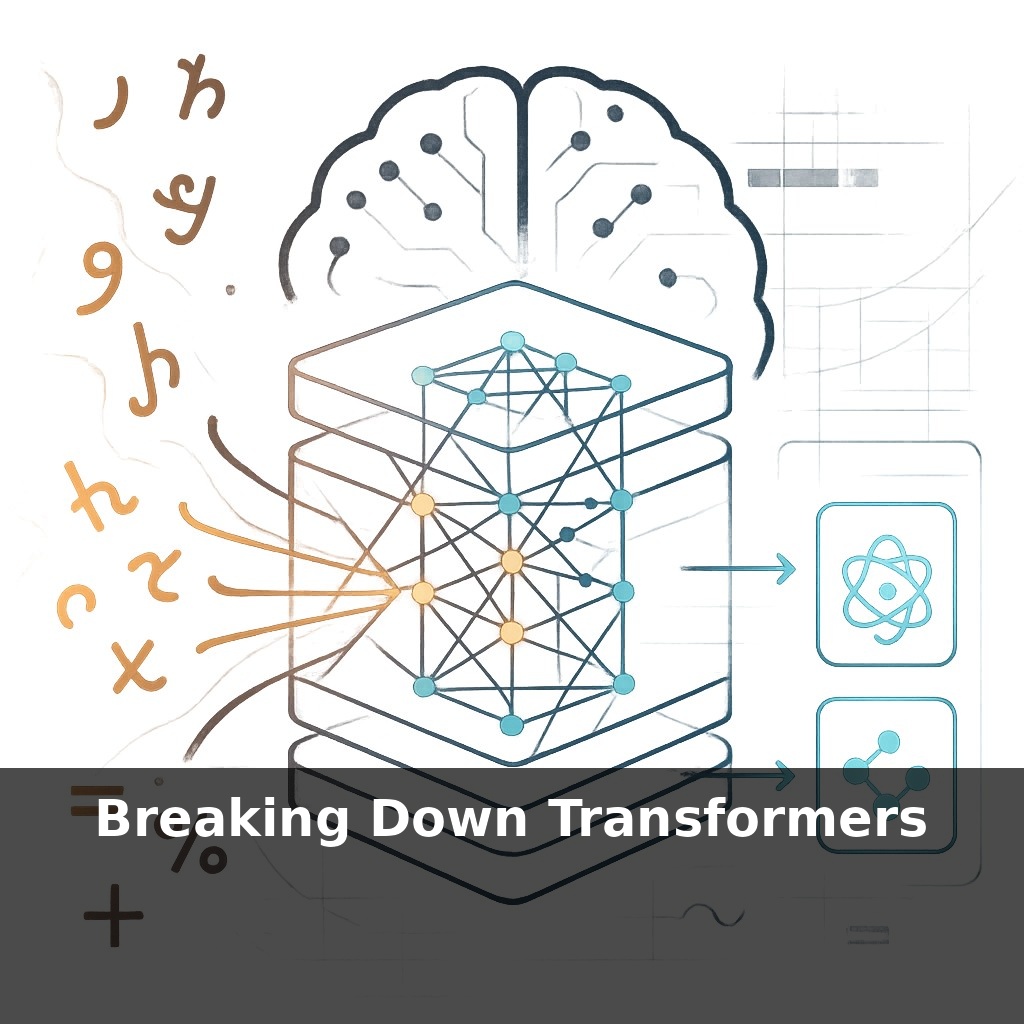
Think about what has to happen, step by step, when you type a sentence into a model like GPT-3. Under the hood, the system first breaks your text into tokens—subword chunks like “trans-”, “form”, “er”. Each token gets mapped to a high‑dimensional vector: a point in a mathematical space where similar meanings lie near each other. At this stage, the model hasn’t “understood” your sentence; it has just turned symbols into coordinates it can compute with.
Now stack dozens of layers that repeatedly refine those coordinates. Early layers tend to latch onto very local patterns—spelling, punctuation, short phrases. Deeper layers encode more abstract structure: who did what to whom in a sentence, what topic you’re on, what you’re likely to ask next. This is where self-attention shines: each layer can selectively mix information from anywhere in the sequence to update every token’s representation.
Crucially, transformers don’t rely on a single notion of “what matters.” They use *multi‑head* attention: parallel attention channels, each free to focus on different relationships. One head might track subject–verb agreement, another might follow coreference (“she” ↔ “Alice”), another might specialize in code syntax. Combined, they form a kind of portfolio of pattern detectors—diversified rather than all‑in on one strategy.
Position information is another key ingredient. Because the architecture itself doesn’t care about order, transformers inject positional encodings into those token vectors. That’s how the model knows “dog bites man” differs from “man bites dog” even if the words are the same. Later variants learn these encodings instead of fixing them, which turns out to matter for tasks beyond plain text, like representing 2D images or 3D protein structures.
These ideas extend naturally across domains. In vision transformers, patches of an image become “tokens,” and attention links distant regions—say, a wheel and a car roof. In protein models like AlphaFold2, attention layers connect amino acids that may be far apart in the sequence but close in the final folded structure, helping the model reason over possible shapes.
Your challenge this week: whenever you interact with an AI system—search, autocomplete, coding assistants—pause and ask: *What are the “tokens” here, and what relationships might its attention heads be tracking?* This lens will make complex systems feel much more legible.
A useful way to see what transformers enable is to look at how different fields quietly redesigned their workflows around them. In web search, for instance, Google’s move to BERT meant the system could treat your query less like a bag of keywords and more like a nuanced sentence—so “can you get medicine for someone else at a pharmacy” is interpreted as a question about permission, not shopping. In finance, firms now feed long sequences of news headlines, earnings call transcripts, and price movements into transformer-based models that try to spot subtle regime shifts—a particular phrase in a CEO’s remarks that historically precedes volatility, or a combination of macro signals that tends to cluster before recessions. In biology, labs use transformer variants to propose mutations likely to boost a protein’s stability or binding strength, then test only the most promising candidates in wet-lab experiments, shrinking costly search spaces. One analogy: transformers act like adaptive investment funds, constantly reallocating “attention capital” toward whichever signals look most informative right now.
As models grow, they won’t just answer questions; they’ll start acting more like strategy partners across domains—reading contracts, scanning medical notes, or monitoring factory sensors. Multi‑modal systems that “listen” to sound, “see” video, and “read” text at once could flag subtle issues, like a car that *sounds* wrong before it fails. The open question is who steers this power: will these systems sit in your pocket, or mostly behind corporate and government walls?
As these systems widen their gaze, they won’t just react to prompts—they’ll start tracing patterns across months or years of data, like a historian reading not one diary but an entire library. Your role is shifting too: from operator to editor, deciding which questions matter and which traces of your world are worth feeding into the next generation of models.
Try this experiment: Pick a tiny dataset you care about (for example, 20 short product reviews you’ve written or 20 of your own tweets) and build the world’s simplest “transformer” on paper. First, invent a 5–10 word “vocabulary” that shows up a lot in that dataset, and assign each word a 2‑D vector (just two numbers you make up that feel intuitive, like “good” = [1, 1], “bad” = [-1, -1]). Next, choose one sentence and, for each word, look at the others and manually assign “attention weights” from 0–1 based on how relevant they feel to that word’s meaning in context, then multiply and sum the vectors to get a new vector for each word. Finally, compare how the “meaning” of an ambiguous word (like “cool” or “light”) shifts when you change the surrounding words and re‑do your attention weights—you’ll literally see contextual meaning emerge the way transformers do.