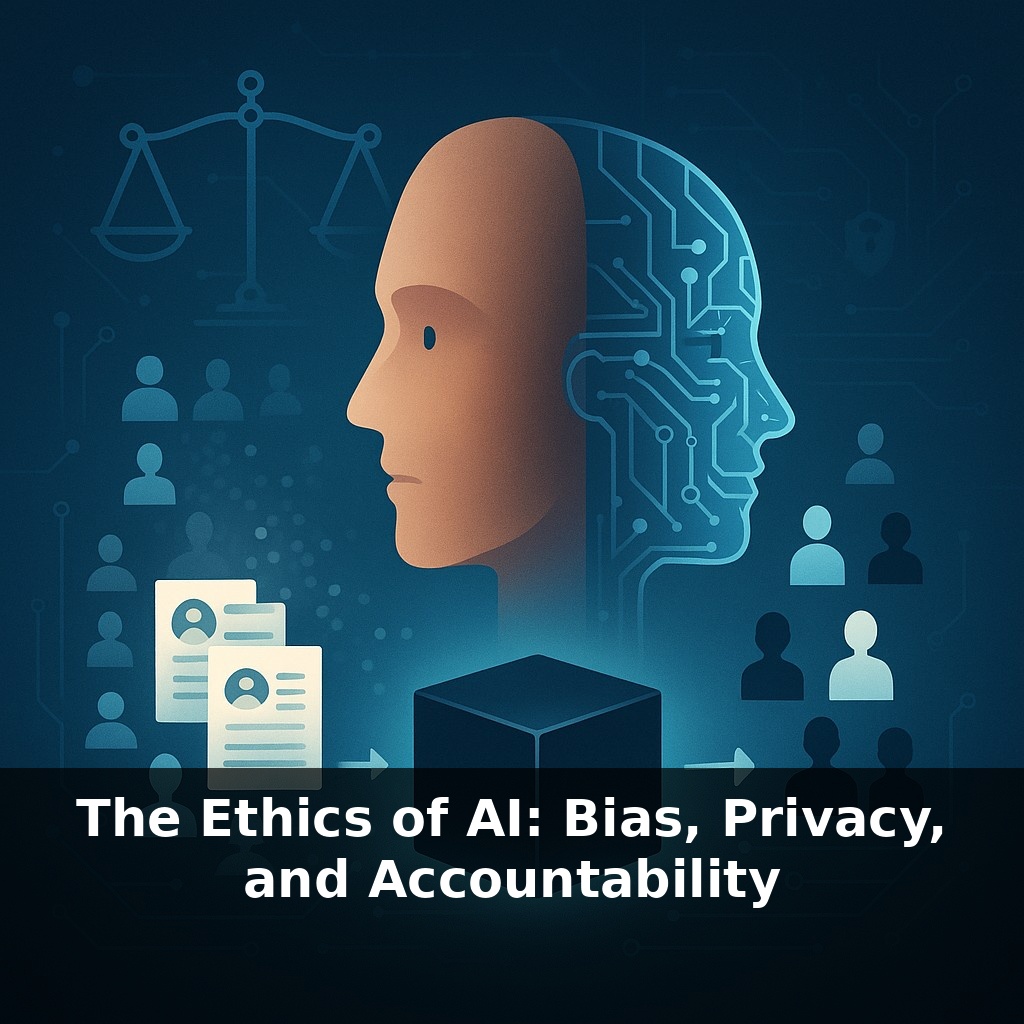
“Bias is not a tech glitch, it’s a mirror.” An AI hiring tool quietly screens thousands of resumes; qualified women keep vanishing from the shortlist. No one touched the code, yet something deeply human went wrong. So where, exactly, do we pin the blame — the data, the model, or us?
The unsettling part is how ordinary the pipeline looks from the inside. A team pulls in a massive dataset, cleans it “enough,” tunes some loss functions, runs evaluations, and ships. Nothing looks villainous in the pull request history. Yet downstream, loan approvals skew, patient risk scores drift, and entire groups of people quietly get worse outcomes.
We’ve already talked about skewed decisions and disappearing candidates; now we widen the lens. Bias isn’t the only ethical fault line. LLMs can memorize fragments of medical notes, private chats, or source code secrets and surface them later to strangers. Logs, prompts, and fine-tuning data can become a shadow archive of our lives.
And when something breaks in this maze — whose fingerprints are on the failure? The engineer, the vendor, the regulator, or the company that deployed it?
In this episode, we zoom in on three pressure points: bias, privacy, and accountability. Bias shapes *who* gets what; privacy shapes *what* can be exposed about us; accountability decides *who* answers when harm occurs. LLMs now write emails, summarize medical notes, assist judges, and help banks flag fraud—quietly sitting between people and critical decisions. Logs and prompt histories can linger like footprints in wet cement, hard to erase once set. Meanwhile, regulators race to catch up, drafting rules that treat some AI uses like hazardous materials requiring special handling and routine inspection.
When people say “AI is just math,” they usually miss the crucial detail: it’s math chained to history. LLMs learn from what *has been* said and done, not what *should* be. That’s why more data doesn’t automatically fix unfairness; if most past loans went to one demographic, scaling up that pattern just bakes the imbalance in more deeply.
Practitioners know this isn’t hypothetical. Surveys of ML teams routinely report bias surfacing *after* deployment, once real users, edge cases, and messy environments collide with clean benchmarks. And those benchmarks rarely include the people most at risk of being misclassified or ignored.
Privacy adds another layer. Training runs can quietly soak up rare snippets: a unique medical phrase, a sensitive chat log, an internal API key. Studies have shown that with clever probing, some of these low-frequency sequences can be pulled back out. Differential privacy offers a kind of mathematical “noise shield,” limiting how much any single person’s data can shape the model. But the tradeoff is real: as you crank up privacy guarantees, performance on niche tasks, small languages, or rare conditions often drops first.
Developers and companies are responding with tools and process: red-teaming to hunt for harmful behavior, bias and leakage evaluations before shipping, governance boards that can block high‑risk launches. The EU AI Act goes further, treating certain uses—credit scoring, hiring, key public services—like regulated infrastructure. If you build or deploy there, you’re on the hook for documentation, bias testing, and privacy controls, with regulators empowered to ask awkward questions and levy painful fines.
We’ve seen that concerted effort can move the needle: computer vision systems that once failed badly on darker skin tones improved dramatically when teams overhauled datasets and training objectives. But notice what that required: admitting the problem, measuring it transparently, and accepting short‑term pain—delays, cost, sometimes accuracy tradeoffs—to get to a more just outcome.
Accountability, then, is about refusing to let harm disappear into the abstraction of “the algorithm.” Someone chooses the objective, someone signs off the launch, someone profits from deployment. Ethical AI starts when those someones can’t look away.
A bank deploying an LLM‑powered assistant may find that certain neighborhoods get subtly different explanations for loan rejections. No one wrote a rule for that; it appears only when real customers start asking real questions. Privacy issues surface the same way: an internal chatbot meant to answer HR questions quietly ingests employee complaints, salary disputes, even medical accommodation requests—then gets queried by a curious manager fishing for “typical cases” in their department.
Accountability becomes very concrete here. Does the vendor have to provide tools to trace why certain answers skew? Does the bank need an internal review board with the power to throttle or shut down the system?
Think of it like a city installing smart traffic lights: if congestion gets worse on one side of town, residents won’t accept “the algorithm” as an answer. They want logs, metrics, and a person who can say, “Here’s what went wrong, here’s how we’re fixing it, and here’s how we’ll prevent it next time.”
Laws and tools won’t be enough on their own; culture has to shift too. As LLMs move into classrooms, clinics, and courts, people will need instincts for when to trust, question, or override them—like learning to read a credit score without treating it as destiny. Ethics teams may become as standard as security teams, and “model recalls” could resemble product recalls: when harm patterns emerge, systems get pulled, patched, and relaunched with public explanations.
Ethical AI is less a destination than a maintenance schedule: updates, inspections, and the occasional recall. As more systems mediate jobs, health, and credit, expect norms to shift—model “nutrition labels,” independent audits, even ethics champions inside teams. The real test won’t be zero harm, but how quickly we detect, admit, and repair it.
Start with this tiny habit: When you open an app or website that uses recommendations (like Netflix, YouTube, or Spotify), pause for 3 seconds and say out loud, “This feed is shaped by algorithms, not just my choices.” Then, once a day, tap into the settings and toggle a single privacy-related option (like limiting ad personalization or turning off location access) for just one app. Finally, when you see an AI-generated suggestion (a recommended video, product, or news story), once a day ask yourself one concrete question: “Who benefits if I click this?”