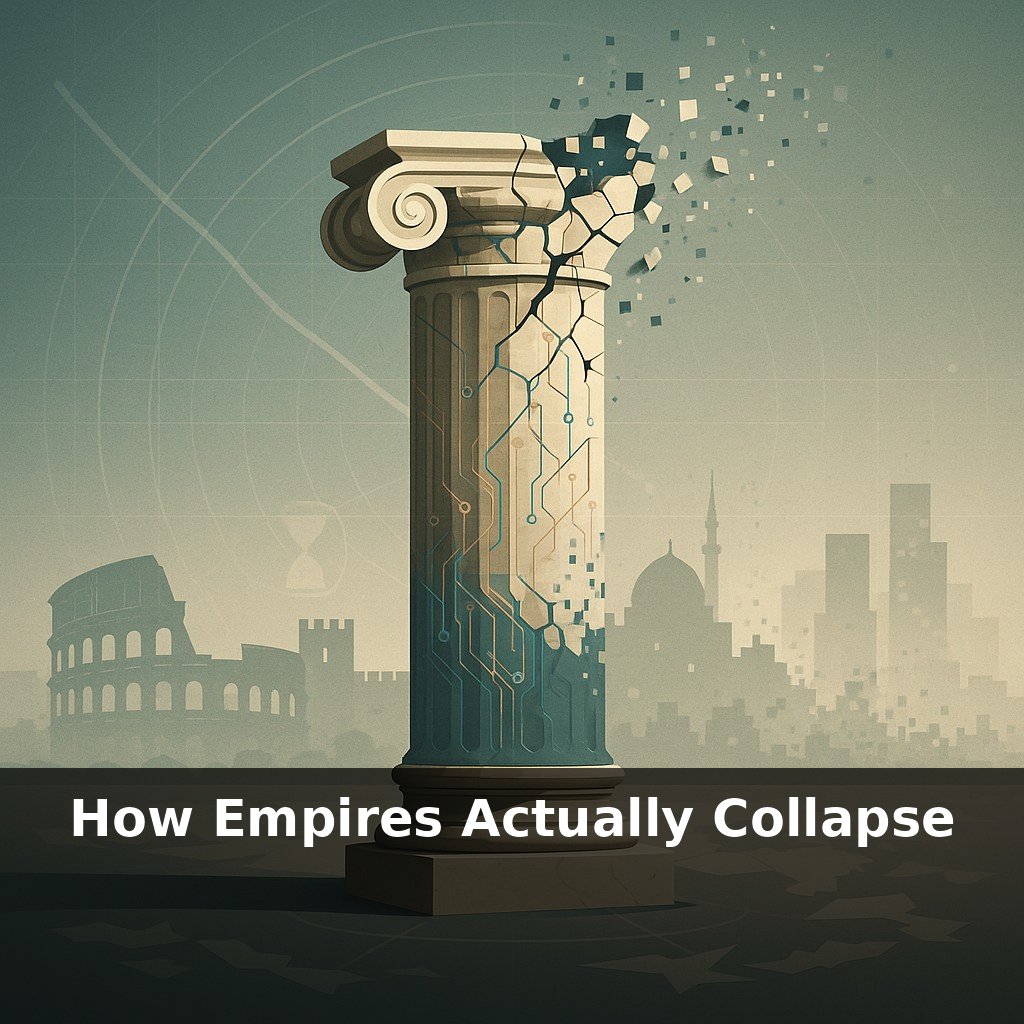
“Most empires don’t explode—they quietly run out of room to maneuver. A treasury stretched thin, elites blocking reform, resources getting pricier, and then one bad shock. In this episode, we’ll step inside that final decade when everyone feels the wobble, but no one hits the brakes.”
A strange pattern shows up when you zoom into the *last* few decades of big powers: the fixes get faster, but the problems get slower and heavier. Budgets are patched year to year, laws are tweaked, crises are “managed”—yet the underlying drift barely changes. It’s like listening to a band that keeps turning up the volume while slowly drifting off‑key; the energy rises, but the harmony decays. In this late phase, technology starts to play a double role. On one hand, it buys time: better weapons, faster communication, clever finance. On the other, it quietly locks in fragility: complex systems that few people understand, supply chains stretched across continents, critical infrastructure dependent on rare materials or single vendors. The result isn’t a dramatic plunge so much as a narrowing tunnel of choices, until one day the options simply… run out.
In that late phase, leaders often double down on metrics and dashboards, convinced that better data means better control. Surveillance expands, financial markets hum 24/7, logistics are timed to the minute. On paper, everything looks *measurable* and therefore manageable. But what actually grows is the distance between the readouts and the real world—like judging a city’s health only by its traffic lights. Historical records show this gap widening just before major breaks: reports stay optimistic longer, warning signals get reclassified as “noise,” and the system’s own tools start hiding the depth of its vulnerabilities.
Technological late stages have a specific signature: systems stop being designed around humans, and humans start contorting themselves around systems. You see it in small, daily frictions. Officials learn which numbers *must* look good and quietly ignore everything else. Workers discover that reporting a near‑miss creates more hassle than fixing it on the spot, so the near‑miss vanishes from the record. Procurement teams optimize for whatever the software rewards—delivery time, unit cost—while resilience, redundancy, and actual usefulness drift off the spreadsheet.
Historically, this shows up as a flip in who serves whom. Early on, tools serve strategy: telegraphs, then radios, then digital networks are adopted to support clear political aims. Later, strategy bends to protect installed systems. Instead of asking, “What do we want to accomplish?” leaders ask, “What would spook the bond market?” or “What would crash the payment rails?” The tail wags the dog. In late Qing China, customs policy increasingly revolved around foreign‑run tariff collection systems that couldn’t be easily altered without financial chaos. In the late Soviet Union, entire five‑year plans were quietly written to keep legacy industrial complexes busy, regardless of whether their output still made sense.
One telling marker: crisis simulations become more polished than crisis responses. Power grids run elaborate war‑games on paper while still depending on a handful of aging transformers that take a year to replace. Cybersecurity drills multiply even as outdated software lingers in critical ministries because no one wants the downtime required to upgrade it. The map grows ever more intricate while the terrain quietly shifts underneath.
Another marker is how failure is framed. When complex platforms stumble—whether that’s a national health database, a defense IT upgrade, or a cross‑border payment system—official inquiries often treat the breakdown as a singular mishap: a bug, a contractor error, a “black swan.” But archives from past empires show patterns: repeated small outages in communication networks before major military blunders; chronic delays in tax collection before fiscal panics; mounting “temporary” workarounds ossifying into permanent kludges.
Underneath, a cultural change is doing as much damage as any technical flaw: people lose the habit of thinking from first principles and default to thinking in menu options. If the software doesn’t offer a button for a response, the response starts to feel impossible. Over time, this shrinks not just what states *can* do, but what they can even *imagine* doing—until a shock arrives that demands moves no one’s systems are set up to allow.
Consider how this looks inside a modern state. A defense ministry procures a next‑gen fighter jet that depends on software updates from a single contractor in one foreign jurisdiction. On paper, it’s a leap forward. In practice, every future operation must be planned around licensing terms, patch schedules, and export controls. Or take public health: a national vaccine registry is centralized onto one cloud provider to “streamline” access. Years later, security teams quietly discover that switching vendors would mean months of disruption, so known weaknesses linger because the migration risk feels worse than the threat.
The late‑stage dynamic isn’t just technical; it reshapes careers. A civil servant who questions the core system risks being branded “anti‑modernization,” while the colleague who masters its quirks gets promoted as a “fixer,” even if they only layer workarounds. Over time, the smartest people learn to navigate bottlenecks, not remove them.
Your challenge this week: trace one technology you rely on daily back three layers—devices, platforms, vendors—and note where a single failure could corner you.
When tools start driving policy, resilience quietly becomes a design choice, not a default. The next phase is political: groups who profit from frozen systems will fight to keep them frozen, even as risks accumulate. Think of it like musicians refusing to change a setlist while the audience shifts and the venue ages. Expect uneven adaptation: cities experimenting with backups and manual overrides, nations testing “paper mode” drills, and alliances debating which shared platforms are simply too brittle to keep.
Late phases rarely feel like endings; they feel like inboxes that never empty. States pile on “temporary” fixes like stickers on a cracked phone screen—usable, but one drop from the wrong height ends it. In the next episode, we’ll zoom in on who benefits from keeping the cracks hidden, and how dissenters sometimes turn fragility into leverage.
Before next week, ask yourself: Where in my work or life did I actually change my mind because of something we learned this year—what was the moment, and what specifically triggered the shift? Which “I used to think X, now I think Y” realization from this episode could immediately change how I handle one concrete situation on my plate right now (a project, a relationship, or a habit), and what would that new approach look like in practice? If I had to bet on just one lesson from this episode being even more important a year from now, which would it be—and what’s one real decision I can make this week that shows I’m treating that lesson like it truly matters?