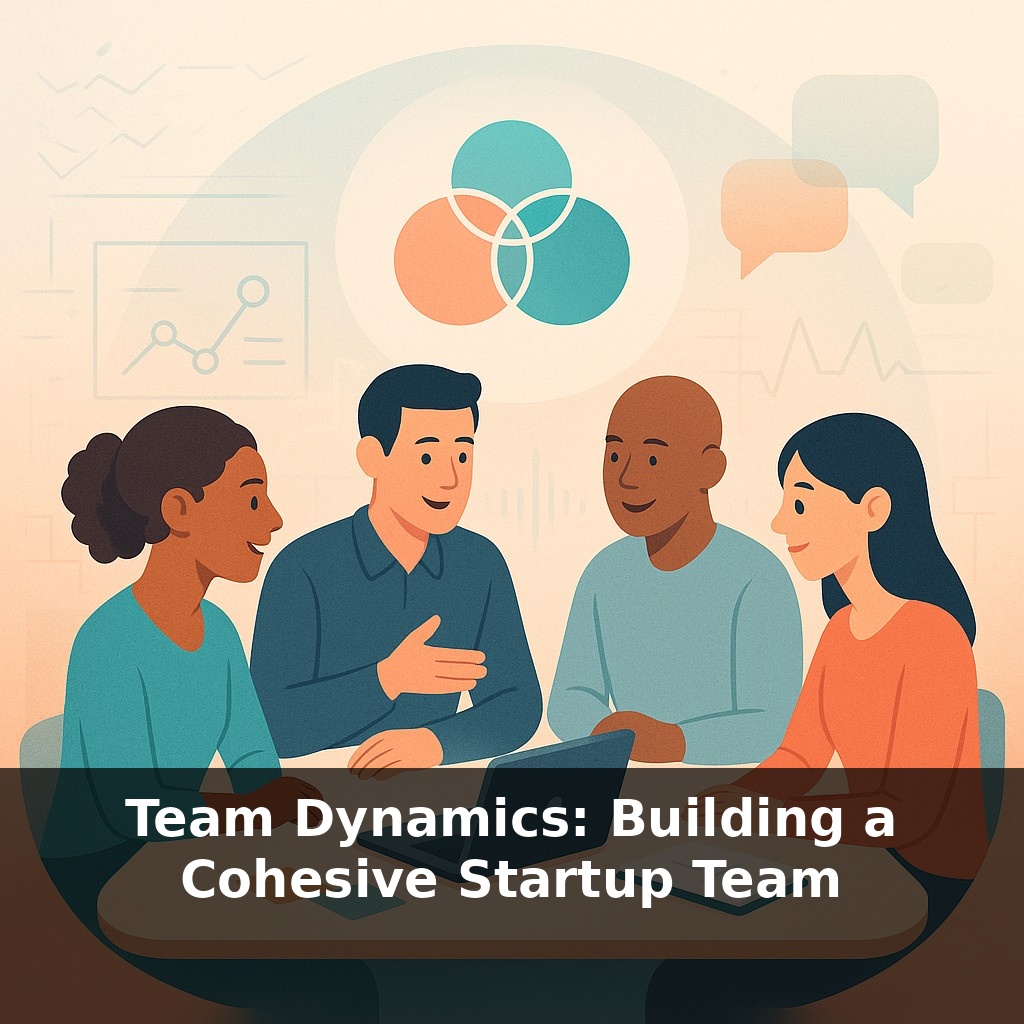
About half of startup failures come from team meltdowns, not bad ideas. A launch date is looming, investors are watching, and two co‑founders silently avoid each other in Slack. Roles blur, trust erodes. In this episode, we’ll dissect how strong teams prevent that slow-motion crash.
Google spent three years studying 180 teams and found one factor that mattered more than raw talent, fancy offices, or big budgets: psychological safety. Teams where people felt safe to speak up without being punished consistently outperformed the rest. For a startup racing toward product‑market fit, that’s not a “nice to have” — it’s the difference between catching a fatal flaw in a roadmap meeting and discovering it six months (and $600k) too late.
In this episode, we’ll connect culture to hard outcomes: why teams with clear roles ship features faster, why cognitive diversity helps you close your next round, and how remote‑first startups like GitLab use ruthless documentation to cut onboarding time by 70%. You’ll see how investing 30–40% of founder time into people and norms early can triple your odds of reaching Series B — and how to do it practically.
A cohesive startup team isn’t just “getting along” — it’s designing how work actually happens under pressure. That starts with composition: mapping the skills you need over the next 12–18 months, not just today. For an early SaaS team, that might mean 1 backend, 1 frontend, 1 designer, 1 GTM generalist, and the founders, instead of three full‑stack friends from college. It also means explicit decision rights: who owns pricing, who owns hiring, who can veto a launch. Teams that codify this early cut decision cycles by 30–40% and avoid the silent power struggles that quietly stall growth.
Titles like “Head of Engineering” or “Growth Lead” are not enough. In a 5–15 person startup, cohesion comes from designing how work, feedback, and conflict actually run hour‑to‑hour.
Start with roles at the level of *specific commitments*. Instead of “CTO handles tech,” define: “owns architecture decisions, code review standards, and incident response.” Do this for every function that touches your critical path: product, sales, marketing, ops, finance. A simple exercise: list your 15–20 recurring decisions (pricing changes, roadmap changes, hiring, discounts, infrastructure spend) and assign three labels to each: D = decides, I = is consulted, R = is informed. If more than one person has D for something major, you’ve planted a future fight.
Next, deliberately separate *status* from *trust*. Early teams often confuse “founder” with “always right.” To prevent that, use written decision memos for high‑risk calls (e.g., committing 40% of runway to a new feature). One person writes a 1–2 page proposal with data, risks, and alternatives; others comment asynchronously; then the owner makes the call. Over time you’ll see which teammates consistently improve decisions — that’s your real influence map, more important than titles.
Hiring should follow a similar level of precision. For each of your next 3–5 roles, define three buckets before you write the job description:
- 3–5 non‑negotiable skills tied to roadmap milestones (e.g., “can run 10 customer interviews/month and synthesize patterns”). - 3–5 cultural behaviors (e.g., “asks for feedback weekly,” “documents decisions without being asked”). - 2–3 “edge” perspectives you’re missing (e.g., “has shipped to non‑US markets,” “comes from a different industry than current team”).
Score candidates explicitly on all three. If someone is 9/10 on skill and 3/10 on behaviors, that’s a *conscious* tradeoff, not a surprise six months later.
Finally, operationalize how you work together. Set one weekly ritual for learning (e.g., a 45‑minute “customer learnings” review where sales, product, and support each bring 2–3 concrete data points) and one for alignment (a 30‑minute “plan vs. actual” where you review 3–5 metrics and reset priorities). Keep participation rules tight: who speaks, how decisions from the meeting are captured, when they become final. A team of 8 doing this rigorously for 12 weeks will feel radically more aligned than a team of 20 winging it.
At Stripe’s early stage, every engineer rotated weekly as “support owner” handling real tickets. That single practice did three things at once: exposed hidden product bugs, surfaced who stayed calm with angry users, and revealed who naturally coordinated across functions. Within 3 months, they adjusted responsibilities for 4 out of 12 people based on observed behavior, not assumptions.
You can borrow that approach with lightweight “role experiments.” For 4 weeks, assign rotating ownership of one cross‑team process: incident commander, user‑research lead for the week, or “demo day” curator. Track three simple metrics: handoff delays (in hours), number of cross‑team blockers resolved, and decisions documented. If a new owner improves two of the three by 20–30%, consider shifting formal responsibilities in that direction.
One more concrete pattern: a 10–person AI startup split product leadership between two co‑founders. After a 6‑week rotation as sole decision‑maker on roadmap, one co‑founder cut thrash by 40%. They made that role permanent and rewrote their org chart to match reality.
Investors are quietly quantifying what you’ve been feeling. Some funds already analyze response latency in founder Slack exports and time-to-resolution for conflicts. Expect “team health” dashboards alongside revenue cohorts. That shifts your job: not just setting norms, but instrumenting them. For instance, track written proposals/month, cross-functional projects/quarter, and speaking-time balance in key meetings. Miss these early, and no later hire fixes the cultural debt you’ve accrued.
Your next step is simple and measurable: treat team health like a product metric. Set two 90‑day targets: cut meeting confusion incidents by 50% (e.g., “who owns this?” moments) and raise peer feedback frequency to at least 2 comments per person per week. Review both monthly. The teams that track this early are the ones still alive at 50 people.
Here’s your challenge this week: Run a 45-minute “team operating system” session with your core startup team where you (1) map everyone’s primary working style on a simple 2x2 (fast/slow + people/task), (2) agree on three concrete norms for decision-making speed (e.g., who decides, how long you’ll debate, when you’ll default to the founder), and (3) set one explicit “disagreement protocol” for when a product or roadmap conflict comes up. Before the meeting, send a 3-question async check-in asking each person what currently makes collaboration easiest, what makes it hardest, and one behavior they’d love the team to try for 2 weeks. End the session by assigning a specific owner for each new norm and booking a 15-minute retro on the calendar for exactly 10 days from now to decide what you’ll keep, tweak, or drop.