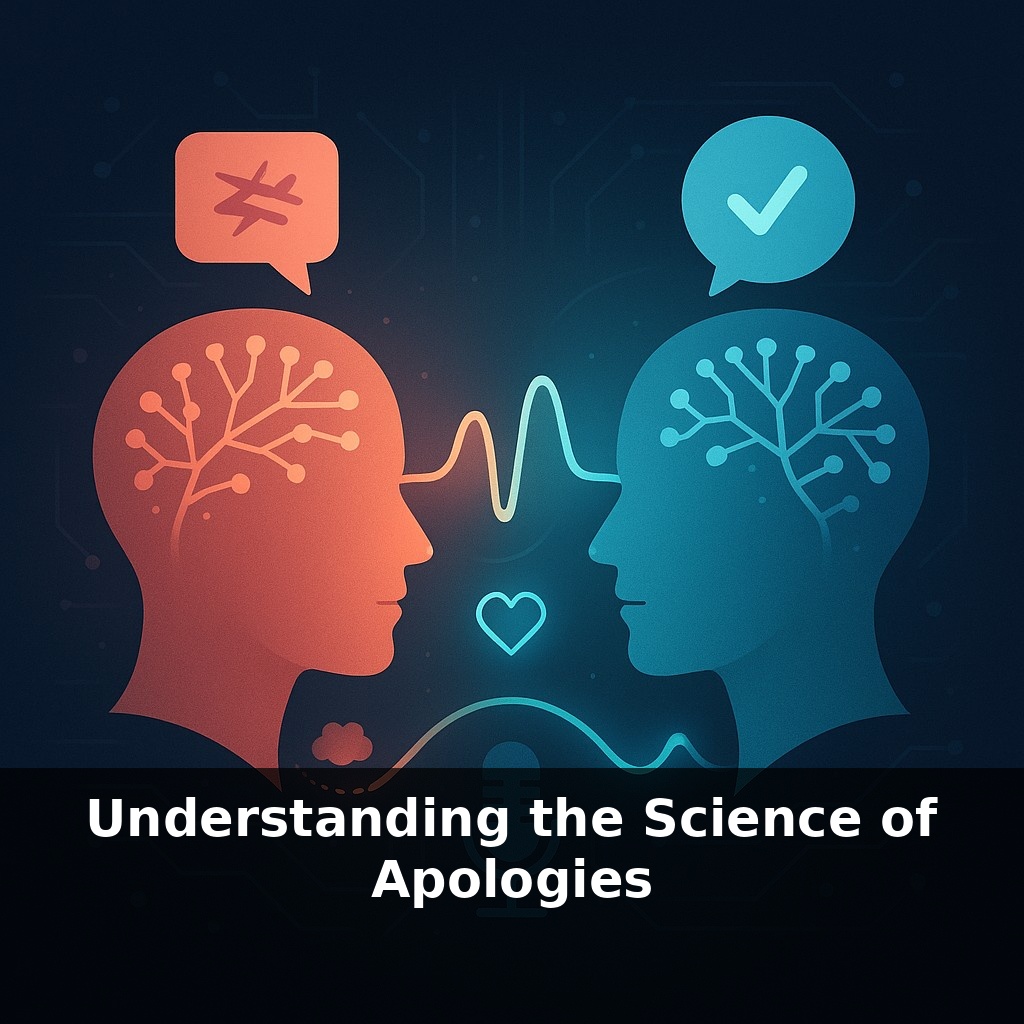
Understanding the Science of Apologies
📝 Transcript
A single word—“sorry”—can measurably calm another person’s nervous system, dropping their stress hormones in minutes. Take a real-life scenario: Two coworkers are in a tense moment. One blurts “my bad” and walks away, while the other slows down, names the harm, and waits. Both apologized. Only one actually repaired anything.
Some conflicts dissolve after a brief “sorry,” while others seem to grow teeth and bite harder afterward. The difference isn’t just in what’s said, but in how our brains interpret the social message underneath. Neuroscience shows that when we receive an apology we trust, regions involved in empathy and perspective-taking light up; when we doubt it, areas linked to threat and self-protection stay active. In other words, our minds are constantly running a quiet calculation: “Is this person actually safe to cooperate with again?” That’s why the same two syllables can either settle your body or tighten your jaw. In group settings—teams, families, even online communities—this calculation scales up. Patterns of weak or strong apologies start to shape culture, turning “sorry” into either a meaningful reset button or background noise everyone ignores.
A useful way to see this is as a double ledger: when harm happens, one side of the ledger records the actual event, but the other quietly tracks stories about intent, respect, and future risk. That second ledger is where apologies do most of their work. Research shows apology strength—how clearly you name the harm, own it, and commit to repair—explains a surprising amount of whether people forgive. This isn’t just interpersonal. In healthcare, honest disclosure plus apology has cut legal costs; in business, strong public apologies have helped brands regain trust after major failures.
Call that second ledger “the story people tell themselves after you hurt them”: Are you careless? Contemptuous? Overloaded but fundamentally decent? Effective repair work focuses less on clearing your own name and more on updating that story in their mind.
Research on apology components gives a practical map here. Strong apologies usually contain five moves, but their order—and emphasis—matters because it shapes that story.
First is clear acknowledgment of harm, stated in their terms, not yours. Vague phrases like “for what happened” force the other person to keep doing emotional labor, re-arguing that something was actually wrong. Specificity tells their brain, “You’re not gaslighting me. You see what I see.”
Next is uncontested responsibility. “I’m sorry you feel that way” leaves the story of you as risky and self-justifying. Even tiny qualifiers (“but I was tired,” “but you also…”) signal that, when stressed, you may prioritize your comfort over their safety. Responsibility without defense is surprisingly disarming.
Remorse is the emotional bridge. People aren’t just scanning your words; they’re micro-reading your delay before speaking, the way your tone slows, whether you rush to move on. Neuroscience studies show that when remorse looks genuine, the other person’s body quietly downgrades its threat level, making forgiveness a live option instead of a fantasy.
Repair is where many stop too soon. Concrete offers—redoing the work, fixing the error, compensating for loss—convert apology from a story about the past into a plan for the present. Crucially, those offers should be proportionate and, whenever possible, shaped by the person harmed, not prepackaged by you.
Finally, commitment to change speaks directly to future risk. People are asking, “What will be different next time pressure hits?” Naming specific safeguards—a new check, a changed habit, another set of eyes—reassures their predictive brain that cooperation isn’t just a gamble.
Your challenge this week: after any conflict, privately draft all five moves on paper or in a note app, even if you never send them. Notice which move feels most uncomfortable; that’s usually where your real work in repairing trust begins.
Think about two managers responding to a missed deadline. Manager A says, “We’ll do better,” and pushes the team harder next sprint. Manager B sits down, spells out exactly where they dropped the ball, asks how it affected the client, and co-designs a new review step. Six weeks later, both are “sorry,” but only one has shifted the story the team tells about leadership.
In close relationships, this shows up in tiny moments. Your partner snaps at you, then later mutters, “Yeah, that was rude.” Compare that to: “I cut you off when you were excited. That’s not how I want to show up for you. Tonight, I’m putting my phone away during that time.” One response shrinks the future; the other reopens it.
Financially, you see the same pattern. Some companies quietly issue refunds after a failure; others add a personal note, explain what changed internally, and follow up a month later. The money soothes the loss; the pattern-change soothes the risk.
Strong apologies may soon be less art and more trainable skill. As neurofeedback tools mature, leaders could rehearse apologies while watching their own empathy circuits light up, like athletes tracking heart-rate zones. In global teams, shared “repair protocols” might sit alongside style guides, clarifying how to own harm across cultures. And as synthetic voices proliferate, we may rely on cryptographic signatures or platforms that certify “who spoke, when, and under what constraints” before we decide whether to forgive.
In a world of AI chatbots issuing scripted “regret” by the million, your rare, well-aimed apology becomes surprisingly valuable social capital. Treat each one like tending a small garden plot: you can’t force growth, but you can clear debris, water the soil, and return regularly. Over time, those repaired moments quietly compound into durable trust.
Try this experiment: Think of one person you owe a real apology to and, using the science from the episode, give them a *five-part* apology today: clearly say what you did, name the impact on them (not your intentions), take full responsibility with no “but”, state exactly how you’ll repair it, and explain how you’ll prevent it in the future. Before you talk to them, predict on a 1–10 scale how much you think this will change the relationship; then, after the conversation, ask them to rate how sincere/helpful it felt on a 1–10 scale. Compare your prediction with their rating to see where you might be over- or underestimating the power of a well-structured apology.
From this course
How to Apologize (And Actually Mean It)
5 episodesUnlock all episodes
Full access to 5 episodes and everything on OwlUp.
Subscribe — $1.99/monthLess than a coffee ☕ · Cancel anytime

