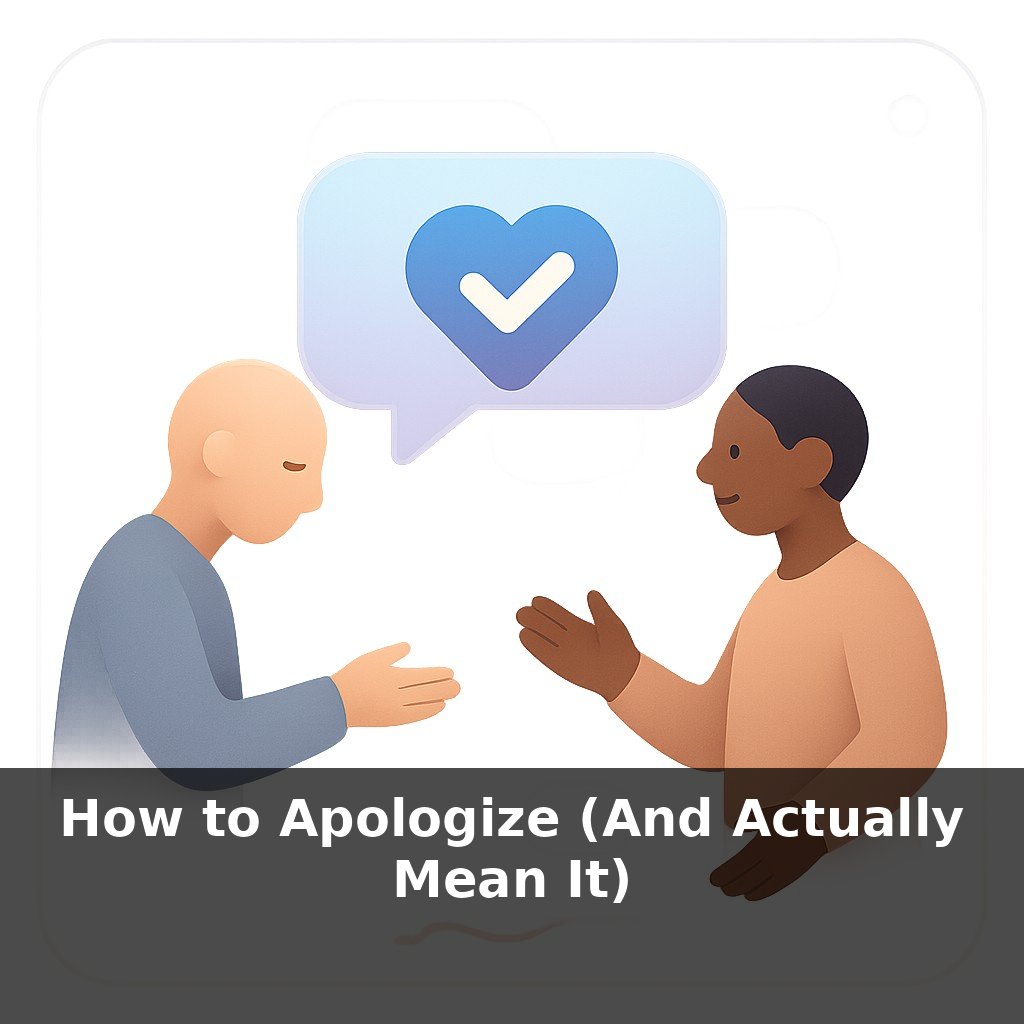
About half of us now say “sorry” through a screen more often than face‑to‑face—yet most people still trust in‑person apologies more. So when the stakes are high, why do we keep turning to text, email, or DMs? And can a digital apology ever feel as real as one in the room?
A 2020 study found the *same* apology was judged about a quarter more sincere when delivered by video instead of text. That doesn’t mean you should fire up Zoom for every missed deadline—but it does mean your choice of tool quietly shapes how your apology lands. In this episode, we’re stepping into the messy, modern reality where “I’m sorry” shows up as a Slack message at 11:42 p.m., a three‑minute voice note, or a carefully worded email your cursor hovered over for ten minutes before hitting send. We’ll look at how to match the medium to the moment, how small features—like read receipts or subject lines—change the emotional weight of your words, and why sometimes adding a short voice clip or video turns a risky apology into a repair that actually sticks.
So instead of asking “Is text bad and video good?” we’re really asking, “How do I get all six ingredients of a real apology to survive the trip through this app?” The tool you pick quietly shapes pace, visibility, and pressure. A DM can feel like a quick tap on the shoulder; a calendar invite for a video call can feel like being called into the principal’s office. Platform culture matters, too: what sounds caring in WhatsApp might feel oddly intimate in a project‑management comment. In this episode, we’ll zoom in on context—power dynamics, urgency, audience size—and turn those into simple rules for choosing *where* and *how* to say “I’m sorry.”
Here’s the tricky part: the same words—“I’m really sorry I dropped the ball on this”—behave very differently depending on *where* they live.
Start with text‑only spaces like SMS, chat, or DMs. They’re fast and lightweight, which makes them good for *opening the door* and bad for carrying the whole load. Use them to signal you’re aware of the hurt and want to talk, not to cram in a 15‑paragraph confession. In pure text, detail does the job that facial expression would normally do: be concrete about what you did, what you understand the impact to be, and what you’ll do next. Specifics are the stand‑in for eye contact here.
Email sits in the middle: it feels more formal, more permanent, and often more thought‑through. That makes it ideal when the issue involves work, money, or repeated patterns. You can structure a full apology—each of the six elements in its own short, clear paragraph—and give the other person time to absorb it without demanding an immediate response. Since tone is easy to misread, tools like tone checkers or even just reading aloud before sending are worth the extra minute.
Voice notes and phone calls bring back tone, pacing, and breath. They’re powerful when the relationship is close but scheduling a live call is hard, or when the person might prefer to *listen* rather than be on camera. A voice message also lets them replay, which can be comforting if they’re unsure whether you “really meant it.” Keep it concise and avoid turning it into a stream‑of‑consciousness defense.
Video—live or recorded—is the closest you’ll get to sitting across from them. Use it when the stakes are high, when you’ve broken trust more than once, or when you hold more power and want to shoulder discomfort instead of pushing it onto them. A short, well‑prepared recorded video can actually be kinder than an ambush meeting: they can pause, cry, or step away without you watching.
One helpful rule of thumb: the more complex and painful the situation, the more you should lean toward richer channels *after* a brief, gentle text to ask for consent. “I know I hurt you. I’d like to apologize properly—would you rather I write it out here, send an email, or record something you can watch when you’re ready?”
A practical way to think about tools is to match them to *how many* people are involved and *how public* the harm was. If you snapped at a teammate in a private chat, a direct message plus a follow‑up call is like quietly closing the office door to talk. But if you undermined them in a group channel, repairing it only 1:1 can feel like you’re tidying your own conscience while their reputation stays dented in public. In that case, a short message in the same group—“I spoke sharply to Alex earlier; that was unfair and I’m sorry”—paired with a personal note is closer to putting the picture back on the wall *and* fixing the frame. For brands, the same logic scales up. A clumsy tweet needs a response on the same platform, yet legal or emotional complexity might call for a linked, longer statement elsewhere. Your goal is to let the audience who *saw* the harm also see you take ownership, while giving those most affected a more human, customized channel.
A hidden shift is coming: as tools get smarter, the hard part won’t be *sending* an apology, it’ll be proving it isn’t hollow. Expect recipients to weigh not just *what* you say, but how much of it looks auto‑generated. Relational “due diligence” may become normal—people checking past patterns the way investors scan a stock chart. In that world, consistent follow‑through becomes your compound interest, and each apology is just a small deposit toward long‑term credibility.
So the real question becomes less “text or video?” and more “does this message help us live together better tomorrow?” As tools evolve, you’re not just fixing a moment—you’re quietly drafting the user manual for your relationship. Each thoughtful repair is like updating the software, so the next conflict runs on a more stable, less crash‑prone system.
Before next week, ask yourself: 1) “If I owed a real apology today, which parts of it would be better said face-to-face or over video, and which details (timeline, context, next steps) could be thoughtfully followed up in writing—email, text, or DM—to make it clearer and more accountable?” 2) “Looking at my recent digital conversations, where did I ‘apologize’ with a weak line like ‘sorry if you felt that way’ instead of clearly owning what I did, and how could I rewrite one of those apologies now to take full responsibility and spell out how I’ll repair trust?” 3) “For the people I’m closest to, what’s each person’s preferred digital channel when things are tense (text, voice note, video call, or in-person), and how could I quickly check in with at least one of them this week to ask, ‘If I ever really mess up, how would you want me to apologize?’”