You could gain a couple of pounds of new muscle in your 40s faster than you gained your last promotion—if you actually knew whether you were improving. One week your jeans feel looser, the next your joints ache. Are you progressing… or just getting better at guessing?
Most people over forty are working with broken “progress meters.” The bathroom scale jumps with every salty dinner, the mirror changes with the lighting, and a tight shirt might mean muscle… or just bloat. No wonder it feels like you’re guessing.
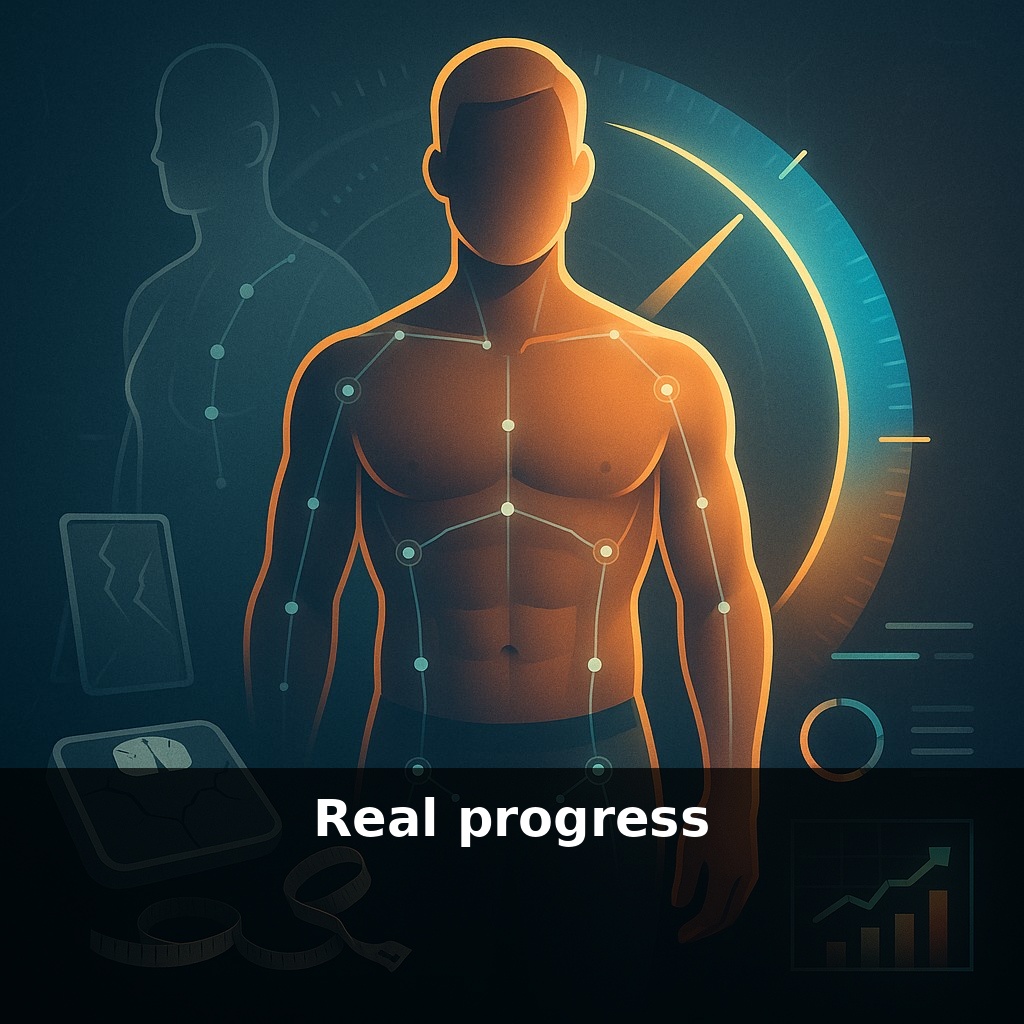
Real progress is quieter and more objective: the bar moves more smoothly on your third set, your left-right strength gap shrinks, you wake up less stiff after heavy days. These are signals you can actually measure, not just “feel.”
This is where technology earns its place. A quick scan, a tape measure, a log on your phone, even how many plates you’re loading—each is a small data point. One on its own is noisy; together, they form a pattern you can trust.
In this episode, we’ll turn those scattered signals into a simple scoreboard you can check every 8–12 weeks, so you know—without guessing—whether your training is really working.
Your body after forty acts a bit like software that’s been patched for years—still powerful, but with quirks. Hormones shift, recovery windows stretch, and random variables sneak in: travel, stress, choppy sleep, old injuries. That’s why single numbers—like today’s weight or one “good” workout—tell such an incomplete story.
To really see what’s changing, you need context: how today compares to last month, how your Tuesday sessions behave over time, how your “tired but fine” feels after different weeks. In this phase of life, progress is less about chasing peaks and more about reading trends—and then quietly steering them.
Here’s the twist most people miss: your “scoreboard” isn’t one number, it’s a stack of simple, imperfect numbers that become powerful when they agree with each other. The goal is not to chase perfection, but to make guesswork unnecessary.
Think of it in three lanes: structure, strength, and feel.
**Structure = what’s changing on your frame** Skip the daily weigh-ins and pick **two “hard” measures** to repeat every 8–12 weeks under similar conditions:
- One **body-composition tool**: DEXA if available, or the same bioimpedance scale, same time of day, same hydration rules. You’re not hunting for exact truth; you’re watching for direction. - One **girth measurement**: tape around mid-thigh, flexed upper arm, or at the navel. Same side, same posture, same tape tension. Mark the spots with a pen the first time; consistency matters more than precision.
Now your structure lane can answer: “Is muscle likely up, fat likely down, or mostly stable?”
**Strength = what you can actually do** This is your most honest lane after forty. Choose **3–5 reference lifts** that matter to you—maybe goblet squat, bench press or push‑ups, Romanian deadlift, and a row variation.
Then, standardize:
- Same warm‑up sequence - Same rep target (e.g., top set of 6–8 or a max-rep set at a fixed load) - Same rest between sets
Log two things: **load** and **total reps** across working sets. Every 8–12 weeks, run the same “test workout” and compare. If weights or reps climb while your form video looks cleaner, that’s progress—even if the mirror feels ambiguous.
**Feel = how your body is tolerating the work** This lane protects you from “progressing” straight into an injury. Track:
- **Session RPE** (1–10): how hard the whole workout felt - **Recovery time**: how many hours until you feel normal again - **Joint report**: green (fine), yellow (nagging), red (sharp/limiting)
Over time, you want a pattern where you’re lifting more in your reference lifts **without** session RPE, recovery time, or joint colors trending worse.
When all three lanes lean the same way—measurements nudging up where you want them, reference lifts improving, and your body feeling equal or better—you’re not guessing. You’re collecting enough evidence to say, calmly and confidently: this is working.
Think of this like checking three passports at an airport gate. One document might have a smudged photo, another a worn-out stamp, but when all three identities match, security waves you through. Your numbers don’t have to be perfect; they just have to agree often enough that the “story” makes sense.
For example, say your tape at mid‑thigh is up 0.5 cm, your RDL top set went from 70 kg × 6 to 70 kg × 9, and your legs feel less wobbly going downstairs after heavy days. That trio likely points to more muscle, not random fluctuation.
Or your scale stays the same, but your push‑up test climbs from 10 to 16 reps and your shoulders move from “yellow” to “green” on your joint report. That suggests a quieter win: strength and tissue tolerance improving without extra scale drama.
Your challenge this week: pick **one** lift, **one** girth spot, and **one** “feel” marker. Record them twice—once now, once after your next 4 similar workouts. Don’t judge; just see whether those three passports start telling the same story.
Data will soon feel less like homework and more like a quiet coach in your pocket. As home ultrasound, wearables, and AI form-check tools mature, they’ll stitch your daily training, sleep, and nutrition into a living “training biography,” flagging when you’re primed to push or need to back off. Think less spreadsheet, more jazz trio: your effort sets the melody, tech adds harmony, and your future mobility keeps the beat far longer than today’s norms.
Over time, you’ll notice something subtle: the numbers start to feel less like a verdict and more like sheet music for a song you’re still learning. You can change the tempo, improvise a new section, even pause between movements. The point isn’t to “win” the chart—it’s to keep composing a body that can play the long tour, not just a single show.
Before next week, ask yourself: 1) “Where in my life am I confusing motion with progress—like tweaking my calendar, buying more books, or re-listening to episodes—instead of doing the one uncomfortable thing that would actually move the needle?” 2) “If real progress is measurable, what is one result I want by next Friday (a finished email, a specific number of outreach messages sent, a concrete decision made), and what will I stop doing this week so I actually hit it?” 3) “When I feel the urge to ‘get ready’—organizing, planning, researching—how can I catch myself in the moment and redirect into five minutes of real work on the actual task I’ve been avoiding?”