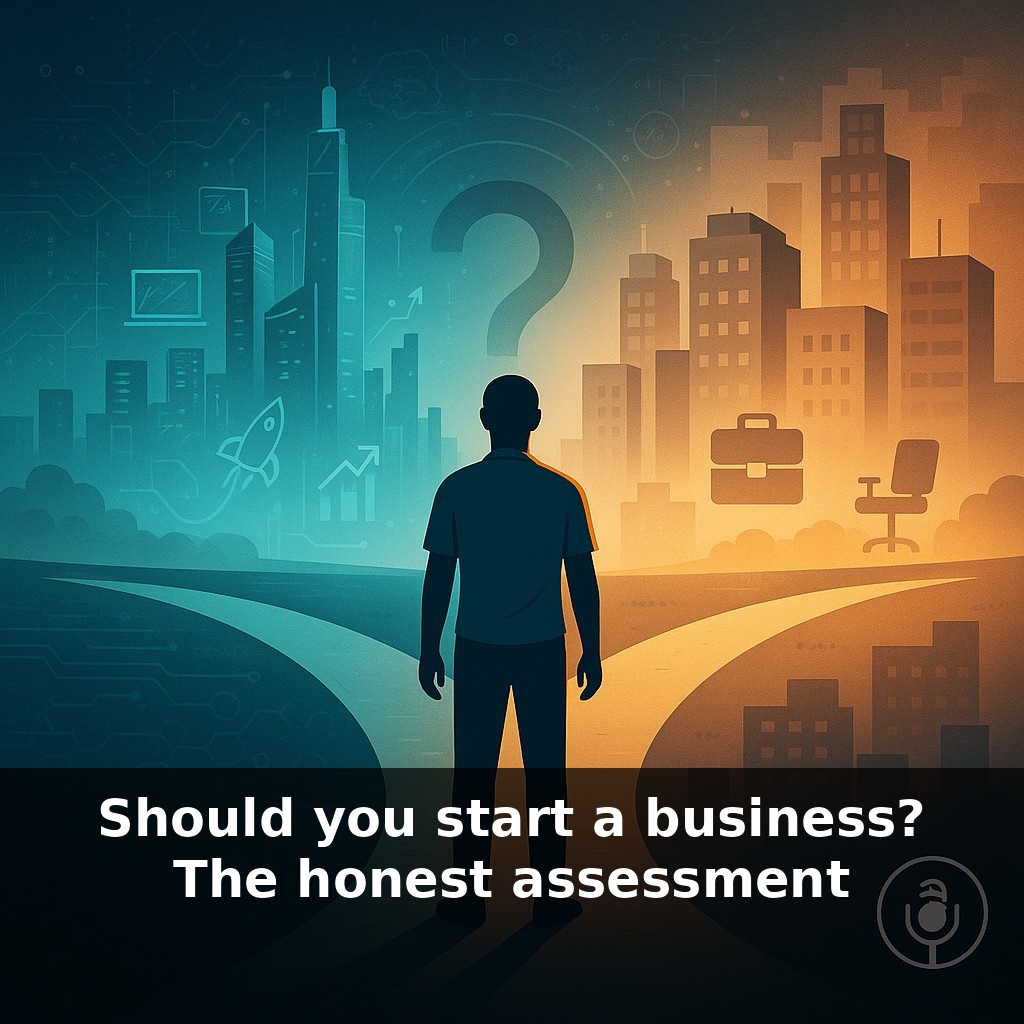
About half of new small businesses disappear within a few years—yet thousands of people still quit stable jobs to start one every month. In this episode, we’ll step into that crossroads moment and explore a simple question: are you actually built for this, or just bored?
So how do you tell the difference between a genuine pull toward entrepreneurship and a passing itch to escape your current situation? This is where honesty gets expensive. Data from psychology and venture research says it’s rarely about being “born an entrepreneur” and mostly about fit: your motivations, risk tolerance, skills, and the specific market you’re eyeing. Some people are chasing autonomy, others a big payday, others impact or creativity—and those lead to very different kinds of businesses and stress. Think of it like choosing an instrument in a band: drums, piano, and violin all make music, but they demand different temperaments, practice habits, and environments. In this episode, we’ll build a practical self-assessment you can actually use—covering your personality, money buffer, experience, and support system—so you can decide whether to commit, delay, or deliberately walk away.
We’ll ground this in data, not daydreams. Most people only see highlight reels—funding announcements, flexible schedules, “freedom.” You rarely see the 60–80 hour weeks, the savings drained faster than planned, or the pressure of paying others before you pay yourself. That’s the real backdrop for your decision. In the next few minutes, you’re not deciding “Do I want a company someday?” but “Given my current life, constraints, and responsibilities, what kind of risk can I responsibly carry now—and what preparation would make that risk smarter, not just bigger?”
Most people start by asking, “Is my idea good enough?” A better starting point is, “Am I willing to live the *process* this idea demands?” The research is blunt: founders who last aren’t necessarily the boldest or smartest—they’re the ones whose daily reality matches what they can sustainably tolerate.
Let’s break that down into four lenses you probably haven’t seriously tested yet:
**1. Energy and time reality check** Those 60–80 hour weeks in the data aren’t a badge of honor; they’re a workload forecast. Where will those hours come from? Sleep? Social life? Parenting? A side hustle? If your current life is already at capacity, your “plan” might secretly depend on superhuman willpower. That’s not a strategy, it’s a fantasy. The honest move is to map a prototype week: when, specifically, would you work on this, and what would you subtract?
**2. Stress and decision load** Early on, every path is foggy: pricing, first hires, which customers to chase, when to quit your job. You’ll routinely choose with incomplete information and live with being wrong in public. Some people find this energizing; others feel physically ill. Notice your reaction to smaller bets you’ve made—moving cities, changing jobs, leading tricky projects. Did uncertainty sharpen you or drain you?
**3. Financial shock absorbers** Runway isn’t just a savings number; it’s also: How flexible are your monthly obligations? Could you relocate, downsize, or delay major life events if things take longer? Founders who survive often have “escape valves”—ways to reduce burn without blowing up their lives. The question isn’t “Can I scrape by?” but “What am I truly prepared to trade away, and for how long?”
**4. Support and accountability grid** Data on founder resilience keeps circling back to one pattern: people who don’t go it alone last longer. Not just cofounders—mentors, peers, a partner who understands the stakes. Who, in your world, will tell you “this isn’t working” *and* help you redesign, not just cheerlead or catastrophize? If you have to hide the truth from everyone around you, your emotional runway is already short.
Across these lenses, you’re not hunting for a perfect profile. You’re looking for mismatch: places where your current life and the likely demands of this business collide. The more mismatch you find, the clearer your options become: reshape the idea, extend your prep period, or decide—consciously—that this isn’t your game right now. That’s not failure; it’s strategic honesty.
Think of three different people standing at the same doorway. One has deep industry contacts but almost no savings. Another has cash but no clue how their chosen sector actually works day to day. The third has neither, but a tight circle of people who will open doors, review contracts, and make introductions. All three are staring at the same threshold—but they’re not bringing the same backpack.
Resource mix matters. Some founders trade salary for access: they stay employed in a target industry a bit longer, quietly mapping workflows, tools, and politics. Others trade speed for stability: they launch smaller, slower, on nights and weekends, specifically to protect their health or caregiving duties. A few decide their best move is to join an early-stage team first, treating it as paid training rather than leaping solo.
Your honest question isn’t “Do I dare?” but “With what assets—relationships, credibility, learning channels—would I actually be stepping in, and which gaps would hit me first?”
As tools lower barriers, the real edge shifts from having an idea to designing how *you* will run it. AI copilots, global contractors, and niche online communities mean you can assemble tiny, high-leverage teams fast—if you’re good at curating people and systems. Think less “lone genius,” more “conductor of a rotating ensemble,” swapping in new instruments as markets, regulations, and technology twist mid-song. Your question becomes: can you keep rewriting the score while the music’s playing?
Treat this as an experiment, not a verdict. You’re not signing a lifelong contract; you’re running a series of small trials to see how your ideas behave in the wild and how *you* respond under load. Like testing a new recipe with friends before opening a restaurant, low-stakes trials reveal whether to scale up, iterate, or gracefully leave the oven off—for now.
Before next week, ask yourself: “If my current salary disappeared tomorrow, what specific problem (that I deeply understand) would I feel compelled to solve for people, even without a perfect business model?” Then ask: “Looking at my last 7 days, when did I actually have the time, energy, and focus to work on something new—and realistically, where would 5–7 consistent hours for a business fit in my real life, not my ideal life?” Finally, ask: “If my first year in this business brought in almost no profit, what concrete non-money payoffs (skills, network, proof of concept, lifestyle changes) would still make it worth continuing—and do those genuinely matter to me right now?”