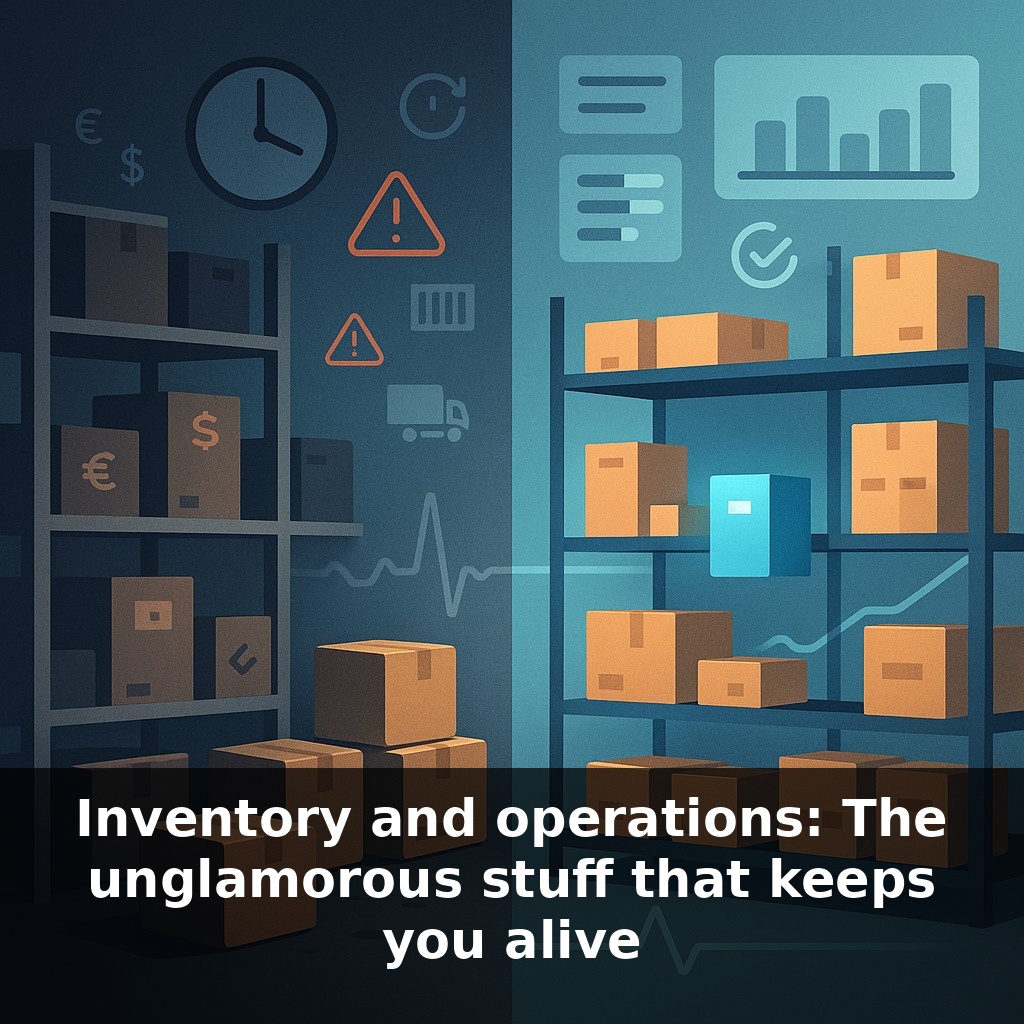
Your business is not killed by bad ideas. It’s killed by empty shelves, late deliveries, and cash trapped in boxes you forgot you ordered. Somewhere, right now, a startup with a great product is dying—not from lack of demand, but from operations it never learned to see.
Most founders obsess over features and marketing, then treat inventory and operations like back-office paperwork to “figure out later.” Later usually arrives as a crisis: your bestseller is perpetually “out of stock,” your slow movers fill every corner of your space, and your bank account is somehow empty even though your shelves are full. This isn’t bad luck; it’s a system quietly doing exactly what you (didn’t) design it to do. The good news: you don’t need a giant warehouse or a PhD in logistics to get this right. You need to see inventory not as stuff, but as decisions made visible—what you buy, when, how much, and how it flows. In this episode, we’ll treat those decisions like a live diagnostic: where money leaks, where speed stalls, and how a few simple rules can turn chaos into rhythm.
So now we zoom in closer: not at “operations” in the abstract, but at the exact moments where things quietly go wrong. The box that sits in a corner for six months. The product that always sells out on Fridays. The supplier who’s sometimes a hero, sometimes a bottleneck. Each is a signal. Modern tools simply turn up the volume on those signals: real-time dashboards, barcodes, cheap sensors, simple automations that nudge you before a problem explodes. You don’t need enterprise software; you need a habit of watching flows—how fast things move, where they pause, and where they pile up. That’s where your real constraints, and your real leverage, live.
Start with three uncomfortable questions: Which items do you always have too much of? Which do you always scramble to find? And which quietly eat cash while doing neither?
Most young companies never write this down. They just “order when it feels low” and “buy extra so we don’t run out.” That gut-driven approach works at tiny scale, then collapses the moment orders spike, a supplier slips, or you add a second product line.
A better lens: every item you stock plays one of three roles.
1. **Workhorse items** These move constantly. They justify prime space and frequent reorders. Your goal here is reliability: short lead times, backup suppliers, and enough safety stock that a late truck doesn’t shut you down. This is where forecasting matters most—tiny errors in your “everyday sellers” multiply fast.
2. **Strategic bets** New products, seasonal experiments, niche SKUs. These are risky on purpose. You cap quantities, review them aggressively, and set explicit “kill criteria” before you order: *If this hasn’t moved X units by Y date, we discount, bundle, or drop it.* The mistake isn’t betting; it’s betting without rules.
3. **Hidden anchors** Items you keep “just in case,” or because a loud customer once asked, or because a vendor gave you a deal. They move rarely, tie up capital, and clutter processes. Your job is to expose them. Tag them, time-box them, then either turn them into cash (bundles, promos, liquidation) or stop buying them.
Underneath these roles are only a few levers you can actually pull:
- **How much you order** each time (order quantity) - **When you reorder** (reorder point) - **How fast it arrives** (lead time) - **How predictably it sells** (demand variability)
Sophisticated systems automate these, but the logic is simple: the more uncertain demand and lead times are, the more buffer you need—or the more flexible your setup must become (shorter production runs, closer suppliers, smaller but more frequent orders).
That’s where process design enters. If your receiving is slow, your “available” stock is lower than it looks. If picking is chaotic, fast movers get lost behind dusty boxes. Shaving minutes off these small loops can remove days from your effective cycle.
Your real advantage isn’t owning more stuff; it’s **shortening and stabilizing the loop from cash → stock → customer → cash again.**
A small cosmetics brand learned this the hard way. Their bestseller lip balm ran out every other week, while a limited-edition shimmer sat untouched in boxes. When they finally tagged products by role, they realized the balm (a workhorse) was ordered on the same schedule as the shimmer (a strategic bet). They split the patterns: balm reordered weekly based on recent sales, shimmer capped and reviewed monthly. Within a quarter, stockouts dropped and they freed enough cash to launch two new shades without extra funding.
On the other end, a DTC bike company mapped every step from frame arrival to shipping. Frames piled up near paint, not assembly. A single spray booth was throttling everything. Instead of renting another warehouse, they staggered deliveries and added a second shift just for paint. Lead times shrank, and they could promise—and hit—faster delivery windows.
Think of it like a touring band: you don’t solve late shows by buying more guitars; you fix the slowest part of setup and soundcheck.
Forecasts will get less about guessing and more about *listening*. As AI watches tiny shifts—weather, search trends, even local events—it will quietly adjust what you stock, where, and when. Think of it like a good jazz trio: each instrument reacts in real time, so the song never falls apart when the tempo changes. The practical upside: fewer “sorry, we’re out” moments, less dusty stock, and the freedom to test bolder ideas without betting the company on every order.
Your next edge won’t be a louder launch; it will be quieter, cleaner motion behind the scenes. As you grow, treat each added product, channel, or vendor like a new instrument joining a band: only keep it if it makes the whole song tighter. Your challenge this week: pick one bottleneck, measure it, tweak it, and see how much smoother everything else suddenly feels.