About 7 in 10 small businesses start in the riskiest legal setup without realizing it. You’re signing contracts, taking payments, maybe hiring help… and every move is tied straight to your personal bank account. Here’s the twist: fixing that might be simpler than you think.
So before you click another “file LLC in 5 minutes” ad, hit pause. The structure you pick right now quietly decides three big things later: who gets sued when something breaks, who gets paid when money comes in, and who gets a headache when the IRS shows up with questions.
This isn’t about “being official” or looking legit on LinkedIn. It’s about choosing how much of *you* is on the line when a client refuses to pay, a contract goes sideways, or a partner suddenly wants out.
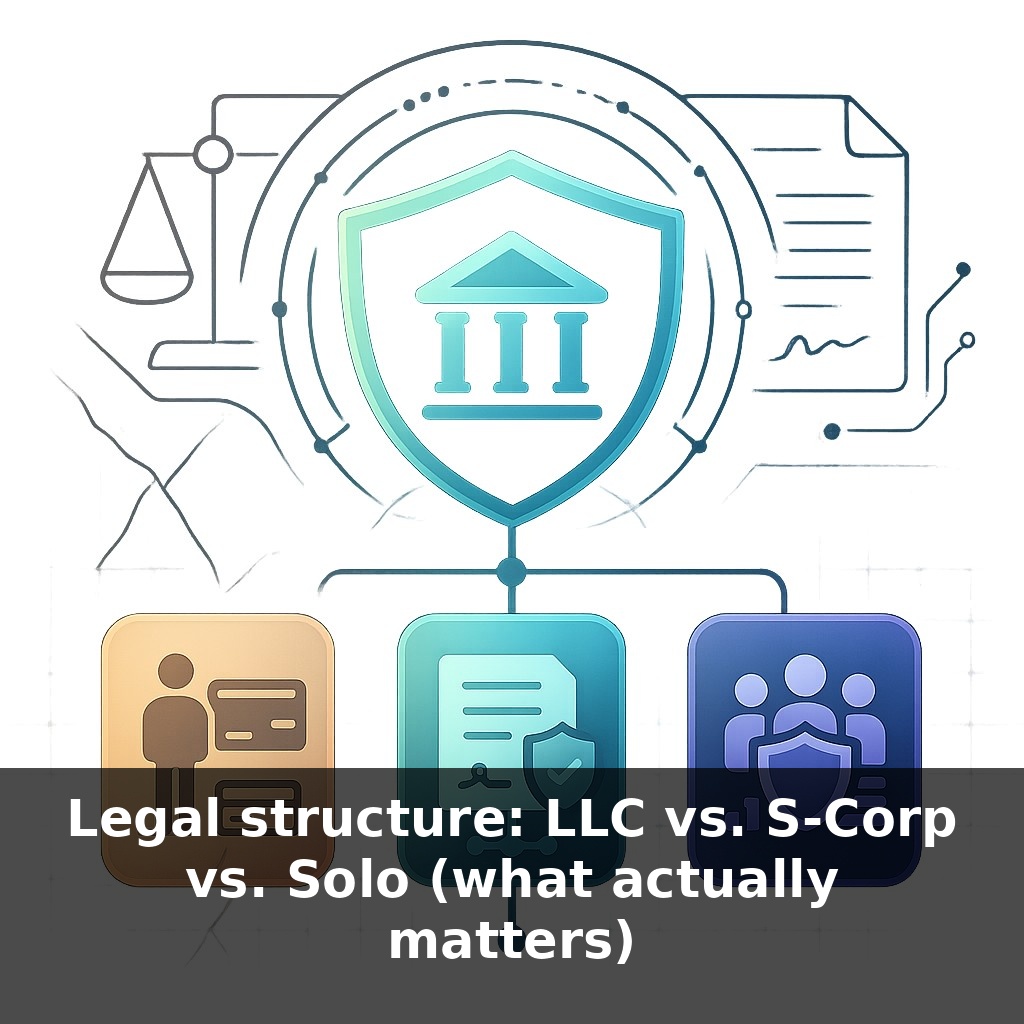
Think of three tracks on your business “album”: - Protection: what happens if something goes wrong - Taxes: how much you keep from every dollar of profit - Flexibility: how easily you can change course as you grow
Over the next few minutes, we’ll map these tracks for Solo, LLC, and S-Corp—so you can pick a structure that matches where you are *now*, without boxing in your future.
Here’s the sneaky part: the government doesn’t care what your website says you are—it cares what box you checked on a form months ago.
Clients, banks, and even potential co-founders will treat you differently depending on that choice. Some setups make it easier to bring on a partner, raise a bit of money, or separate your freelance gig from the product you’re quietly building on nights and weekends. Others lock you into habits that are cheap now but expensive to unwind later.
We’re going to zoom in on the trade-offs *at your current stage*, not some imaginary future empire.
Let’s start with the “default” path: staying solo with no formal entity. In practice, this is just you using your own name or a simple DBA, sending invoices, and reporting everything on a Schedule C. It’s fast, cheap, and invisible—no new bank accounts, no extra filings beyond what you already do in April. For a tiny, experimental project with a few hundred dollars at stake, this can be totally fine. The real question is: how long do you want *everything* you do in the business to point straight back to you?
Now layer in an LLC. On paper, it’s just a state-level wrapper you bolt around the work you’re already doing. You still control the money, still decide who you work with, still file a personal return. But you also get a clearer border between “you” and “the thing you run.” That border only holds if your behavior matches the paperwork: separate bank account, clear records, contracts in the company’s name. Think less about the form you file and more about whether your day-to-day habits would make sense to a skeptical judge or lender reviewing them later.
Then there’s the S-Corp election. You’re not changing the state-level entity; you’re changing how the IRS looks at your profit. Instead of treating all profit as your personal “work income,” the rules let you split it into two streams: one as wages, one as leftover profit. That split is where the potential savings live—but it also pulls you into a more structured world: running payroll, putting yourself on a set pay schedule, documenting why the salary you chose isn’t unreasonably low.
The hard part isn’t knowing these options exist; it’s matching them to your actual numbers and risk. A writer making $12k on the side from one client has a different profile than a dev shop at $180k with contractors touching production code. One might just need clarity around banking and contracts; the other might justify the extra layers of compliance to protect a growing operation and shave down self-employment tax.
So instead of asking “Which structure is best?”, a sharper question is: “What specific problems am I trying to solve this year: confusion, risk, or excess tax—and at what dollar amount do those problems become worth paying to fix?”
Sam is a UX designer freelancing on weekends. She keeps her day job, brings in $8k a year on side projects, and her “risk surface” is tiny: short contracts, low dollar amounts, no employees. For her, staying informal for a few months while she proves demand might be smarter than rushing into paperwork—her real constraint is time, not structure.
Now contrast that with Ravi, who’s about to sign a $90k annual contract to maintain a client’s internal tools. He’ll subcontract parts of the work and handle production data. Suddenly, questions like “Who signs the contract?” and “Whose name is on the checks?” matter more than how quickly he can file his return. His bigger problem isn’t picking a perfect structure; it’s making sure one ugly incident doesn’t follow him home.
Then there’s Lena, whose SaaS side project quietly crossed $120k in profit. She’s not quitting her job yet, but she’s bumping into a new constraint: how much of that profit will reliably stay hers each year—and what rules she’s willing to follow to keep more of it.
Law around all this isn’t static—it shifts under your feet. Think of how streaming flipped music: same songs, new distribution rules. A structure that feels “obvious” this year might look expensive or clunky after a single change to deductions or state thresholds. That’s why the real skill isn’t memorizing today’s “best” setup; it’s building a lightweight review rhythm, so when rules or your revenue jump, your entity choice can evolve with you.
You don’t need a perfect answer today—just a version that fits your current “season.” As your revenue, risk, and goals evolve, your entity can, too; think of it like upgrading lenses on the same camera body as your shots get more ambitious. The real win is staying agile enough that paperwork never dictates what your business is allowed to become.
Before next week, ask yourself: (1) “If my business brought in the exact revenue I expect this year, how much would I actually save in taxes by switching from a sole proprietor/LLC to an S-Corp, after I pay for payroll, bookkeeping, and extra compliance?” (2) “Given how many clients I realistically have (or expect) in the next 6–12 months, what specific legal risks do I face—nonpayment, contract disputes, liability for my work—and does my current structure plus insurance really cover those?” (3) “If I knew I’d need to change structures in 18–24 months, what would I do differently today with my contracts, bank accounts, and payment systems so that upgrading from a simple LLC/solo setup to an S-Corp is basically a paperwork formality instead of a stressful overhaul?”