Invest Smarter — Why Index Funds Beat Most Investors
📝 Transcript
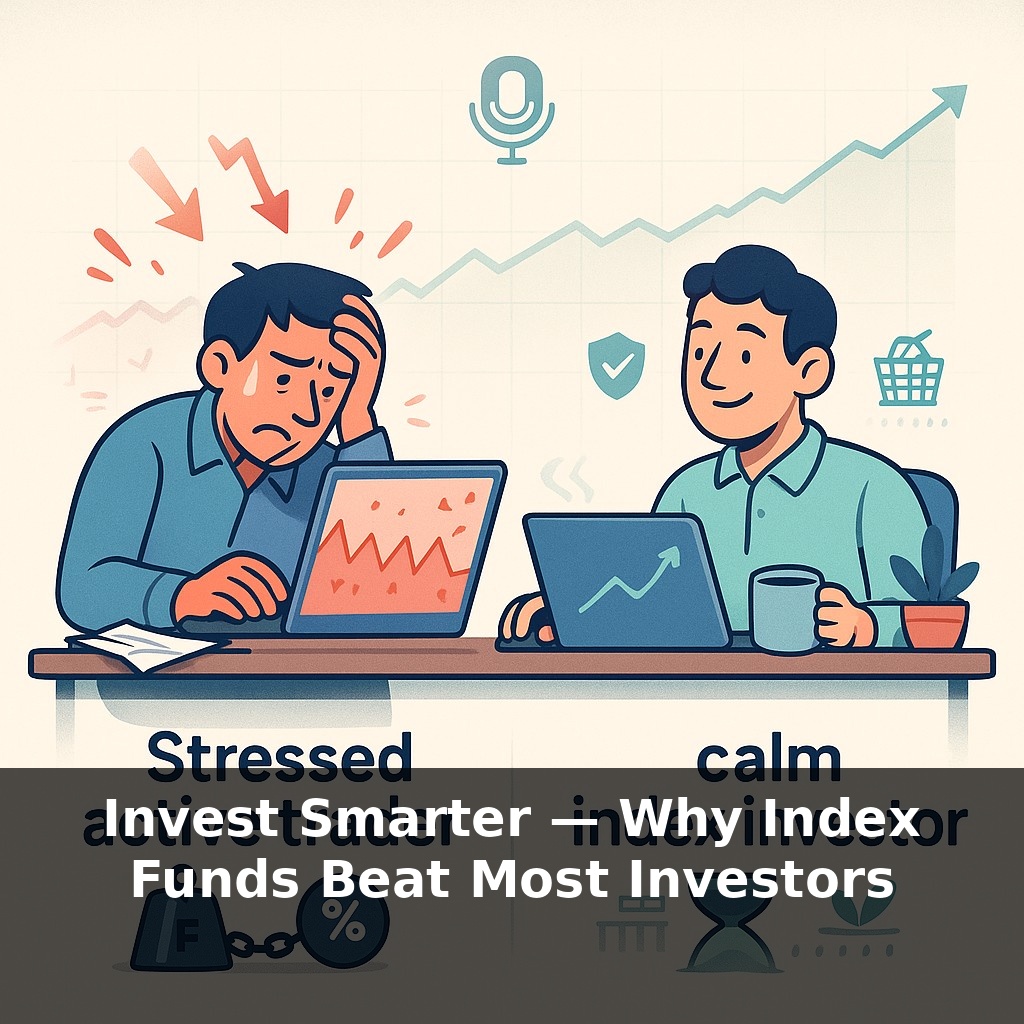
Most Wall Street pros fail a basic test: beat a simple “set it and forget it” index fund over a decade. Two coworkers sit side by side, checking their retirement accounts—one appears stressed, the other relaxed. Despite being in the same market, during the same years, their results are worlds apart. The twist is *how* they invested.
Earning stock-market returns is surprisingly different from *keeping* stock-market returns. A lot of investors quietly lose the gap in between—through fees, bad timing, and constant tinkering. So two people can own “the market” for 10 years and end up with very different outcomes, not because the market treated them differently, but because of the way they chose to participate in it.
Think about all the hands that touch your money on its way to being invested: advisors, fund managers, platforms, even your own impulses. Each one can either protect your results or shave a little off the top. Over time, those tiny slices compound into a visible dent in your wealth.
In this episode, we’ll zoom in on three forces that quietly separate index-fund investors from most stock pickers: costs, consistency, and diversification. You’ll see why, for beginners, “boring and broad” often beats “clever and complex.”
The tricky part is that, in real time, both approaches feel tempting. Market headlines shout about “can’t-miss” opportunities, friends brag about a stock that doubled, and glossy fund ads highlight stellar recent performance. It’s like scrolling through social media—your calm, long-term plan can suddenly look boring next to someone else’s highlight reel. Under that pressure, even smart people start chasing what just worked, upgrading to pricier “expert” strategies, or bailing when volatility spikes. Quietly, small deviations stack up, and the simple path you *meant* to follow drifts off-course.
Most people never see the numbers that quietly decide whether they end up “comfortable” or “scrambling.” Start with something simple: how much of every $1,000 you invest actually gets to work.
With a typical active fund, about 0.66 % disappears each year in expenses. On $10,000, that’s $66 in year one. Doesn’t sound deadly—until you stretch it over decades and layer in growth. At a 7 % gross return, paying 0.66 % vs. 0.05 % doesn’t just cost you $61 a year; it can mean *tens of thousands* less by retirement, because every dollar paid in fees is a dollar that never earns for you again.
Now put that next to performance. Over the 10 years ending 2022, 86 % of U.S. large‑cap managers failed to beat the S&P 500. That’s after all their research, trading, and strategy shifts. In other words, most investors are paying *more* for *less*—and often don’t realize it, because the underperformance trickles in slowly.
Stretch the lens further. Over 15 years, Vanguard’s 500 Index Fund earned 10.6 % per year. Its average active peer: 9.0 %. A 1.6‑point gap might sound minor, but over 30+ years, that difference can separate “I think I’m okay” from “I can stop worrying about money.” Long-term compounding is brutally sensitive to small advantages.
This is why money has been quietly migrating. By the end of 2023, index mutual funds and ETFs held around $13 trillion in the U.S., over half the equity fund market. That’s not a fad; it’s millions of investors voting with their dollars after years of watching the scorecard.
And when markets get rough? The temptation is to hunt for a hero—some strategy or manager who’ll sidestep the pain. But even elite professionals struggle here. Warren Buffett’s famous bet against a set of hedge funds showed it clearly: over nine years, a plain S&P 500 fund earned about 7.1 % annually, versus 2.2 % for the handpicked hedge‑fund portfolio, despite all their freedom to maneuver.
Think of it less as “settling for average” and more as deliberately *opting out* of a game where the odds are stacked against you. The real edge isn’t guessing better; it’s quietly aligning with the part of the system that already works in your favor and then getting out of your own way.
Maya and Jordan both start investing with $300 a month at age 25. Maya picks one low-cost fund and lets automatic contributions run. Jordan rotates between “hot” themes—AI this year, clean energy the next, emerging markets after that—reacting to headlines and friends’ tips. Twenty years in, they’ve both “been in the market,” but Maya has actually *captured* more of what the market offered, simply by staying put.
Here’s the tricky part: in any given year, Jordan might look smarter. One of his bets surges, his balance jumps, and for a moment he’s ahead. Then the spotlight shifts, a previous winner cools off, and he chases the next story. Those little performance detours are costly, even if he never blows up completely.
Think of a stormy coastline. One ship charts a straight, preplanned route; another keeps darting toward every patch of temporarily calm water. Both face the same ocean, but the zigzags burn extra fuel and time. Over decades, the calmer captain doesn’t just arrive first—they arrive with more resources left.
As more money follows indexes, markets may start to feel like a crowded hiking trail: well-marked, but with everyone marching in step. That could push stock-pickers to hike off-trail—into niche sectors, smaller companies, or unloved regions—where mispricing is more likely. At the same time, a few giant firms will quietly gain more say in corporate decisions. How they vote on issues like climate risk or worker pay may nudge business behavior long before most investors notice.
The real question isn’t “Can I beat the market?” but “What game gives me the best odds of reaching my goals?” Index funds free up mental bandwidth: less scoreboard‑watching, more life planning. As you add income bumps or side‑hustle cash, you can quietly route those flows into the same simple system and let small, steady decisions do the heavy lifting.
Try this experiment: Pick one broad-market index fund (like a total U.S. stock market or S&P 500 index fund) and one actively managed fund you either own or are considering, then track them side by side for the next 30 days. Invest the same dollar amount in each on the same day (even if it’s just $50–$100), and record the value of both once a week using your brokerage app. Pay attention not just to performance, but also to fees, how often each fund trades (turnover), and how “hands-off” each one feels. At the end of the month, decide which approach actually made your life calmer and your returns-to-effort ratio higher—then commit your next automatic contribution based on what you learned.
Unlock all episodes
Full access to 10 episodes and everything on OwlUp.
Subscribe — $1.99/monthLess than a coffee ☕ · Cancel anytime