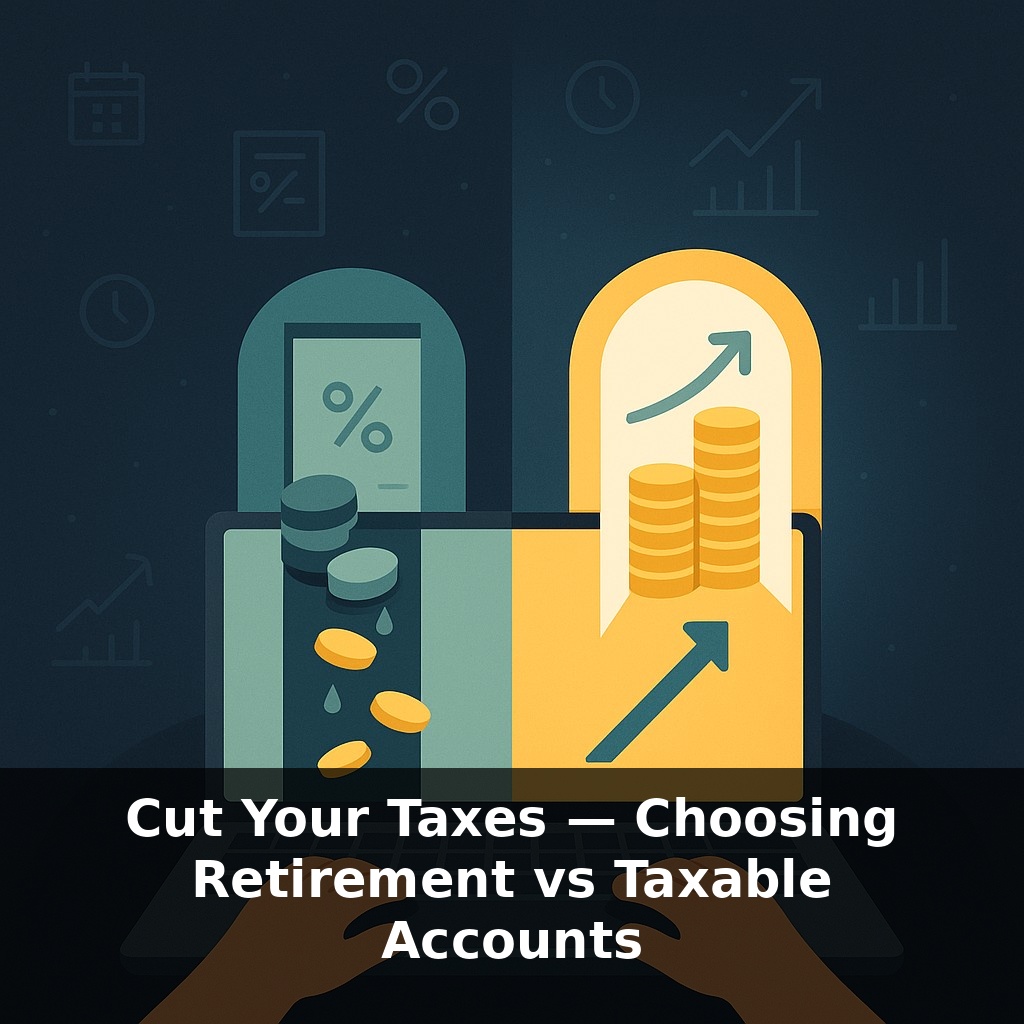
Half of many people’s “investment strategy” is really just a tax donation they never meant to make. You’re at your laptop, ready to invest a bonus. Same fund, same risk, same timeline—two clicks lead to wildly different tax bills. Which door do you walk through?
You’ve already seen how fees quietly skim your returns and how compounding does the heavy lifting over time. Now we’re adding a third force to that mix: the account you choose to hold your investments in. Two beginners can buy the exact same index fund on the exact same day, but if one uses a retirement account and the other a regular brokerage account, their long‑term outcomes can diverge like two trains taking slightly different tracks. At first the gap is invisible; decades later, one ends up states away. This isn’t about fancy strategies or predicting the market. It’s about understanding the basic rules different accounts play by—when you get a tax break, when you don’t, and what strings are attached. Once you see those rules clearly, “where” you invest becomes just as important as “what” you invest in.
One more twist: your choice isn’t just “retirement vs regular” accounts—it’s also *which kind* of retirement bucket you use. Traditional and Roth versions change *when* you pay taxes, which can matter more than the exact funds you pick. Add in employer matches, income limits, and early‑withdrawal penalties, and you’re no longer just an investor—you’re quietly doing tax planning too. This is where your personal details start to drive the decision: your current tax bracket, how long until you’ll need the money, and how steady your income is likely to be over the next few decades.
Think of this as zooming in from “accounts matter” to “how do *you* actually choose?” Start with three questions:
1) When might you need this money? 2) What’s your tax rate likely now vs. later? 3) Do you have any special benefits tied to certain accounts?
Short‑term goals—say, a car in three years or a safety buffer—fit poorly in retirement buckets. Withdrawal penalties and hoops can turn a small emergency into an expensive headache. That’s where a plain brokerage account shines: no contribution limits, no age rules, and you can sell anytime. For anything you might need before roughly age 59½, this is usually the default home.
Long‑term, the trade‑off becomes: pay tax now for future freedom, or delay tax and hope your later rate is lower. If you expect higher income later (medical resident, new grad in a fast‑track field), paying tax now to use Roth space often makes sense. If you’re at a peak salary, or you’ll likely have lower income in retirement, nudging more into Traditional can reduce today’s bill and spread taxes over future years.
Then there’s the “blend” strategy most people overlook: you don’t have to pick a side. Many savers use all three layers over time—retirement payroll contributions for the core, Roth for long‑term flexibility, and a brokerage for goals that don’t fit cleanly into “retirement” or “next year.” That mix later gives you real control: in a high‑income year, you can draw from Roth or brokerage; in a low‑income year, you can tap Traditional more heavily without jumping brackets.
Dividends and fund turnover also matter more as your balances grow. A broad index ETF held in a brokerage account tends to throw off fewer surprises at tax time than a high‑yield, high‑churn fund, keeping annual taxes manageable. In retirement accounts, those differences mostly disappear, since activity inside doesn’t show up each April.
Your job isn’t to forecast tax law for 30 years. It’s to avoid extremes: don’t lock *everything* up where you can’t reach it, and don’t ignore powerful tax sheltering when your horizon is clearly decades long.
Mia is 24, in her first job, earning $50,000. She thinks she’ll go to grad school in five years. She decides any money she might need for tuition or a move lives in a flexible account, while anything she’s sure she won’t touch until her 60s goes into long‑term buckets. That split means she can invest aggressively in both places, but she won’t be forced to sell at a bad time just to cover a surprise bill.
Now consider Ben, 45, at a career peak. He already saves into his workplace plan but also wants to slow down at 55. He maps out “buckets” by decade: money for age 55–60 in a flexible account, 60–70 mostly in accounts with looser rules, and 70+ in the more locked‑up options. As he shifts through life stages, he keeps topping off the next bucket instead of randomly scattering contributions.
Like a doctor choosing between treatments, both of them focus less on which option is “best in theory” and more on what fits their specific timeline, risk tolerance, and likely future income swings.
Future rules may shift like changing weather fronts—favoring one “side of the sky” (Roth or pre‑tax) for a while, then the other. That’s why many planners now talk about *tax diversification*: spreading money across buckets so future Congresses can’t wreck a single bet. New tools—robo‑advisors, tax‑aware funds, smarter 401(k) defaults—are quietly baking this in. Your edge isn’t predicting laws; it’s staying flexible enough to adapt when they move.
You don’t have to lock in one perfect path today. Think of each new job, raise, or life change as a fresh draft, not the final version. As laws, goals, and paychecks shift, you can tilt contributions, open new buckets, or slow others. The real win isn’t guessing right once—it’s building a setup you can keep quietly improving for decades.
Before next week, ask yourself: 1) “If I moved the next $500 I plan to invest into a tax-advantaged account instead of my brokerage account, how would that change my lifetime tax bill given my current tax bracket and expected retirement bracket?” 2) “Looking at the funds I own in my taxable account right now, which ones kick off the highest dividends and capital gains, and could I relocate those into a Roth or traditional IRA to cut my annual tax drag?” 3) “If I map out when I might need money in the next 3–5 years, which dollars clearly belong in a taxable account for flexibility, and which dollars I truly won’t touch for 10+ years and should be shifted to retirement accounts for tax sheltering?”