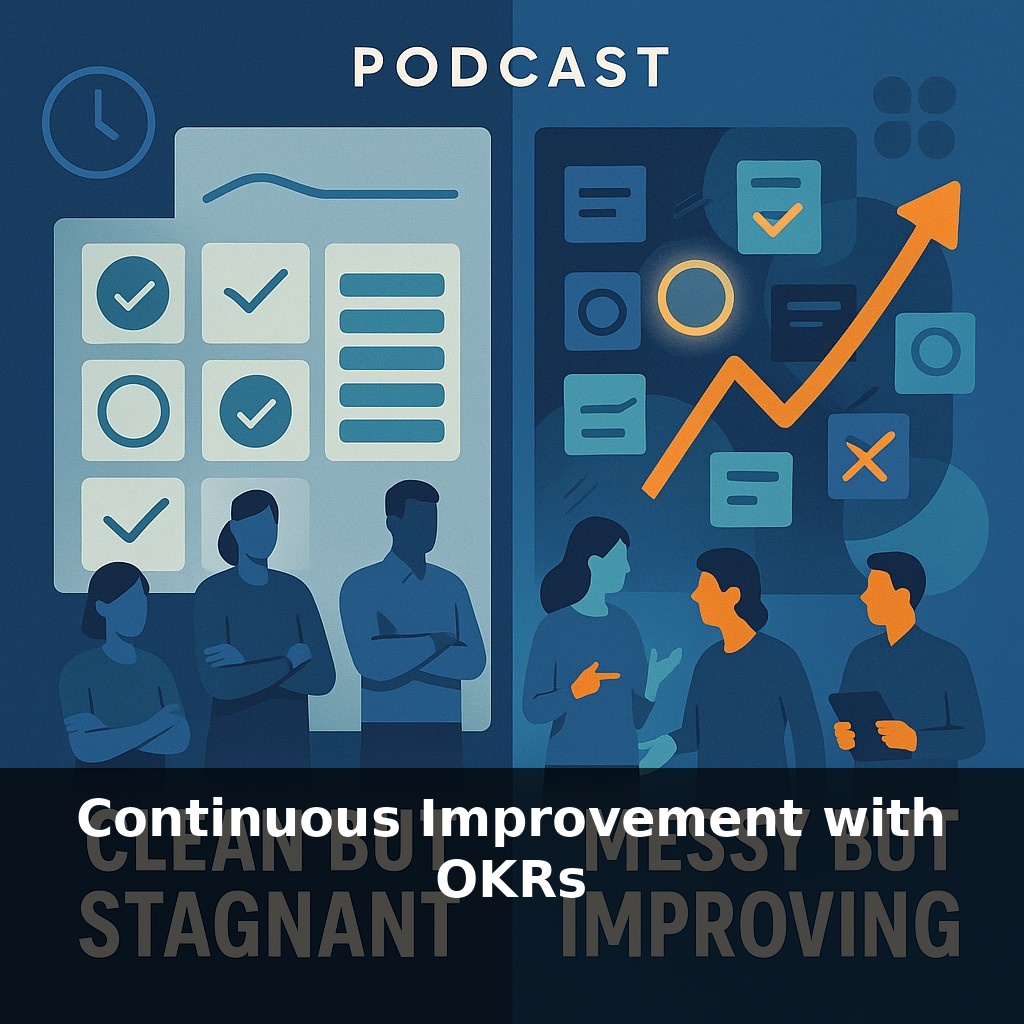
A team hits every target on their OKR dashboard—and slowly gets worse at the one thing that matters: real results. Another team misses a third of their goals, but each quarter gets sharper, faster, more aligned. Same framework. Completely different engine under the hood.
A strange pattern shows up in teams that use OKRs for more than a year: the highest performers rarely have the “cleanest” track records. Their quarters look messy—missed numbers, revised targets, key results that changed mid-cycle—but their trajectory keeps bending upward. The difference isn’t how well they plan; it’s how deliberately they learn.
This is where OKRs shift from a planning ritual to a continuous improvement system. The objective isn’t to draft perfect commitments every quarter; it’s to run disciplined experiments on how your team creates impact. Which bets actually moved the needle? Which “safe” initiatives quietly consumed time without shifting anything important? Which assumptions about customers, capacity, or sequencing turned out to be wrong?
When you treat each OKR cycle as a test, not a verdict, you stop chasing flawless reports and start building a repeatable engine for getting better.
Most teams never unlock this engine because they treat each quarter like a verdict on their competence, not raw material for redesign. That’s why companies obsess over whether they hit 100% instead of asking whether they chose the right bets. Notice how few teams deliberately tune their cycle length, reflection rituals, or feedback channels. Three-month plans become habit, not hypothesis. Yet product groups experimenting with 6‑week “sprint OKRs” discover new cadences, sharper focus, and faster learning loops—closer to release trains than annual roadmaps, with each turn tightening the track.
24% better results from one habit change.
That’s the reported lift for teams that run structured OKR retrospectives compared with those that don’t. The framework is the same. The difference is how often they stop, look in the mirror, and tune the system.
To make OKRs drive continuous improvement, you’re really designing three things: your **learning rhythm**, your **evidence**, and your **feedback channels**.
**1. Design your learning rhythm**
Cycle length is a strategic choice, not a default. Three months may be fine for sales or operations. But if you’re in product or R&D, ask: “How fast can we realistically see signal from our bets?” That answer might point you to 6‑week or even monthly cycles.
Shorter cycles force sharper scoping: fewer initiatives, clearer hypotheses, quicker course‑corrections. Longer cycles allow for deeper, cross‑functional bets—but demand stronger interim checkpoints so you don’t discover in week 11 that you’ve been optimizing the wrong thing.
The key: choose a cadence where your assumptions can be tested before the cycle ends, then revisit that choice twice a year.
**2. Upgrade what counts as evidence**
Many teams track activity, not learning. For each key result, ask three questions:
- *What early signals will tell us we’re on the right track?* - *What would we expect to see if we’re wrong?* - *What specific decision will this metric inform?*
Now you’re not just measuring progress; you’re encoding decisions you’ll make when the numbers move. That turns mid‑cycle reviews from status updates into forks in the road.
A simple practice: annotate your key results with the explicit bet behind them—“We believe X will drive Y”—and revisit those statements in the retrospective.
**3. Close the feedback gap**
Most organizations ask employees how they feel about leadership, tools, and culture—but almost never how well the goal system itself works. That’s a missed input.
Treat your OKR process like a product: who are the users, and where are they getting stuck? Lightweight pulse surveys after each cycle can surface friction: unclear ownership, too many objectives, metrics no one trusts. Patterns in that data become backlog items for evolving the process.
Your aim isn’t prettier scorecards; it’s a team that learns, on purpose, every single cycle.
A product director at a mid-sized SaaS company tried an experiment: every cycle, each squad had to name *one* assumption they were most nervous about and tie a key result to it. One team picked, “Users will adopt self-serve onboarding without human help.” Mid-cycle, activation lagged. Instead of quietly accepting a miss, they ran three fast interviews and discovered that customers *wanted* guidance for the first complex workflow. Next cycle, their key result shifted from “reduce human touch” to “reduce *time to value*,” and they introduced a 20-minute expert session. Adoption jumped, and that learning spread to two other squads.
Another leader treated their OKR rhythm more like an artist’s sketchbook than a polished portfolio. Every six weeks, they pinned printouts of metrics and brief notes (“what surprised us,” “what confused us”) on a wall. Patterns started to appear: the same dependency blocking progress, the same vague metric causing debate. Those recurring smudges became the basis for redesigning ownership, interfaces, and even who joined which rituals.
Some teams will soon treat their OKR rhythm like air traffic control: AI quietly scanning patterns, flagging “runway conflicts” between teams, and proposing better paths before work collides. As social and environmental metrics join financial ones, managers will juggle trade‑offs more often—yet also see sooner when a short‑term win harms long‑term health, much like a trail map warning you where erosion is quietly reshaping the route.
Treat the next cycle less like a contract and more like a field expedition: pick a direction, set markers, then stay curious about what the terrain teaches you. Over time, your “map” shifts from static plan to living record of what actually works for your team. That’s how OKRs quietly evolve from paperwork into a craft you and your people keep refining together.
Before next week, ask yourself: 1) “Which current KRs are giving me real learning signals versus just looking ‘green’ on the dashboard—and what uncomfortable truth might I discover if I dug into one ‘yellow’ or ‘red’ KR today?” 2) “If I treated this OKR cycle like a series of weekly experiments instead of a quarterly scorecard, what is one specific experiment I could run this week (e.g., change a customer touchpoint, tweak a feature, adjust a sales script) and what would success/failure actually look like?” 3) “Looking at last week’s OKR check-in, where did we talk about numbers without changing behavior—and what concrete decision or adjustment will I insist we make in the next check-in so the conversation leads to action, not just status?”