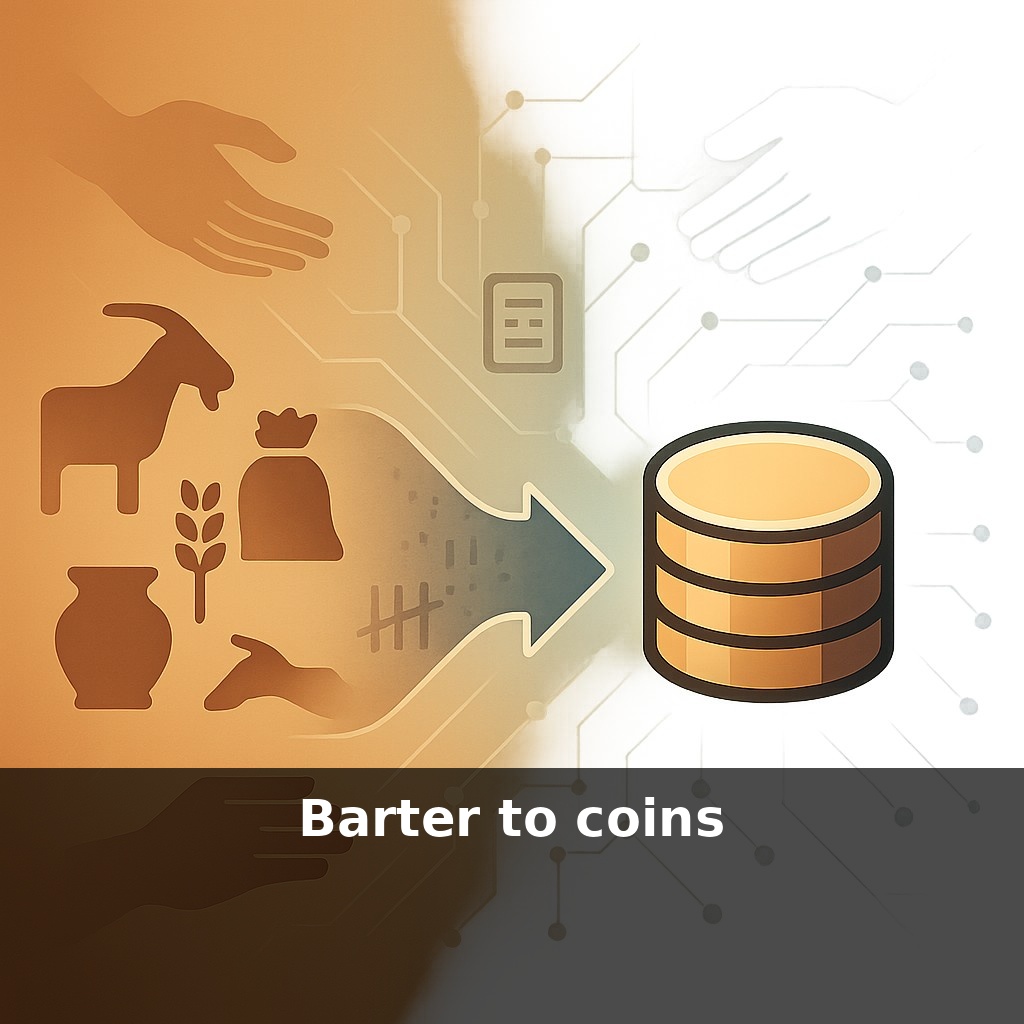
Most ancient trades weren’t simple swaps of goats for grain. In fact, pure barter was the exception. Picture a farmer, a potter, and a sailor all stuck in a three-way stalemate—each rich in goods, but unable to trade, waiting for the perfect partner who never arrives.
So how did people escape that stall-out and turn exchange into something scalable? They started leaning on *memory* and *trust* instead of constant trades. Neighbors kept informal tabs: “You helped with my harvest; I’ll owe you meat in winter.” Temples and palaces logged who delivered grain and who could claim rations later. In small communities, reputation functioned like an invisible ledger—break your word and you’d lose access to the network.
But as villages grew into towns, memory hit a ceiling. You couldn’t personally know every shepherd, potter, and sailor walking into a busy port. Long-distance traders faced an extra headache: how do you trust someone you’ll never see again? That pressure pushed societies toward something new—objects that could *stand in* for trust itself. Not just useful goods, but special items everyone agreed had claim power, even far from home.
Suddenly, some goods started to play a different role. Grain, cattle, beads, metal tools—people noticed these were easy to pass along, store, and value, even outside the original deal. A sack of grain might settle a debt today, buy passage on a boat next month, and pay temple fees later. Bit by bit, certain items became *preferred* for settling up, like a song everyone in town already knew the words to. Rulers leaned into this. They gathered metals, set standards for weight and purity, and used these to pay workers and soldiers. Once the palace said, “We accept this,” everyone else took notice.
Across the Eastern Mediterranean, this quiet shift kept accelerating. In busy port cities, merchants were juggling wool, wine, timber, spices, and metal in dozens of separate dealings. Writing every obligation on clay tablets or tally sticks worked for temples and palaces, but it was slow, local, and tied to whoever held the records. Traders needed something they could carry on a ship, hand over in a crowded marketplace, and trust at a glance.
Metal was the breakthrough. Unlike grain, it didn’t rot; unlike cattle, it didn’t wander off. You could melt it, split it, weigh it, and—crucially—reuse it in the next deal. Early on, people just weighed lumps or ingots. But that still forced each side to test purity and argue about measures. In a bustling agora, those frictions added up. Shaving a little metal here, sneaking in some cheaper alloy there, could quietly drain profit and slow everything down.
That’s where Lydia’s electrum pieces changed the game. When a royal authority stamped a mark onto a fixed chunk of precious metal, they weren’t just decorating it; they were broadcasting a promise: “This unit meets our standard, and we’ll treat it as such in our own payments and taxes.” Suddenly, the time-consuming parts of each deal—testing, weighing, haggling over quality—were compressed into a tiny symbol struck into metal. A merchant in Ephesus didn’t need to know the miner in Lydia; the mark connected them.
As other regions adopted their own issues, coins became a kind of travelling contract. Athenian owls, Roman denarii, later the Venetian ducat—each coin carried not only metal, but reputation. If a city kept its issues reliable, its pieces could circulate far beyond its walls. If it repeatedly cut corners, traders discounted or refused its money, punishing the issuer without any formal vote or protest.
For ordinary workers, this shift was just as radical. Regular pay in coin turned sporadic obligations into predictable streams. Soldiers could compare offers between commanders. Craftspeople could sell to strangers and still be sure their earnings would be welcome in distant markets. Bit by bit, coins connected local worlds into a wider economic web, and the people quickest to navigate that web—shippers, money changers, wholesalers—found entirely new ways to build fortunes from the flow itself.
A Lydian miner who once hauled raw ore for local elites could now be paid in stamped pieces and quietly stack them away. A savvy woman in a harbor town might take those same pieces, buy surplus olive oil after harvest when prices dipped, then ship it north and sell when demand spiked—keeping the difference. Early moneychangers set up in busy ports to swap foreign issues: Athenian owls for Persian siglos, local pieces for trusted ducats centuries later. Their edge wasn’t strength or land; it was noticing small gaps—one city overvaluing a coin that another discounted—and living in that spread.
Think of it like music: before coins, each village played its own rhythm; you had to learn every beat to join in. Coins acted more like a shared tempo that let strangers improvise together without a conductor. Anyone who learned to “hear” that tempo—reading mint marks, weighing risks, sensing which issues traveled farthest—could turn everyday exchanges into a craft, and that craft into unusual income.
Lurking in today’s apps and blockchains is a similar crossroads. Programmable tokens can carry rules the way coins once carried rulers’ seals: who can use them, when, and for what. That flexibility cuts both ways. A startup might airdrop tokens like concert wristbands, unlocking services or discounts. A government could issue “expiring” vouchers that vanish if you save. The real opportunity—and risk—is in who gets to write those rules, and whose habits they quietly reshape.
Coins didn’t just tidy up markets; they rewired ambition. Once you could stack value like books on a shelf, new questions appeared: How many “shelves” do I want? What risks am I willing to take to fill them? Your challenge this week: notice every modern “coin” you earn—points, credits, likes—and ask, *who benefits most if I keep playing by these rules?*