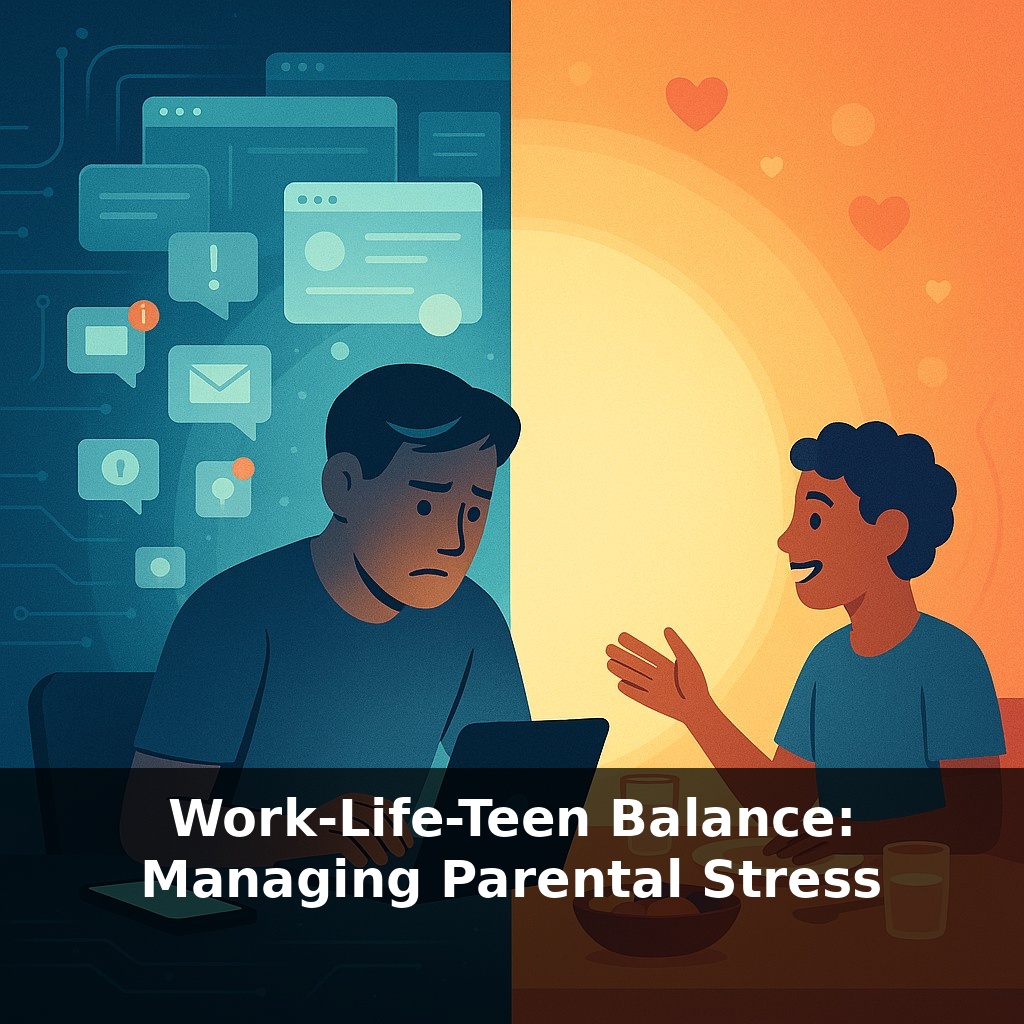
A recent study found parents felt significantly calmer on days they had just three tech‑free dinners with their teens. Now, jump to a different evening: you’re answering “just one more” work email, your teen needs you, and your patience is gone. How did the same parent end up here?
Twenty minutes lost to traffic, three new work deadlines, one tense text from your teen about a missing hoodie—by 7 p.m., your stress already feels like an overloaded browser with too many tabs open and no idea where the music is coming from. This is the “triple‑demand” zone researchers talk about: work, home, and teen‑raising all peaking at the same time, all insisting they’re urgent.
In earlier episodes we focused on your teen’s inner world—privacy, friends, hard conversations. Today we turn the camera around. Because your nervous system is the emotional climate your teen grows up in. When you’re stretched thin, even neutral teen behavior can feel like defiance, and small conflicts can snowball fast.
We’ll explore how to align your time, energy, and expectations so you’re not just surviving weekdays, but shaping them with intention.
Stress research on parents of teens keeps circling back to the same quiet truth: your schedule isn’t just a calendar problem, it’s a physiology problem. The way your day is stacked changes your heart rate, your hormone levels, your ability to notice the difference between “eye‑roll” and “crisis.” That’s why strategies like boundary setting, cognitive re‑appraisal, and shared family planning matter—they’re less about becoming hyper‑organized and more about creating recovery pockets. Think of these as tiny trail shelters along a long hike, where you and your teen can catch your breath before the next steep section.
Stress usually sneaks in sideways, not head‑on. You might feel “totally fine” at 4 p.m., then snap at your teen at 7:15 and only notice the tightness in your jaw after the argument. So the first step isn’t fixing evenings; it’s getting curious about the whole day that leads into them.
Start with inputs, not willpower. That University of Illinois finding—every extra hour of after‑work email predicts a 20% jump in next‑day irritability—highlights something crucial: your patience with your teen is strongly shaped by what happens *before* you see them. If your job regularly leaks into the hours when your teen is most available, you’re trying to parent from an overdrawn emotional account.
Here’s where boundaries stop being a buzzword and become concrete. Instead of “I should be more present,” translate it into one visible behavior: for example, no replying to non‑urgent emails between 6–8 p.m. three days a week. You’re not promising eternal balance; you’re running a contained experiment on how a tiny shift upstream changes the tone downstream.
Cognitive re‑appraisal is another upstream tool. It’s the mental move from “my teen is being impossible” to “my teen is having a hard time, and I’m running on fumes.” Same situation, different story, different options. Before reacting, ask two quick questions: “What else could be true here?” and “What state am *I* in right now?” Research on parents shows that this kind of re‑framing lowers physiological stress even when external pressures don’t change.
Shared family planning brings your teen into the solution. Instead of secretly juggling everything, try a 15‑minute weekly “logistics huddle”: sports, rides, tests, late meetings, who’s cooking what, which night absolutely has to stay light. You’re not just coordinating schedules; you’re modeling how adults name limits and negotiate needs.
Think of it like tending a small garden: you can’t control the weather—work crises, teen moods—but you can choose where the shade cloth goes, what gets watered first, and which plants you let go of this season so the essentials actually thrive. The research on lowered cortisol with mindfulness and lower turnover with flexible workplaces tells us the same thing from different angles: when adults have room to reset, kids do better too.
A practical way to start is to sort your weekly commitments into three buckets: non‑negotiable, flexible, and optional. A non‑negotiable might be a medical appointment or your teen’s championship game; flexible could be when you prep meals; optional might be saying yes to that extra committee. You’re not judging the worth of each task, only its true urgency. This is where that “juggling balls” idea matters: a skipped vacuuming session rarely has the same long‑term cost as skipping your own sleep or a teen’s late‑night vent.
Consider two evenings. In one, you agree to a last‑minute project, stay up late, and tell yourself you’ll just “push through.” In the other, you negotiate a realistic deadline, protect your wind‑down time, and accept that tomorrow’s dinner might be frozen pizza. The outside world may not see much difference, but your teen will feel it in your tone, your patience, and your capacity to listen without turning every problem into an emergency.
Stress management with teens isn’t about becoming endlessly calm; it’s about designing margins. As work cultures evolve, parents may treat their attention like a monthly budget: not every demand gets funded. Flexible hours, remote options, and brief recovery rituals—like a quiet 10‑minute commute walk or a solo coffee before pickup—can act as “interest payments” that keep relationships out of debt. The experiment for families and workplaces alike is how far we can shift structures, not just self‑control.
So balance becomes less a finish line and more like steering through shifting traffic: you’re scanning, adjusting speed, choosing which exits can wait. Your challenge this week: test one tiny structural change—a 10‑minute decompression ritual, a clearer “offline” signal, or a teen‑led planning huddle—and just notice how it subtly reshapes the evening’s tone.