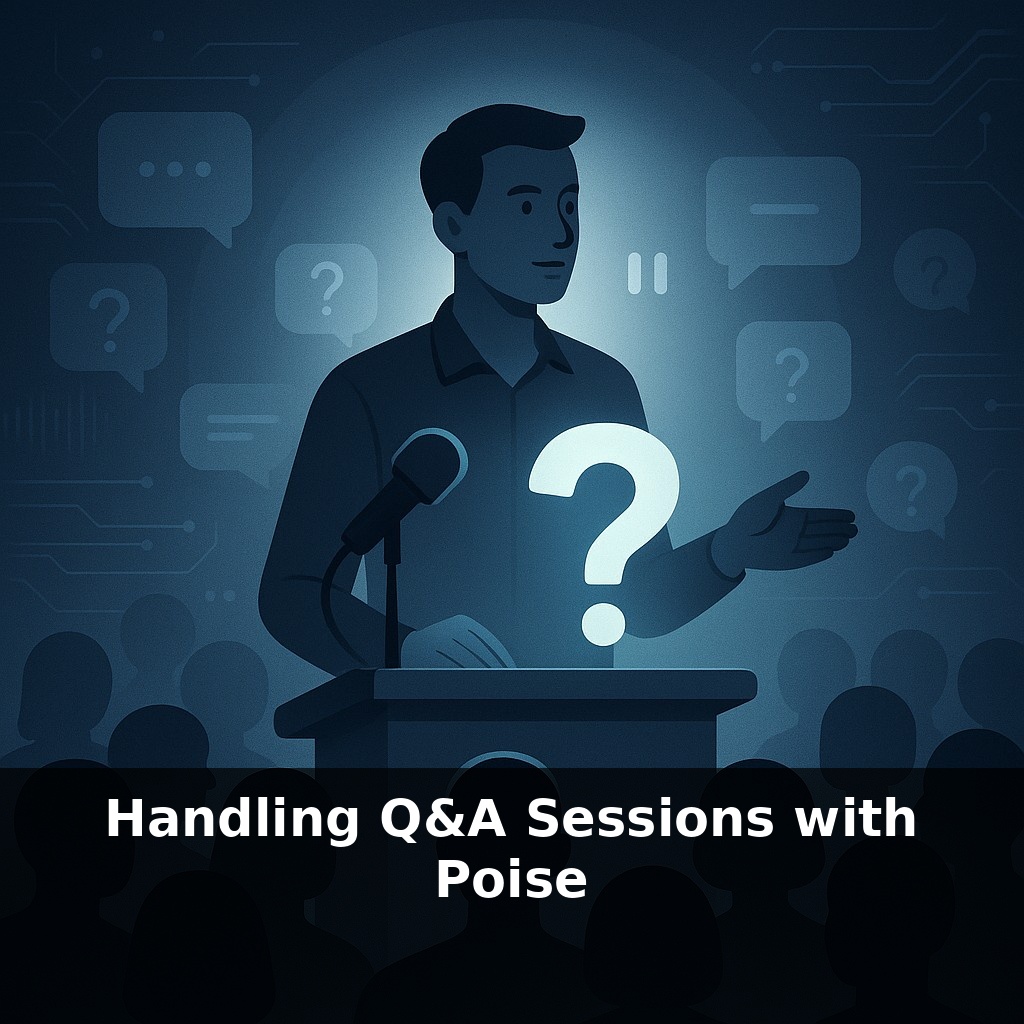
About half of what your audience remembers doesn’t come from your slides at all—it comes from the Q&A. A single awkward answer can erase a polished presentation, while a calm, well-placed pause can boost your credibility. So what actually happens in those tense few seconds?
Harvard Business Review reported that audiences retain roughly twice as much from Q&A as from slide decks. That means the “after-party” of your talk quietly becomes the main event. Yet most presenters treat Q&A like a wildcard—hoping for friendly questions, bracing for hostile ones, and relying on adrenaline to carry them through. In tech settings, this pressure multiplies: questions can be deeply technical, politically loaded, or both. The good news is that poised Q&A isn’t a mysterious talent; it rests on three trainable skills. First, anticipating the lines of inquiry that matter most to your stakeholders. Second, listening in a way that slows the moment down instead of speeding your heartbeat up. Third, responding with a simple internal structure so you never ramble, even when you’re unsure. We’ll unpack how to build those muscles deliberately, not just survive on instinct.
In tech talks, Q&A is where stakeholders quietly test you: not “Do you know everything?” but “Can I trust how you think when things get messy?” That trust forms around three pressure points—how you handle uncertainty, how you handle pushback, and how you handle overload. A senior engineer drilling into edge cases, a VP probing risk, a user challenging assumptions: each is less a quiz and more a stress test of your judgment. Like debugging a live system, your goal isn’t flawless performance; it’s demonstrating calm diagnostics, clear priorities, and a willingness to expose your reasoning without collapsing into defensiveness.
Think of Q&A as three overlapping games you’re playing at once: forecasting, decoding, and composing.
Forecasting happens long before anyone raises a hand. Start by mapping “question territories” rather than specific questions: feasibility, risk, cost, ethics, integration, roadmap, impact on existing teams. Under each, jot down: “If I were skeptical, what would I ask?” and “If I were excited but cautious, what would I ask?” This gives you clusters, not scripts. For each cluster, prepare one crisp takeaway sentence you’d be happy to repeat in different forms. That sentence becomes your “home base” when a question wanders.
Decoding begins the moment a question starts. In tech settings, the visible question (“Will this scale?”) often hides the real one (“Will this make me look foolish if I back it?”). Listen for clues: role (security, legal, ops), emotional charge (anxious, angry, curious), and time horizon (today’s fire vs. next year’s risk). A useful move is to briefly paraphrase what you heard: “So you’re mainly concerned about X, especially in Y scenario, right?” This does three things at once: buys thinking seconds, lets them correct your aim, and signals that you’re engaging with their concern, not just the words.
Composing is how you shape the answer in your head while you speak. Keep your internal template ruthlessly simple: “Core answer → brief reason → concrete example → landing line.” Many presenters attempt to cover every angle and drown their main point. Instead, choose one angle, go one level deeper than the questioner expects, and stop yourself before you feel “fully empty.” That slight sense of “I could say more” is usually the audience’s “That was enough.”
Hostile or loaded questions need the same structure with two extra moves: separate the emotion from the issue (“There’s a lot of frustration here about timelines; on the technical side, the key constraint is…”) and narrow the scope (“Let me focus on the part we can change this quarter…”). This reduces the cognitive load for everyone and prevents you from fighting ghosts.
Your goal isn’t to win every exchange; it’s to show that your thinking stays clear even when the room doesn’t.
A founder fielding Q&A on a new API might map territories like “integration risk,” “data ownership,” and “support expectations.” When a developer asks, “What happens when your service goes down?” the founder resists the urge to defend uptime. Instead, they decode: this is really about operational blast radius. They answer with a tight arc: “Outages are rare but inevitable. Here’s how we isolate failures, here’s our rollback window, and here’s the status channel you’d see in the first five minutes.” Specific, bounded, and then they stop—no tour of every microservice.
Think of it like a point guard under pressure in the last minute of a game: they don’t sprint blindly; they create a small pocket of space, read the defense, then make the highest-percentage pass. In Q&A, your “space” is the brief paraphrase, your “read” is the role and emotion behind the question, and your “pass” is a single, well-chosen example that moves the room toward your key message without trying to score on every possible angle.
AI won’t just capture your words; it will profile your Q&A “signature” — how often you dodge, concede, or reframe. As tools surface live sentiment and confusion spikes, your poise becomes a visible metric, not a vague impression. Think of each answer as a single brushstroke on a shared canvas: messy strokes still count. Practicing now with small, high‑pressure rooms prepares you for hybrid stages where silent chats, avatars, and in‑person eyes all react to your next sentence.
As we wrap up, it's crucial to treat each Q&A as a lab, not a verdict. Notice which questions light you up, which ones knot your shoulders, and where your structure frays. Over time, patterns emerge like footprints in wet cement: where you rush, where you sidestep, where you stand firm. That awareness is your real upgrade path—slides change, your reflexes travel with you.
Before next week, ask yourself: 1) “If I had to handle a rapid-fire Q&A tomorrow, which 3 ‘heat-seeker’ questions (the ones I secretly dread—like budget objections, past failures, or tough data challenges) am I most likely to get, and how would I answer them in 60 seconds or less without getting defensive?” 2) “What is one high-stakes meeting or presentation on my calendar where I can *intentionally* pause for three seconds before answering each question and restate the question in my own words—how will I remind myself in the moment to actually do that?” 3) “Who is one colleague I can ask, this week, to throw 5 unexpected or even slightly hostile questions at me for a ‘pressure-test’ practice round, and what specific feedback do I want from them about my tone, body language, and clarity under pressure?”