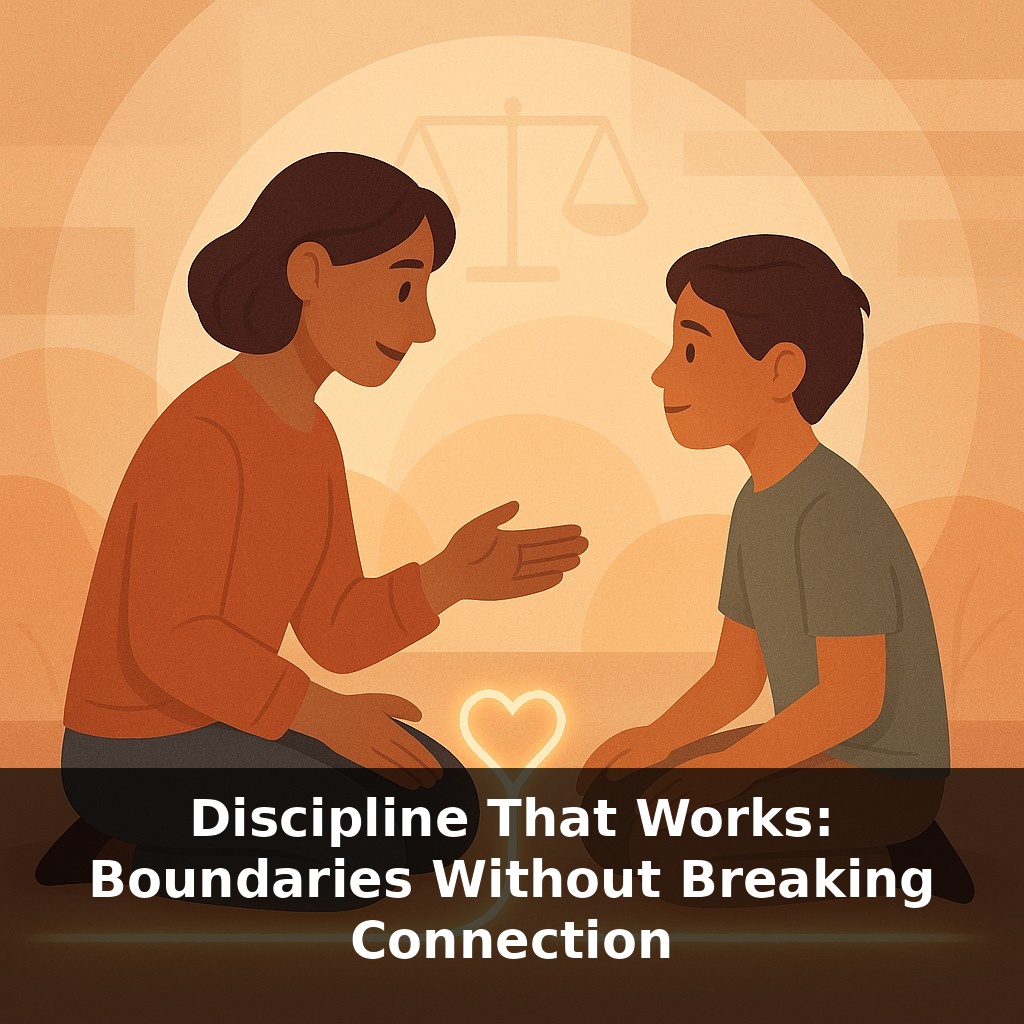
A major study of families found something striking: kids raised with strict rules *and* steady warmth did better in school and in life than kids raised with either harsh control or almost no limits. So here’s the real puzzle: how do you hold a firm line without losing your child’s trust?
“Don’t talk to me like that!” you snap—and instantly see your child’s face harden. The rule you care about just collided with the connection you care about even more. This is the tightrope modern parents walk daily: you’re not trying to run a boot camp or a free‑for‑all, but real life brings homework battles, tech overload, sibling wars, and exhausted evenings where your patience is on 2% battery.
Here’s the nuance research adds: kids don’t just react to *what* you do, but to *how* safe and understood they feel while you’re doing it. The same limit can land like a slammed door or a sturdy handrail, depending on your tone, timing, and ability to stay regulated yourself. In other words, your nervous system is quietly teaching theirs what “discipline” feels like. In this episode, we’ll turn that invisible process into practical moves you can actually use.
Think of your day like a series of “micro-moments” with your child: the rushed school drop‑off, the Lego explosion before dinner, the eye roll at bedtime. Each one is a tiny fork in the road where you can either escalate the power struggle or protect the relationship *while* holding your ground. Research on co‑regulation shows that what matters most in those moments isn’t having the perfect script, but how quickly you can move from reactivity to leadership—like shifting from emergency mode to steady pilot when the turbulence hits. That shift is a skill, and it’s one you can actually practice.
Here’s the twist most of us were never taught: effective discipline isn’t one big parenting philosophy, it’s three different jobs you’re doing—often in the same 30 seconds:
1. **Regulate the moment** 2. **Teach the skill** 3. **Protect the relationship**
When discipline “doesn’t work,” it’s usually because one of these three has gone missing.
**1. Regulate the moment: lead the temperature, not the drama.** Before you correct your child, you’re actually managing a *situation*: voices, bodies, energy. Kids borrow your steadiness (or your chaos). A practical rule of thumb: first lower intensity, then set the limit. That might sound like: “Pause. Hands down. I’m right here. Now—throwing toys isn’t okay.” You’re not being soft; you’re creating the conditions where any consequence can actually land.
**2. Teach the skill: what should happen *instead*?** Misbehavior is often an immature attempt to solve a problem: “I’m bored,” “I feel left out,” “I don’t know how to stop.” Consequences alone don’t install better options. After the dust settles, name the missing skill and practice it briefly: - Hitting sibling → “When you’re mad, you can say, ‘Move away,’ or come get me.” - Homework refusal → “Let’s practice starting with the hardest question while I sit next to you for two minutes.” Think of it like upgrading glitchy software: you don’t just yell at the computer; you install an update.
**3. Protect the relationship: separate the kid from the behavior.** Kids are tracking one core question: “Am *I* bad, or was my *choice* bad?” Your words answer that. Sharpen the difference: - Instead of: “You’re so rude.” - Try: “That was a rude way to talk. You’re not a rude kid, and I’m going to help you fix it.”
Over time, a few anchor routines make this way easier:
- **Pre-agreed boundaries**: “Screens off at 7” works better if it’s written on the fridge and reviewed *before* the show starts. - **Predictable follow-through**: one or two simple consequences you actually use, not ten threats you never do. - **Short repair conversations**: a quick debrief later—“What happened? What can we try next time?”—so every conflict becomes a tiny lesson, not a scar.
Your child slams their door after being told “No more YouTube.” You walk over, knock once, and calmly say, “We do doors gently. I’ll wait while you try that again.” That tiny sequence holds a lot: a clear boundary, a chance to repair, and a message that they’re still welcome with you, even when they’re upset.
Notice what you *didn’t* have to do there: launch a lecture, match their volume, or hand out a huge punishment. Discipline that works is often surprisingly small and specific. It’s less “giant consequence” and more “one clear next step.”
Think of it like cooking on a gas stove: you’re constantly turning the flame up or down so the food doesn’t burn or stay raw. Too low, and kids don’t take you seriously. Too high, and they go into shutdown or fight mode. The art is catching yourself *one notch earlier*—before you yell, before they bolt—to adjust the “heat” of your response while keeping the rule non‑negotiable.
As these kids grow up, the same pattern tends to echo outward. Classrooms with this style of guidance see fewer power struggles and more real collaboration. Teen friendships often feel safer, because “no” doesn’t automatically mean rejection. Later, partners and coworkers meet someone who can disagree without detonating or disappearing. Like a well-tuned orchestra, everyone still plays their own part—but they’ve learned to adjust volume, timing, and tone without losing the shared song.
You won’t get this perfect—and you don’t need to. Kids grow from patterns, not isolated moments. Every time you circle back after a hard interaction, you’re quietly teaching: “Conflict is safe here. We can repair.” Like tending a small garden, consistent light care—check‑ins, calm limits, brief do‑overs—gradually grows a sturdy, flexible kind of confidence.
Before next week, ask yourself: 1) “The next time my child resists a limit (like turning off screens or getting ready for bed), how can I calmly state the boundary once, then stay physically close and emotionally warm instead of repeating myself or snapping?” 2) “When I feel triggered by their behavior, can I pause for 10 seconds and ask, ‘What is my child needing underneath this behavior—connection, autonomy, or reassurance—and how can I respond while still keeping the boundary firm?’” 3) “Looking at the most common conflict we’ve had this week, what is one specific, clear boundary I can communicate ahead of time (with the consequence included) so my child isn’t surprised in the moment?”