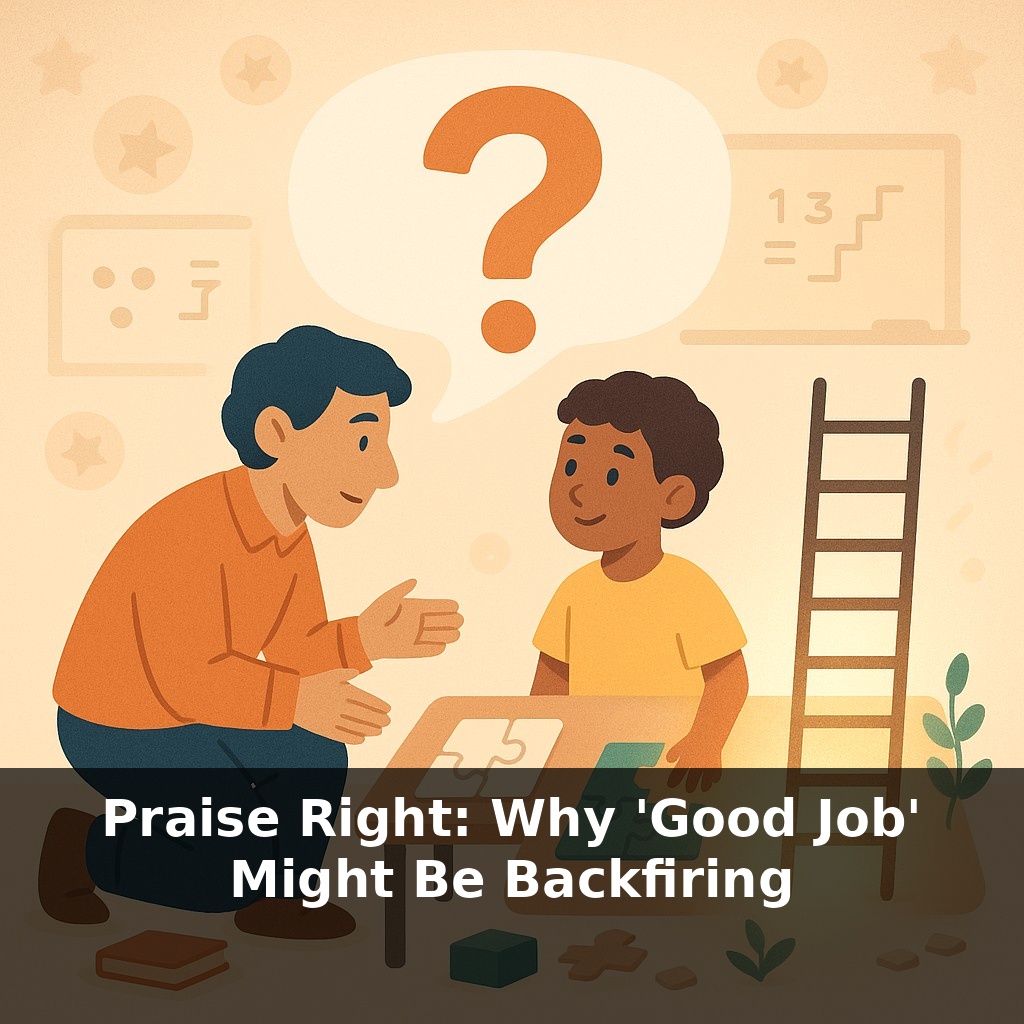
About half of kids who hear constant “Good job!” actually start choosing easier tasks. In one classroom, a teacher praised less and described effort more—and watched her most anxious student volunteer to solve the hardest problem on the board.
“Good job” has quietly become the background noise of modern parenting and teaching—on the playground, in classrooms, even after the smallest everyday wins. But as this phrase spread, something else did too: kids who melt down when they’re not instantly successful, or who quit as soon as things feel hard. That’s not a coincidence. When praise sticks to the surface, kids learn to protect the surface. They start scanning adults’ faces like weather apps: “Is it sunny approval or stormy disappointment today?” Over time, some children chase that forecast instead of their own curiosity. Others stop taking risks because they’re afraid of “ruining” the good impression. In this episode, we’ll zoom in on the tiny differences in how we respond—often just a few words—that can shift kids from approval-chasing to authentic engagement.
So where does that leave us in real life—on the sidelines at soccer, over math homework, in the rush of bedtime routines? Many adults feel stuck between two unsatisfying options: say “Good job!” on autopilot, or say nothing and worry kids will feel ignored. The goal isn’t to become a praise robot, mechanically listing every effort; it’s to tune our responses so they actually match what matters in the moment. Think of shifting from quick applause to quiet noticing: instead of adding more noise, we start turning up the signal children can actually use to steer themselves.
A 230 % spike in “good job” in parenting books sounds harmless—until you pair it with what kids actually do next. In Dweck & Mueller’s study, children who heard person-focused praise were far more likely to reach for the easy worksheet; kids who heard process-focused feedback went hunting for harder problems. Same kids, same ability, different words—and their appetite for challenge flipped.
What makes those small wording shifts so powerful is *what they highlight*. Person-focused comments pull attention to identity: “I’m the smart one,” “I’m the artistic one,” “I’m the kid who’s good at this… as long as I don’t mess up.” Process-focused comments pull attention to levers kids can move: strategies, persistence, planning, asking for help, trying again.
This is where Deci’s puzzle study matters. When praise felt controlling—“Do it this way, so you’ll be a good participant”—people actually *stopped* choosing the activity for fun. The task hadn’t changed. But the experience shifted from “This is interesting” to “This is how I stay in someone’s good books.” For kids, that can quietly turn reading, math, or music into a performance they’re always being graded on, even when no one’s holding a red pen.
In everyday life, you can almost hear the difference:
- Person-focused: “You’re a natural athlete!” - Process-focused: “You kept adjusting your kick until it curved where you wanted.”
- Person-focused: “You’re so organized.” - Process-focused: “You sorted everything into piles and didn’t stop until each one had a spot.”
Notice how the second version gives kids a mental replay of *how* they got there. That replay is what they can pull up when things are *not* going well.
The Chicago classrooms experimenting with growth-mindset feedback didn’t just add more compliments. Teachers were trained to spotlight specific moves: “You checked your answer two ways,” “You tried a new method after the first didn’t work.” That shift is small enough to fit into a rushed school day, but big enough that test scores budged within a semester.
And this isn’t about schools only. At home, the same logic applies whether a child is learning to zip a coat or navigate a friendship conflict: words that map the path are far more useful than words that decorate the finish line.
At a weekend soccer game, a parent tries a tiny experiment. Instead of calling out, “Good job!” after every kick, they wait. When their child finally makes a tricky pass, they say, “You spotted your teammate and curved the ball right to her feet.” The kid jogs back grinning—not because the parent is pleased, but because someone noticed the *choice* they made.
During homework, consider swapping praise for neutral narration: “You stuck with that word until it made sense,” then pause. Often kids will fill the silence with their own reflection: “Yeah, breaking it into parts helped.” That step—hearing themselves name a strategy—matters more than extra compliments.
In the kitchen, it’s like adjusting seasoning while you cook: a pinch of acknowledgment here, a bit of curiosity there. When your child says, “Look what I drew,” try, “Show me the part you like best,” then mirror it back: “You played with shading on this corner.” The goal isn’t to talk more; it’s to notice smarter.
As AI mentors and workplace tools learn to “talk,” their feedback style will quietly shape how whole generations tackle hard things. Picture a study app that reacts like a thoughtful coach, not a slot machine: “You tried three approaches on that proof—want a hint for a fourth?” Future report cards and performance reviews may look more like nutrition labels, breaking down strategies used rather than just scores—inviting reflection instead of a thumbs-up tally.
When kids grow up hearing feedback that maps their moves instead of rating their worth, they’re better equipped to coach themselves later—studying alone, learning to drive, navigating first jobs. Like adjusting sails to match shifting wind, they start scanning situations, not faces, and asking, “What can I try next?” instead of, “Did I do enough to stay liked?”
Here’s your challenge this week: Pick one child you interact with regularly and go the entire day without saying “Good job” or “You’re so smart”—instead, give only process-focused praise (for example: “You really stuck with that puzzle even when it got tricky” or “You tried three different ways to solve that problem”). At least three times today, pause for 10 seconds before responding and then describe exactly what you noticed them doing, rather than judging it (“I noticed you shared the markers without being asked”). By tonight, choose one moment where you would *normally* have given generic praise and rewrite it out loud to the child as very specific, effort-based feedback.