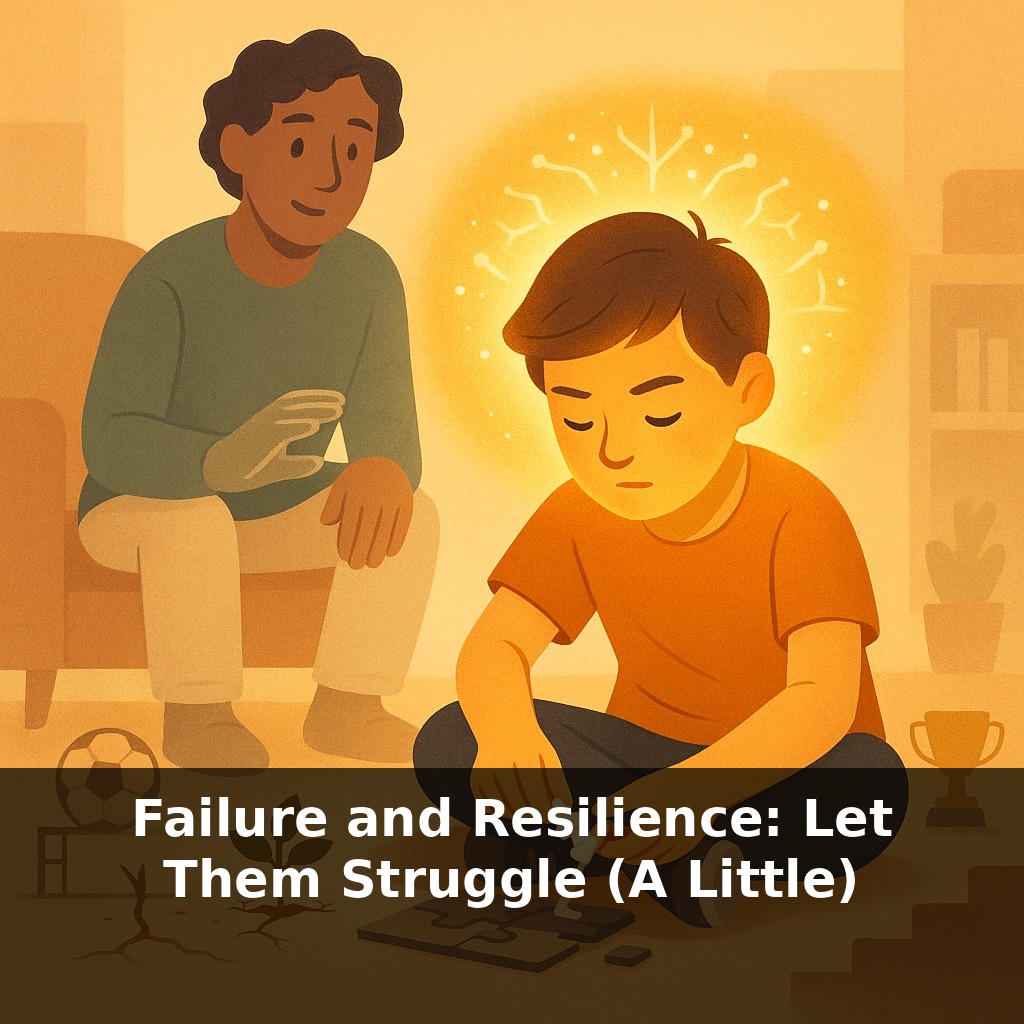
Your child is stuck, eyes watering, waiting for you to fix it. Suddenly, they figure it out on their own and their face lights up. They're not just learning; their brain's reward center is lighting up brighter than ever before. What just happened? Do you step in… or hold back just long enough for their brain to grow?
Your child misses the winning goal, blanks on a test question, gets left out of a group chat—tiny earthquakes in their world. In those moments, most modern parents feel the same urge: rush in, smooth it over, erase the sting. Yet a growing wave of research suggests something uncomfortable: when we remove every wobble, we quietly steal the very stability we’re trying to create.
Resilience doesn’t appear when life is calm; it’s built in these small storms. Developmental studies track a pattern: kids who regularly face age-appropriate setbacks—and have a steady adult beside them, not in front of them—develop more grit, better coping skills, and fewer anxiety symptoms over time.
So the question shifts from “How do I protect my child from failure?” to “How do I dose just the right amount of struggle… and stay close while they learn to stand?”
Many parents secretly run on the rule: “If I can prevent the hurt, I should.” It feels loving, especially if you grew up with too little support yourself. But research keeps finding a twist: kids whose parents “support, not rescue” end up more confident, not less. They learn their feelings are survivable and that effort changes outcomes. In real life this looks boringly small: letting your 6-year-old wrestle with a stuck zipper, your tween email the teacher about a missing assignment, your teen call to reschedule their own appointment while you wait nearby like quiet backup.
Here’s the twist most parents don’t see coming: kids don’t learn “I can handle hard things” from our pep talks; they learn it from *their own* track record. Their nervous system quietly keeps score: “Last time I messed up, did I fall apart… or did I figure something out with a grown-up nearby?” That internal ledger becomes the backbone of how brave they feel trying the next hard thing.
Studies in classrooms and homes show a repeating pattern. When adults jump in fast—tying every shoe the second a child struggles, emailing the teacher at the first sign of conflict—kids start drawing a quiet conclusion: “If the adults always have to fix it, I must not be capable.” Over time, that belief predicts lower persistence in school, more avoidance, and more “I can’t” before they’ve even tried.
But when adults allow small stumbles and stay steady, kids start to connect effort with improvement. That’s one reason programs that *teach* about mistakes—like Blackwell and Dweck’s work on explaining how errors help the brain change—don’t just make students feel better; they measurably raise performance. Kids behave differently when they see setbacks as useful data instead of a verdict on who they are.
Here’s where many caring parents get stuck: “If I don’t fix it, am I being cold?” The research points to a middle lane. Kids do best when adults: - Normalize mistakes out loud (“Everyone blows a test / misses a shot sometimes”). - Ask process questions instead of offering instant solutions (“What have you already tried?” “What’s one next step?”). - Give just enough help to keep things from becoming overwhelming, not zero help and not total takeover.
Think of it like a good doctor adjusting a medication dose: too little challenge and nothing changes; too much and the side effects are worse than the illness. Your job isn’t to eliminate discomfort, it’s to calibrate it—staying close enough that your child feels emotionally held while they do the hard part themselves. Over hundreds of small moments, that’s how the story in their head quietly shifts from “I need someone to save me” to “I can do hard things… and I’m not alone while I learn.”
A practical way to “dose” struggle is to scan your day for tiny handoff moments. Your 5-year-old can’t open the snack wrapper? Instead of taking it, you start it and let them finish. Your 9-year-old forgets their homework? Rather than driving it over, you coach them to talk with the teacher about a late plan. Your teen blows their budget? You don’t wire more money; you sit down with their bank app and help them map out how to recover this month.
Think of how James Dyson treated each failed prototype: not as proof he was hopeless, but as information. You can borrow that stance at home. When your child groans, “I messed up,” you might ask, “What did this teach you about what *doesn’t* work yet?” That word “yet” quietly keeps the door open.
Different kids need different doses. A cautious child might need you to shrink the task (“Just email one sentence”). A headstrong child might need firmer boundaries (“You can be upset, but you still need to call and apologize”). Over time, your consistency turns these tiny experiments into your child’s private evidence file: problems come, feelings surge, and they can still take the next step.
A paradox is emerging: tools that make life easier for kids may quietly make challenge feel harder later. As AI coaches and adaptive apps learn to “smooth the path,” parents may need to *reintroduce* mild bumps—like keeping some tasks manual, some conversations face‑to‑face. Think of tech as a power tool: fantastic in skilled hands, risky if it replaces practice. Families that deliberately leave room for small, real‑world mistakes will likely raise adults who can handle a future full of unknowns.
Here’s the quiet payoff: kids who regularly work through small snags become the ones who raise their hand with a half-formed idea, try a new sport mid‑year, or apply for the internship they’re not “perfect” for. Like a young cook burning a few pancakes before nailing breakfast, they stop fearing the mess and start trusting they can improvise.
Try this experiment: The next time your child hits a frustrating moment (like homework confusion, a tricky puzzle, or a sports skill they “can’t” do), set a silent 5-minute timer and consciously do *nothing* to rescue them—no hints, no fixes, just calm presence and curiosity. Before the timer starts, say, “I’m here if you need me, but I believe you can figure out a way to try this on your own for a few minutes.” During those 5 minutes, only ask questions like, “What have you tried so far?” or “What’s one different way you could approach this?” After the timer ends, briefly reflect together: ask them what they figured out, how it felt to keep going, and what they might try next time they get stuck. Then notice for the rest of the day whether they show even a tiny bit more confidence or willingness to struggle before asking for help.