Opening Up: Recognizing the Need for Change
📝 Transcript
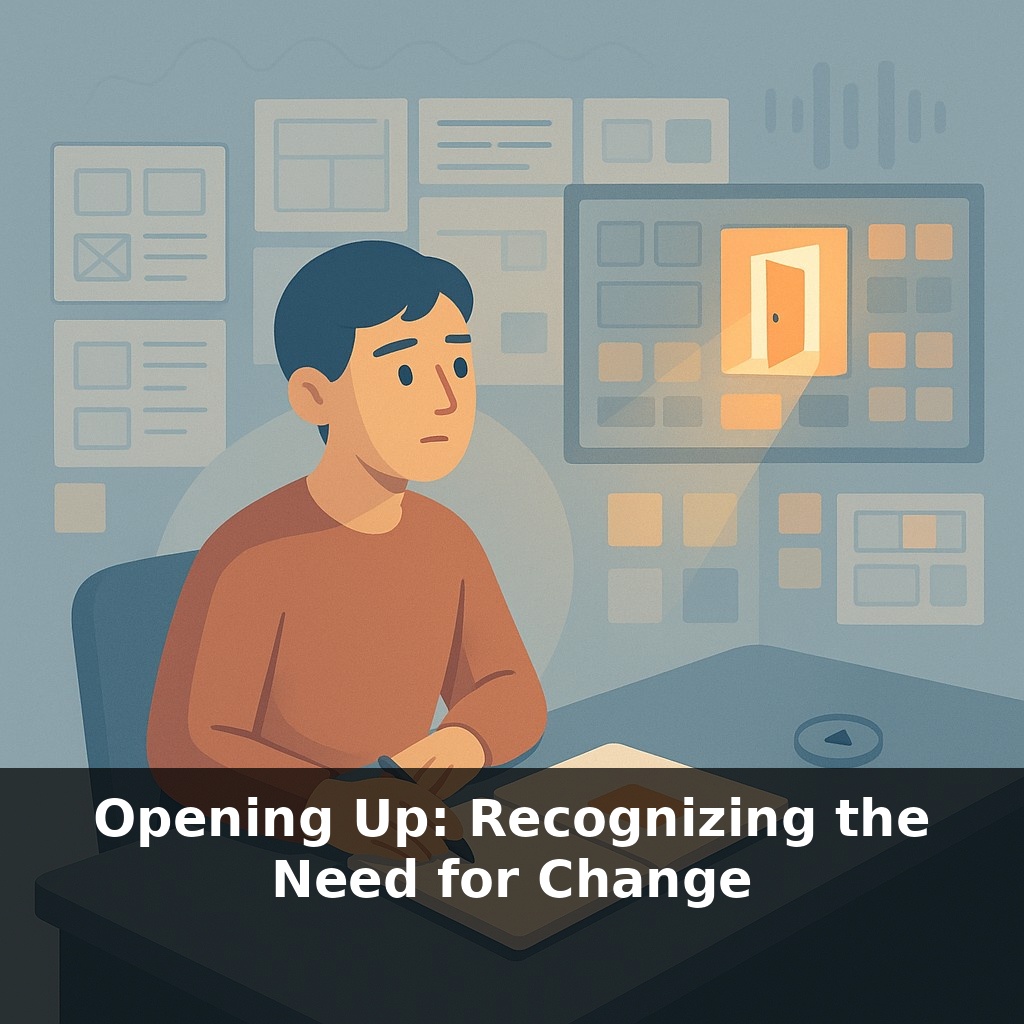
Right now, about half the world’s employees are quietly checked out at work—yet most would swear they’re “fine.” You’re shipping projects, hitting deadlines… and still, something feels dulled. This episode is about that invisible moment when “fine” quietly becomes stuck.
Maybe you’ve noticed it in small ways: your go‑to design trick shows up in every project, your Figma files are starting to look like cousins, and feedback sounds less like “interesting” and more like “solid, thanks.” Nothing’s wrong, exactly—but nothing’s really stretching, either.
What’s happening here isn’t laziness or lack of talent; it’s your brain doing its efficiency job a little *too* well. Once it learns a pattern that “works,” it starts auto‑completing your creative process, quietly turning bold decisions into default choices. Over time, that efficiency can sand down your curiosity without you ever deciding to play it safe.
In this episode, we’ll treat that subtle flattening as data. You’ll learn how to spot early signals of creative stagnation in your body, your calendar, and your files—before your work or your confidence take the hit.
So instead of asking, “Am I burned out?” we’ll ask a sharper question: “Where, exactly, have I stopped being surprised by my own work?” That shift matters, because stagnation rarely hits everything at once. It hides in specific pockets—certain clients, a recurring deliverable, the part of the process you can do half‑awake. In the next few minutes, we’ll zoom in on three layers of evidence: what your day actually looks like, the patterns buried in your recent projects, and the tiny frictions you’ve been unconsciously working around. Each layer gives you a different, concrete signal that it’s time to adjust course.
Start by zooming out from “how you feel” and look at what you’re *producing*. One simple lens: novelty. Over your last 5–10 projects, how many times did you genuinely try something you weren’t sure would work? Not a tiny tweak to a button style, but a move that made you slightly nervous to present. If you’re honest and that number is close to zero, you’re not just being consistent—you might be running on creative autopilot.
Neuroscience gives a clue why that matters. Your brain’s reward system spikes when it encounters something new, then rapidly flattens with repetition. After a handful of similar passes at the same kind of brief, the internal “this is interesting” signal fades, even if the external feedback is positive. When that happens, shipping on time can mask the fact that your own curiosity has quietly left the room.
A second lens: motivation source. Scan your recent projects and ask, “Why did I push on this?” If the answer is mostly deadlines, client pressure, or fear of looking unprepared, you’re leaning heavily on extrinsic fuel. Intrinsic motivation—being pulled forward by interest or challenge—tends to show up as staying a bit longer *because* you’re onto something, not *until* you’ve covered yourself. A sustained shift away from that internal pull is a reliable early-warning sign.
Third lens: skill trajectory. Look at your craft like a version history, not a portfolio. In the last 6–12 months, where can you point to a clear upgrade—an interaction pattern you can now design faster and deeper, a research method you actually integrated, a motion language you couldn’t have pulled off a year ago? If your skills feel more “spread sideways” than “pushed upward,” you may be orbiting what you already know instead of expanding it.
Teams offer another mirror. Who do you collaborate with, and how often? Long-running, stable groups are comfortable, but data from design firms shows that periodically changing who’s in the room injects fresh perspectives and increases the odds of non-obvious ideas. If your feedback circle hasn’t changed in ages, you’re likely hearing the same mental models reflected back.
All of this points to a simple but uncomfortable truth: you can be performing *well* and still be slowly narrowing the range of what you’re capable of. The goal isn’t to chase novelty for its own sake; it’s to notice when your work has stopped surprising even you, and treat that not as failure, but as a clear signal that it’s time to adjust your inputs before your output goes flat.
Think about designers you admire whose work keeps evolving. Often, their calendars tell a different story than yours: side projects that have nothing to do with their day job, recurring sessions where they dissect other people’s products, and collaborations that look slightly “out of their league.” Those aren’t random; they’re deliberate ways of keeping their inputs ahead of their outputs.
Take IDEO’s habit of rotating team members. The benefit isn’t only diversity of thought; it also forces each person to re-explain their defaults to new collaborators. In that act of explaining, stale assumptions surface. Or look at Adobe’s Kickbox: it doesn’t wait for someone to feel stuck. It bakes in small, time-boxed experiments that regularly put designers in contact with uncertainty, before their work starts looping.
A creative career is closer to a well‑architected building than a single room: load‑bearing walls (core skills) stay; movable partitions (tools, collaborators, formats) shift as new needs appear. Recognizing where you haven’t moved a “wall” in years is often the cleanest signal that it’s time to reconfigure your space, not just decorate it.
As AI systems learn your style and start offering “good enough” options by default, the real risk isn’t doing worse work—it’s slowly losing your edge without noticing. The designers who stay sharp will treat their own habits like a product in beta: instrumented, reviewed, and regularly refactored. Think of recurring “version updates” to how you learn, not just what you ship.
Your challenge this week: For the next 7 days, run a personal “creative telemetry” experiment.
Here’s how:
1. **Set up three tiny sensors** Each day, capture just three quick data points (on your phone or notebook): - One moment you felt mildly curious or energized while working - One moment you felt yourself going on autopilot - One moment you dodged a stretch opportunity (even a small one)
Keep each note to a single sentence and timestamp it. Don’t judge, don’t analyze yet—treat it like logging events in an app.
2. **End-of-day micro review (5 minutes max)** At the end of each day, look at your three notes and answer, in bullets: - What *specifically* triggered the curiosity spike? - What conditions were present when you went on autopilot? - Why did you skip the stretch moment—time, confidence, pressure, something else?
You’re not trying to fix anything yet, just labeling patterns as they emerge.
3. **End-of-week “release notes” (15–20 minutes)** After 7 days, scan all your logs and write a one-page “v1.0 Creative OS – Release Notes” with three sections: - **Known Bugs** – 2–3 recurring contexts where you default to autopilot - **Performance Boosters** – 2–3 environments, times of day, or collaborators that show up near curiosity spikes - **Deferred Features** – 2–3 stretch moves you consistently avoid (certain tools, types of problems, or stakeholders)
The point is to see your week like a system trace, not a mood diary.
4. **Choose one micro‑patch for next week** From your “Known Bugs” and “Deferred Features,” pick *one* tiny behavior to flip next week—for example: - When you notice autopilot during routine production work, spend 10 minutes trying a different approach before reverting to default. - When a stretch task appears (presenting, exploring a new tool, joining a different kind of meeting), say “yes” once instead of “maybe later.”
Frame it as a limited experiment, not a personality overhaul.
5. **Set a 14‑day checkpoint** Book a 15‑minute meeting with yourself two weeks from now titled: “Creative Telemetry Checkpoint.” Bring your logs and ask: - Did my week *feel* the same, even though some behaviors changed? - Did any outputs or reactions from others shift, even slightly? - What’s one new metric I want to track about my work next? (E.g., “number of ideas I kill too early,” “number of times I asked for outside input.”)
By the end of this experiment, you’re not aiming to feel wildly more inspired. The goal is to install a lightweight “early detection system” so that, as tools and expectations accelerate, you can see your creative trajectory with enough clarity to steer—before invisible ruts harden into your new normal.
Seeing this as an experiment, not a verdict, is what keeps you movable. Instead of waiting for a crisis, you’re installing low-key “status lights” on your process—like a dashboard in a car, not a fire alarm. Over time, those signals let you steer toward harder problems, stranger inputs, and bolder collaborations long before your work starts to feel like reruns.
Here’s your challenge this week: choose one area of your life you’ve been “white-knuckling” through (like staying in a draining job or pretending a relationship is fine) and have one honest, face-to-face conversation about it with someone you trust. Before that conversation, say out loud—twice—the specific change you’re considering (for example, “I’m seriously thinking about setting a boundary with my boss around after-hours emails”). During the conversation, ask them one direct question: “From the outside, what patterns do you see me repeating here?” and just listen without defending or explaining. By the end of the week, send that person a short follow-up message telling them one concrete step you’ve decided to take based on what you heard.
Unlock all episodes
Full access to 5 episodes and everything on OwlUp.
Subscribe — $1.99/monthLess than a coffee ☕ · Cancel anytime