About half of people quietly believe they’re failing at creativity—while still posting, presenting, “being creative” every day. You’re in a meeting, an idea pops up, and you kill it in under three seconds. Not because it’s bad—because an old voice says, “Don’t risk it.”
That instant shutdown isn’t random; it’s muscle memory. Years of school critiques, rushed client edits, and silent meetings have trained your brain to slam the brakes the moment something feels even slightly off-script. Over time, those tiny “better not” moments harden into rules you don’t remember writing: “My ideas need to be polished before I share them.” “Others are more original than me.” “I’m only good at execution, not concept.”
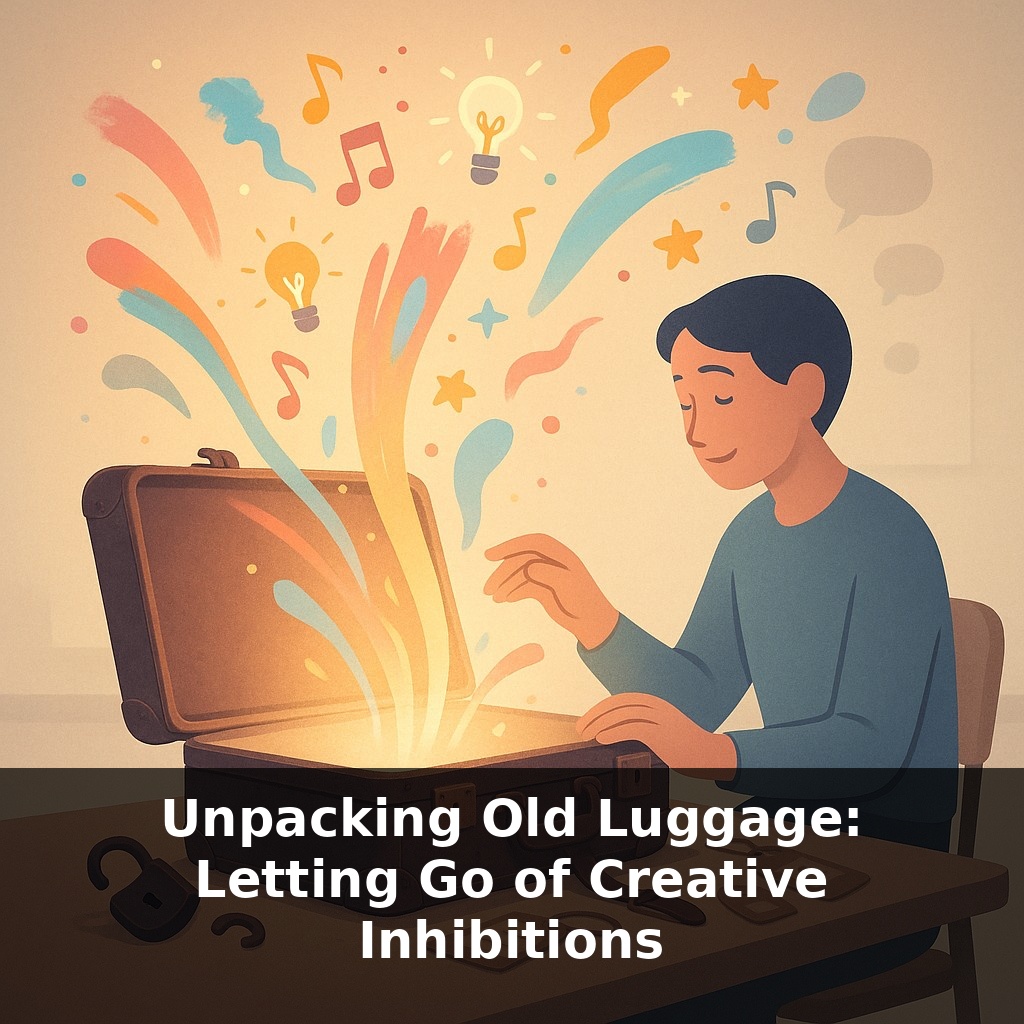
These rules travel with you from job to job, team to team—quiet, heavy, unquestioned. You might switch tools, titles, even industries, yet still feel the same ceiling on what you allow yourself to attempt. In this series, we’re going to open that luggage up. Not to relive every old critique, but to sort: What’s actually useful craft wisdom…and what’s just inherited anxiety posing as “professionalism”?
Some of those rules started as protection. Maybe a harsh professor tore apart your early concepts, so now you over-prepare every presentation. Maybe one risky idea flopped in front of a client, and since then you only pitch “safe” options. Each episode, we’ll surface one of these guards, test what it’s actually doing for you, and—if it’s outdated—retire or rewrite it. Think of it as updating the settings on an old operating system: the goal isn’t chaos, it’s to remove background processes quietly draining the energy you could spend on bolder, more original work.
Most people don’t wake up thinking, “Today I’ll block my own ideas.” Yet study after study shows that’s exactly what’s happening under the surface.
Adobe’s State of Create report found that 70% of people believe they’re not living up to their creative potential. That gap rarely comes from lack of skill or opportunity. More often, it comes from invisible brakes: “Don’t embarrass yourself.” “Stay in your lane.” “Only speak when it’s perfect.”
Psychologists call these creative inhibitions—learned patterns that limit which ideas you even allow into consciousness, let alone into a sketch, prototype, or deck. They’re efficient in the worst way: they filter out risk *before* you can evaluate whether that risk is smart, necessary, or exciting.
You can usually spot three big culprits:
- Fear of failure: not just “I might mess up,” but “If I mess up, it says something permanent about me.” So you default to familiar aesthetics, safe formats, proven solutions. You ship, but you don’t stretch.
- Perfectionism: high standards are useful; perfectionism is standards weaponized against yourself. Work stays in endless “refinement” loops, or never leaves the notebook at all. The bar for sharing is so high that nothing early, messy, or truly novel qualifies.
- Stereotype threat: the quiet pressure of “people like me aren’t usually the ones with the bold ideas here.” Maybe you’re the youngest in the room, the only designer among engineers, the only non-native speaker, or the only woman pitching to a certain kind of client. Research shows that simply *anticipating* judgment tied to your identity can shrink your risk-taking and originality—even when your actual skills are strong.
None of this means you’re “not creative.” It means your creative process has accumulated safety protocols that trigger too early and too often. The promising part: those protocols are learned, and what’s learned can be re-trained.
Studies on growth mindset, psychological safety, and even guided mind-wandering all point to the same conclusion: when you change the conditions around your thinking—how you frame mistakes, how your team responds to half-formed ideas, how you move between looseness and focus—you literally expand the range of ideas your brain is willing to surface.
In other words, the problem isn’t that your imagination is small. It’s that your internal approval board has gotten overly strict, rejecting concepts long before they’ve had a chance to show what they can become. This series is about renegotiating that approval process so more of your real thinking is allowed into the room.
A useful test: notice where your behavior doesn’t match your reputation. Maybe teammates praise your “big-picture thinking,” yet when the brief lands, you instantly open last quarter’s deck and start rearranging slides. That’s an inhibition: you’re known for one thing, but you act like someone whose job is not to rock the boat.
Or think of the ideas you only share *after* someone else says something similar: “I was actually thinking along those lines too…” That delay is another brake. The idea existed. The filter just wouldn’t let it through until it felt socially “validated.”
On teams with high psychological safety—like the ones studied in Google’s Project Aristotle—people surface those half-formed, slightly weird suggestions *early*, then refine together. The originality doesn’t come from lone geniuses; it comes from more raw material entering the room.
Your own version might be tiny: a headline you delete, a prototype you never click “present” on, a question you swallow. Those micro-moments are exactly where your old luggage shows up.
As AI takes over more of the “assembly line” in design, the value of your work shifts toward defining the problem, not just decorating the solution. Letting go of old luggage makes you better at asking heretical questions: “Why are we solving *this* at all?” Teams that normalize this kind of challenge-thinking will set the brief, not just respond to it—and clients will increasingly pay for that upstream influence, not just polished outputs.
So the work ahead isn’t becoming a “new you,” it’s recovering versions of you that took more creative swings before the critiques, deadlines, and titles piled up. Think of this as reopening tabs you closed too quickly: side projects, odd interests, questions that still itch. Those are often the trailheads that lead to your next, truer design self.
Here’s your challenge this week: Choose one “old luggage” story you’re carrying about your creativity (like “I’m not a real artist” or “My ideas are too weird”) and deliberately break it in public once. Pick a low‑stakes arena—like posting an unpolished sketch, sharing a messy song demo, or reading an unfinished piece aloud to a friend—and share it exactly as it is, with no “sorry it’s rough” disclaimer. Before you hit send or speak, say out loud: “This is me making something now, not proving anything about my past.” Afterward, jot down exactly what *actually* happened (who responded, what you felt in your body, what didn’t fall apart) so your brain has fresh evidence that the old story is losing its power.