About half of what you did today ran on autopilot. You chose clothes, checked your phone, opened tools—without really deciding. Now here’s the twist: your creativity mostly *isn’t* on autopilot. That gap between automatic routine and intentional creation is where we’re going.
Roughly 40–45% of what you’ll do tomorrow will be the same as today—and your brain will barely notice. That’s not a bug; it’s an efficiency feature. The opportunity is this: instead of trying to “feel inspired” on command, you can quietly wire creativity into that 40–45% band through small, repeatable moves.
Research on habit formation shows it takes an average of 66 days to lock in a new behavior—and for more complex patterns, it can stretch to 8 months. That might sound slow, but here’s the payoff: once a behavior is encoded as a habit, it shifts from effortful choice to reliable default.
Studios like Pixar don’t wait for big breakthroughs; they rely on short, daily rituals—like tightly timed critique sessions—to keep creative muscles firing. In this episode, you’ll design your own version of that: simple, timed practices that steadily reshape your design identity.
Most people try to “upgrade their creativity” with big, irregular pushes: a weekend sprint, an all‑nighter, a once‑a‑month workshop. The data points a different way. In one pilot study, designers who simply sketched for 30 minutes a day, five days a week, boosted idea fluency by 25% in six weeks. Pixar’s 30‑minute “Dailies” cap keeps momentum high without draining the team. The pattern is clear: short, scoped, repeatable practices compound. In this episode, you’ll translate that pattern into a tiny, trackable routine that fits inside a real workday—no sabbaticals, no perfect conditions required.
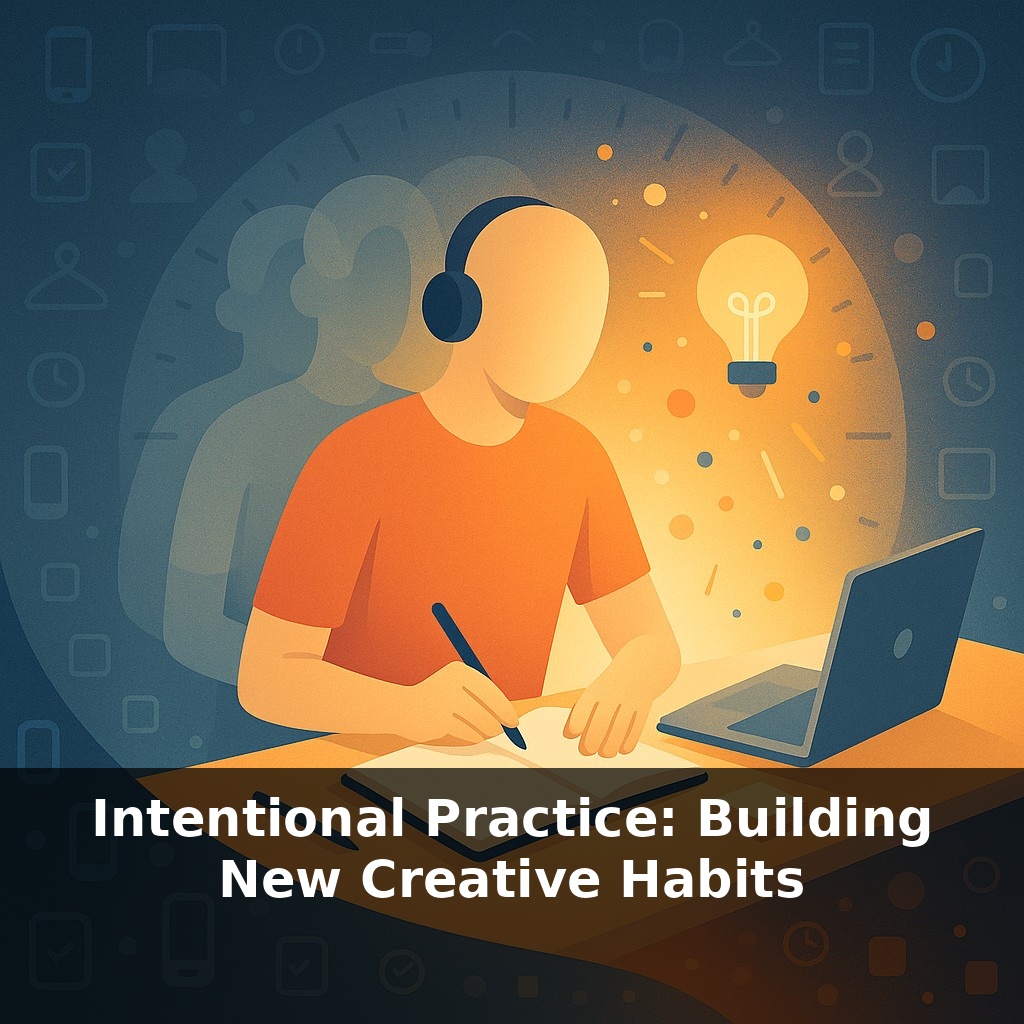
Stop relying on “motivation spikes.” Treat this like a design problem: you’re prototyping a repeatable behavior system. That system has four parts: cue, routine, reward, and feedback loop. When you deliberately shape each part, you’re no longer hoping you’ll do the work—you’re making it harder *not* to.
Start with the cue. It must be specific, observable, and already anchored in your day. “After my first coffee,” “right after stand‑up ends,” or “as soon as I plug in my laptop at 8:45” works; “sometime in the morning” doesn’t. To stress‑test your cue, ask: could someone watching you know exactly when it happens? If not, tighten it. Aim for a cue that occurs at the same 10–15‑minute window at least 4 times a week.
Next, define the routine in concrete terms: duration, location, and action. For example: “15 minutes, at my desk, generating 10 thumbnail layouts for one interface state,” or “20 minutes, away from my main screen, rewriting 3 microcopy variants for a specific flow.” The key is scoping: if you can’t describe the routine with a verb and a measurable output, it’s too fuzzy. Cap it at 30 minutes to stay friction‑light.
Now engineer the reward. Your brain needs a fast, reliable “that felt good” signal, not a vague future payoff. Options: - Micro‑reward: a visible streak on a calendar or tracking app; 1 box filled per session. - Sensory reward: a specific playlist only during this routine, or a favorite snack right after. - Social reward: a weekly screenshot or photo you send to 1–2 trusted peers.
Add a feedback loop so the routine improves rather than calcifies. Choose 1 metric to track for 14 days: count of variations generated, minutes spent, or days completed. Then, once a week, review in under 10 minutes: what made it easier or harder, and what’s the smallest tweak you can test next week (shorter timebox, different time slot, clearer prompt)?
Think of this system like refactoring legacy code: you’re not rewriting your whole day; you’re inserting one reliable function that always runs when a specific trigger fires. Over weeks, that function becomes part of your mental “standard library” for making.
A senior product designer I coached set up a 12‑minute “variant sprint” right after her team’s 9:30 stand‑up. Her rule: generate exactly 8 alternatives for a *single* interaction—no polishing, no Figma auto‑layout fixes. In 4 weeks, she’d logged 19 sessions, 152 variants, and surfaced 3 options that shipped with minor tweaks.
Try a similar constraint: pick one screen or flow each weekday and run a 10‑minute divergence drill. Aim for 7–10 distinct directions, label them with a timestamp, and stop when the timer hits zero. After 10 days, review: which time of day gave you the weirdest ideas? Which prompts led to dead ends?
Teams can do this too. One startup blocked 20 minutes at 4:05 p.m., Monday–Thursday, as “micro‑lab.” Each person tackled 1 small UI friction point and produced 5 low‑fidelity fixes. In a quarter, they’d archived over 900 small bets. About 40 made it into A/B tests; 6 drove measurable uplifts, including a 7% boost in onboarding completion from a re‑sequenced tooltip pattern.
Within 3–5 years, expect “practice layers” built into your tools. A design suite might log 120 micro‑sessions per month, ranking which prompts, time slots, or collaborators yield your top 10% solutions. Hiring could shift too: instead of static portfolios, candidates share 30‑day practice dashboards—showing iteration velocity, risk patterns, and response to feedback. Programs that now grade 3 projects per term may soon score 90–120 logged drills, crits, and refinements per student.
In 30 days, 1 focused drill can become 20 logged reps, 3–5 shippable options, and 1 clear pattern about when you do your sharpest work. Over 90 days, that’s ~60 sessions and a personal library of 400+ variants. Your challenge this week: choose one 10–20 minute drill, schedule 4 runs, and capture *before/after* snapshots of your process, not just outputs.