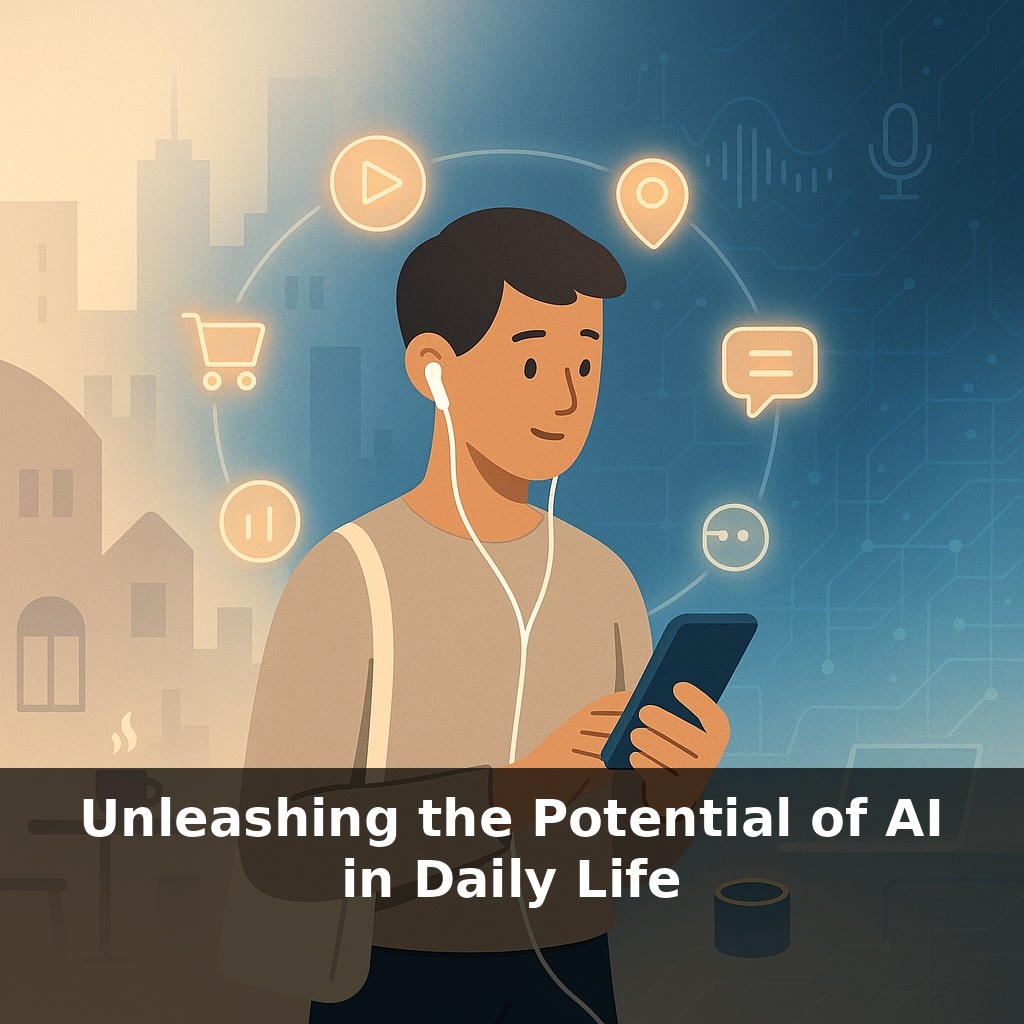
Unleashing the Potential of AI in Daily Life
📝 Transcript
Right now, as you’re listening, AI is quietly making choices about what you see, hear, and buy—yet most of its biggest wins are completely invisible. Today, let’s peel back that curtain and explore how these hidden systems are already reshaping your daily routine.
You’ve probably noticed the obvious AI moments—asking a voice assistant for the weather, letting your maps reroute you around traffic, or watching your streaming app queue up something scarily on-point for Friday night. But the real transformation happens in all the subtle places you don’t label as “AI” at all. It’s there when a grocery app suggests a smarter shopping list based on what you actually use, or when your email quietly filters out junk so you only see what matters. In the background, models are constantly learning from patterns in clicks, swipes, delays, and deletions. Think of your digital life as a crowded train station: AI acts like a dynamic signal system, routing the right “trains” of information so you get where you want faster, with fewer collisions and delays—often without realizing anything special is happening.
Beyond your inbox and shopping cart, these systems are starting to stitch together entire experiences across your day. Your fitness tracker doesn’t just log steps; it spots when your sleep tanks after late-night screen time and nudges you earlier. A calendar app may learn that “30-minute” meetings actually run 45 and start spacing them out. In cars, driver-assist tools adapt to your habits, braking style, and typical routes. At work, tools summarize long documents, surface key decisions, and draft responses so you can focus on judgment calls instead of digital paperwork. Bit by bit, the “default settings” of life are becoming personalized.
Look past the obvious “smart” features, and a pattern starts to emerge: the most powerful uses of AI don’t shout; they quietly reshape the flow of how you live, learn, and work.
Start with your phone. Autocorrect and predictive text used to be punchlines; now, AI models trained on billions of sentences can adapt to your personal phrasing, slang, and even multilingual habits. They’re not just fixing typos; they’re compressing the effort between your intention and what appears on screen. The same goes for photo libraries that can find “that picture of the red jacket in Paris” without you ever tagging it. Underneath is a swarm of specialized models—vision, language, ranking—cooperating behind a single search box.
In your home, recommendation and control systems are fusing. Smart thermostats no longer follow rigid schedules; they infer when you’re actually home, how quickly your place heats or cools, and what trade-off you prefer between comfort and energy bills. Lighting systems learn that “movie night” means dim, warm light in the living room and a darker hallway, then adapt that scene to winter evenings versus bright summer days. These systems don’t need a sweeping, human-like intelligence; they need tight feedback loops and clear goals.
Healthcare is where this quiet assistance becomes life-altering. Wearables can flag irregular heart rhythms days or weeks before you’d notice symptoms. In clinics, AI tools help radiologists highlight suspicious regions in scans, or suggest differential diagnoses based on subtle patterns across thousands of similar cases. The clinician still decides; the system just makes sure less is overlooked, especially in rushed or resource-constrained settings.
Education is undergoing a similar shift. Instead of every student progressing through the same problem set, adaptive learning platforms adjust difficulty in real time—slowing down when you’re stuck on fractions, accelerating when algebra finally clicks. Duolingo’s GPT-4 tutor doesn’t replace teachers; it gives each learner a patient, always-available conversation partner that can rephrase explanations until they land.
Zoom out, and you can see a broader architectural change: dozens of narrow models orchestrated like a well-coached team, each specializing in vision, language, prediction, or control. In cars, one model predicts pedestrian movement, another interprets traffic signs, while yet another decides when to nudge the steering. In productivity apps, a summarizer, a classifier, and a recommender combine to decide what deserves your attention first.
Crucially, the real unlock comes when these systems are designed with you in the loop. Interfaces that let you correct, override, or explain your preferences turn opaque automation into a genuine partnership—one where the system keeps adapting as your habits, goals, and circumstances evolve.
Think about the “invisible helpers” you don’t see as AI at all. When you open a streaming platform, the rows that surface a documentary right after you finish a true-crime series aren’t random; they’re tuned to patterns across millions of viewers who took similar paths. In retail, those “people also bought” sections are quietly reshaping shelf space, inventory decisions, and even which products get designed in the first place, because a 40% nudge in buying behavior is powerful feedback.
Public services are starting to lean on this, too. City planners can prioritize bus routes by learning not just where people say they travel, but where anonymized phone location data shows traffic actually surges on rainy Tuesdays or during events. Hospitals can predict which days will overload emergency rooms and staff accordingly.
As these systems spread, the real question becomes: which decisions should we let them streamline, and which should always pause for human judgment and explanation?
As these systems spread, the boundary between “online” and “real world” blurs: routes shift as cities react to live congestion, prices flex with demand, even job tasks rearrange themselves around your strengths. It’s like living in a building where the walls can subtly move to fit each new activity—useful, but disorienting if you never see the floor plan. The key implication: you’ll need literacy not just in using AI tools, but in questioning when and how they should adapt to you.
So the real opportunity isn’t squeezing a few more minutes from your day; it’s reshaping *which* moments get your attention. Think of it less as handing the wheel to algorithms and more as coaching a skilled teammate. As more tasks become “auto,” the leverage shifts to people who can ask sharper questions, set clearer goals, and notice when the system is drifting.
Here’s your challenge this week: Pick one daily routine (like planning meals, scheduling your day, or managing email) and fully “co‑pilot” it with AI for 7 days straight. Each morning, give an AI assistant your actual calendar, to‑do list, and constraints, and have it generate a concrete day plan (including time blocks, priorities, and 1–2 suggested automations, like draft emails or summaries). Follow that AI‑augmented plan as closely as you realistically can, then spend 3 minutes each evening asking the AI to review what actually happened and adjust tomorrow’s plan based on what worked and what didn’t. At the end of the week, compare your real outcomes (tasks completed, time saved, or stress level) against the previous week and decide which parts of this AI routine you’re going to keep.
From this course
Rewire with AI: Transform Your Mindset and Career
5 episodesUnlock all episodes
Full access to 5 episodes and everything on OwlUp.
Subscribe — $1.99/monthLess than a coffee ☕ · Cancel anytime

