Understanding Script Structure
📝 Transcript
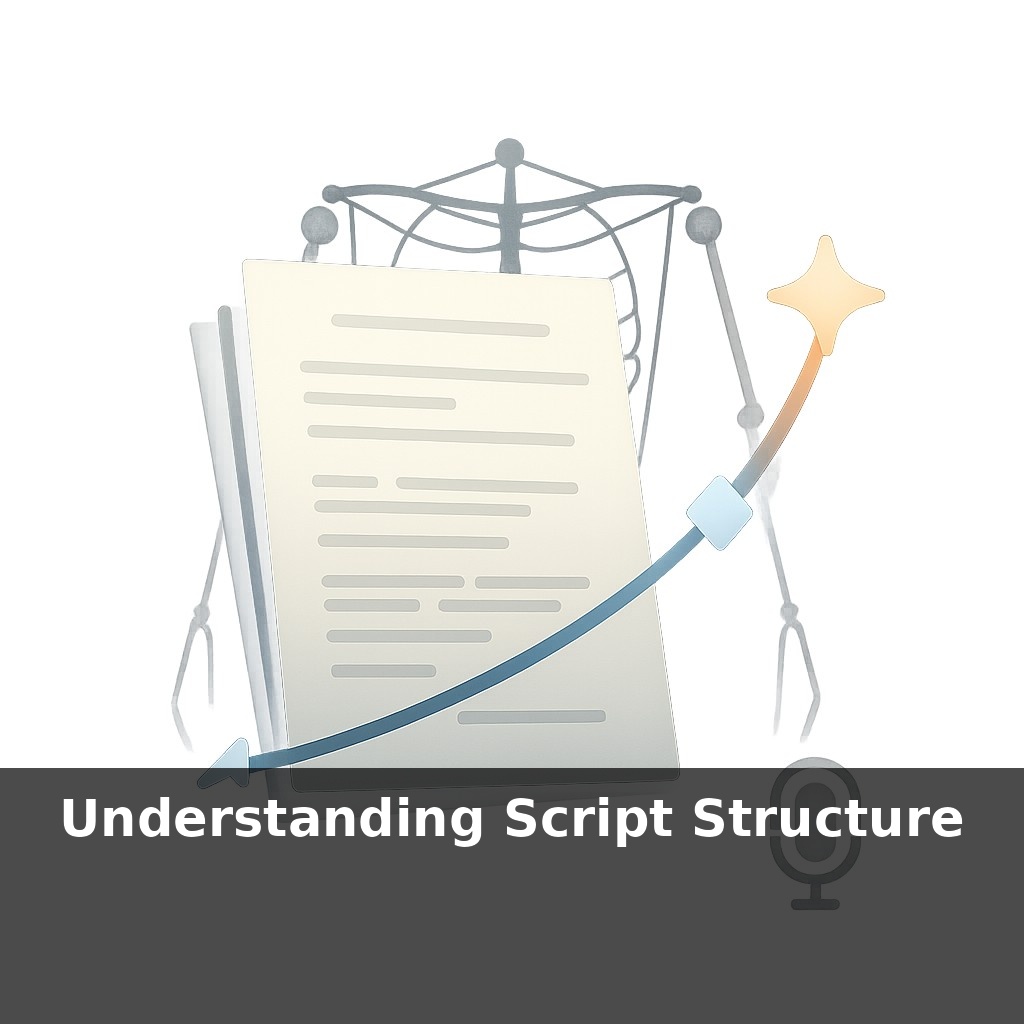
Almost every hit movie you know, from decades ago to last night’s streaming binge, is secretly built on the same invisible skeleton. In this episode, we’ll freeze that fast-moving experience and walk through the hidden beats that quietly guide your emotions.
Those hidden beats don’t just “happen” because a writer feels inspired; they’re the result of an underlying plan the audience never sees on the page, but absolutely feels on the screen. In this episode, we’re going to crack open that plan: the basic shape of a feature script that working writers rely on every day.
Rather than treating structure like a set of handcuffs, we’ll treat it like city zoning: broad rules that keep traffic flowing while still allowing wildly different neighborhoods to exist side by side. A quiet character drama and a sci‑fi spectacle might look nothing alike on the surface, yet both are usually anchored to the same foundational layout of beginning, middle, and end.
By the time we’re done, you’ll know where those major story turns typically land on the page, why professionals care, and how to use that knowledge without flattening your creativity.
Think of this episode as zooming out from the “feel” of a film and zooming in on the nuts and bolts that make that feeling reliable. Professional screenwriters aren’t guessing where things should happen; they’re working with timing the way a game designer works with levels—placing challenges, rewards, and surprises so players never get bored or lost. We’ll look at how page count quietly shapes pacing, why that early “no going back” moment is scheduled, and how the infamous long middle stretch becomes a controlled climb instead of a storytelling treadmill.
Act I is your contract with the audience. On the page, that means you’re not just “starting the story”; you’re making specific promises about genre, tone, and whose journey we’re following. In practical terms, the early pages are where you establish what “normal” looks like for your protagonist, then disturb that normal with a problem that can’t be ignored. The energy here is curiosity and orientation: Who is this about? What do they want? What’s off‑balance in their world?
By the time you approach the end of Act I, readers should feel a click: “Okay, now I see what movie this is.” The key isn’t explosions or big spectacle; it’s commitment. Often, the protagonist actively chooses a path that will make the rest of the story inevitable. In professional drafts, this isn’t treated as a single magic moment so much as a short runway of scenes that funnel the character toward that commitment.
Act II shifts the engine from setup to pressure. The central question becomes: “Given the choice they just made, how does life push back?” Instead of one big obstacle, this middle stretch is usually built from a sequence of mini‑goals. Solve this problem, uncover a new complication. Win a small victory, trigger a larger threat. The rising sense of difficulty isn’t accidental—it’s engineered so each new situation costs the protagonist more emotionally, physically, or morally.
Because this section is long, pros often divide it in their heads into two halves. The first half leans into exploration and early tactics: trying obvious solutions, testing allies, maybe even enjoying early success. Around the midpoint, something lands that changes the *meaning* of the journey—new information, a reversal of stakes, or a reveal that the real opposition is bigger than assumed. The second half then tilts darker and tighter, translating that new understanding into consequence.
Act III is where debt comes due. All those earlier choices and compromises converge into a final situation that forces the protagonist to answer the story’s core question with action, not talk. Structurally, this climax isn’t just about outsmarting a villain or surviving danger; it’s about demonstrating internal change. Industry readers look for a direct link between whatever flaw or fear you planted early and the way your character behaves in the decisive moment. The resolution that follows doesn’t have to tie up every subplot neatly, but it should let us feel the ripple effects of that choice—how the world, or at least this character’s corner of it, has shifted.
From above, these acts resemble three connected bridges in a large software project: onboarding (Act I), feature‑rich main system (Act II), and final deployment (Act III). Each has a distinct purpose, yet all must align so users—your audience—experience one coherent flow instead of three separate builds.
Think of structure as the skeleton key that lets you unlock wildly different kinds of stories with the same tool. Take *Get Out* and *Finding Nemo*: one is horror‑satire, the other a family animation, yet both quietly march through escalating dilemmas, a world that tightens around the hero, and a final, personal reckoning. The difference isn’t the blueprint; it’s the surface design, the tone of each beat, the kinds of problems thrown at the characters.
A simple way to test this: grab three movies you love from totally different genres. For each, jot down in one sentence: - How the story starts “small” and personal - How the problems get more tangled and public - How the ending forces a choice that couldn’t have happened on page ten
You’ll start to see patterns you can steal. Not the scenes—those are specific to each film—but the *rhythm* of escalation. That rhythm is what you’re really training: when to tighten the screws, when to let characters breathe, and when to cash in everything you’ve set up.
Three‑act structure is quietly migrating into places that don’t look like movies at all. TikTok creators sequence posts so each one tees up a new question, like chapters in a compressed script. Game designers use it to shape questlines and DLC drops. Even newsletter series lean on it: onboarding readers, deep‑diving, then delivering a payoff. As formats splinter, this shared rhythm becomes a kind of creative API, letting audiences “plug in” faster, no matter the medium.
Treat this framework like a trail map, not a cage: you can bushwhack, loop back, or take side paths, but you’ll always know roughly where you are. As you draft, notice where tension dips or drifts—those soft spots often signal missing turns. Adjusting them is like tuning a playlist: one off‑beat track can dull the whole emotional arc.
Here's your challenge this week: Pick one script idea and outline it using the classic three-act structure—with a clear inciting incident by page 10, a midpoint twist that changes your hero’s goal, and a “dark night of the soul” moment near the end of Act 2. Then, write just three scenes: the opening image, the inciting incident, and the midpoint, making sure each one clearly raises the stakes from the last. Before the week is over, read those three scenes out loud (or record yourself) and adjust any moment where the conflict or objective isn’t instantly clear.
From this course
Scriptwriting Secrets Unveiled
6 episodesUnlock all episodes
Full access to 6 episodes and everything on OwlUp.
Subscribe — $1.99/monthLess than a coffee ☕ · Cancel anytime